The Encroaching "Zombie Student Culture"
I must admit that when I first began reading and hearing about the long term effects of the internet and screen time on students (as well as students using the internet and AI to cheat on assignments) I largely dismissed it because I thought (naively), “This isn’t affecting our Anabaptist schools because our parents know better than to let their children spend inordinate hours on the internet, plagiarize, or play online games for hours.” Sadly, I am concerned about it now.
A colleague recently shared with me the article “What’s Happening to Our Students?” and I am indeed worried, because although most Anabaptists are usually a little behind pop culture and its trends, the Internet has allowed us to be almost, if not completely, caught up with the world and its trends. We are definitely being affected by it and are headed in the wrong direction.
I have talked to several teachers who confirm that this is true in our schools as well, and all agree that they have seen the effects (although not as dramatic as in public schools) in our schools. This is especially the opinion of teachers who have taught ten years or longer. One teacher had overheard her second graders (who were tired and not focused on their work) talking to other students about staying up late and using their big brothers’ accounts to play online computer games with each other after school and in the evenings.
This makes me want to cry, or bang my head against a wall, or both. These children should be outside riding their bikes, climbing trees, and building tree forts with their fathers. Unfortunately, some of them head home from school to retreat to their bedrooms, shut the doors, and play online games, staring at a screen and interacting online with people they just spent seven hours with in real life at school.
I have two questions.
Why is this happening in our Anabaptist schools?
What are the parents thinking?
I have some suggestions for answers.
I believe that this is happening because we are just a few steps beyond secular society. Regrettably, the lure of being cool and fitting in, which is greatly influenced by social media, is extremely appealing to the parents of our students, the 25-40 year olds, many of whom are buying into the new norm of Youtube influencers, Instagram, and Facebook likes; along with all the hype, lingo, fashion, and accompanying mannerisms.
This is exactly the opposite of what God instructs us to do in His word: "Wherefore come out from among them, and be ye separate, saith the Lord, And touch not the unclean thing; And I will receive you." 2 Cor. 6:17.
Woefully, this is the answer to question number two as well. The only other option is that the parents are simply not aware or are not monitoring the activities of their children, which is equally as bad. The end of that verse is frightening. Will God receive this?
Many of our Anabaptist brethren are just steps behind the world, and the resulting consequences are becoming apparent in our schools. Students are becoming more and more tuned out, overly stimulated mentally from other more entertaining sources. They are becoming bored with maps and interesting history and science facts. They are more enthralled by computer screens and online games than they are teachers, math problems, or English grammar.
There is almost nothing the teachers can do except to gently warn our students of the dangers of such behavior. From what I have seen and heard from other teachers, the students will politely listen and then go back to their same activities. It is the parents who need to be aware of the dangers and be proactive about this hazardous situation.
We can make parents aware of what we are hearing at school, but this obviously can be unappreciated and labeled as “tattling”, unless the parents ask us directly, which rarely happens.
In conclusion, what we can do is to pray for our students, pray for their parents, set a good example ourselves, and to cling to Paul’s words: “whatsoever things are true, whatsoever things are honest, whatsoever things are just, whatsoever things are pure, whatsoever things are lovely, whatsoever things are of good report; if there be any virtue, and if there be any praise, think on these things.” Philippians 4:8


Fun Ways to Practice Spelling Words
Games like these can help to make learning spelling words competitive, creative, and fun. Of course, good, old-fashioned copying the list is still the simplest and most efficient way to practice spelling words. But this can so quickly become tedious and dull, causing students to turn their brains off. On the other hand, when student’s minds and imaginations are engaged through games and activities, their whole brain is activated to learn more effectively.

College Student Weekend 2026
College education can be an opportunity for Christians to learn more about the creation of God and interact with people from a variety of backgrounds and beliefs. At the same time, this opportunity comes with a unique set of challenges socially, spiritually, and intellectually. For example, conservative Anabaptist college students are often a minority in both their churches and colleges.
Who: We welcome applications from full-time and part-time college and university students currently in school and/or planning to begin a program in the next academic year. Registration priority is given to full-time students and students who are currently in school and will continue their studies next year.
Where: Faith Builders hosts the College Student Weekend at the River Ridge Mansion, an early-20th-century mansion built by an oil baron near Franklin, PA.
When: College Student Weekend 2026 begins on the afternoon of Friday, July 3, and continues through lunch on Sunday, July 5.
Cost: The cost of attendance is $255 per person, including two nights of lodging and five meals. The event is limited to 48 participants. Registration is required.


Science Alive 1-2
The inspiration for the creation of Science Alive began when I was teaching in a first and second grade classroom. One of the years I taught, the children had quite a bit of spare time, so we would have impromptu classes on the digestive system or whatever else I happened to field a question about. It didn’t take me long to begin recognizing that the children seemed to retain this style of learning almost better than what they considered work. I wished at that point to have a science curriculum that started out based more on input than output.
However, I didn’t really begin to do anything about this dream until I began to teach the Living Threads curriculum for history class. Then the lightbulb moment hit. I could use similar methods to teach science.
Since this curriculum is designed for multiple grades at the same time, you can guiltlessly hold a class that is amazingly distracting because they are all supposed to be involved. The curriculum is designed for grades one through three, with grade one skipping out on tests. They all take the same levels together and alternate levels for variety of learning. For example, the first-year grades one through three take level 1-2 together, the next year level 2-1. If you use this for three grades, first and third grade are a repeat level. The level is made to be taught three days a week for a 45-minute period for ½ of the term.
This curriculum is designed for the children to be paired up into partner teams. Generally, it works best to put an older child with a younger child for coaching purposes.
When teaching this class, there are a few basic structures I use to instill information. The first is constant review of facts you want them to have for life. There are a few extra pieces of information for the fast learners and for interest’s sake, but by and large, study the tests to know what they should master.
Use the experiments. If you have any that are bigger and more exciting to illustrate the point, use them. Practice the experiments before having class.
Vary the flashcard drill as inspiration hits. Let them practice together in pairs. Use your creativity.
Feel free to add or chop up lessons as needed. There are several books mentioned in this curriculum. While you may not have the exact book mentioned, the library often has good resources that will work just as well or better.
Enjoy teaching the amazing world of science!

Science Alive 2-1
The inspiration for the creation of Science Alive began when I was teaching in a first and second grade classroom. One of the years I taught, the children had quite a bit of spare time, so we would have impromptu classes on the digestive system or whatever else I happened to field a question about. It didn’t take me long to begin recognizing that the children seemed to retain this style of learning almost better than what they considered work. I wished at that point to have a science curriculum that started out based more on input than output.
However, I didn’t really begin to do anything about this dream until I began to teach the Living Threads curriculum for history class. Then the lightbulb moment hit. I could use similar methods to teach science.
Since this curriculum is designed for multiple grades at the same time, you can guiltlessly hold a class that is amazingly distracting because they are all supposed to be involved. The curriculum is designed for grades one through three, with grade one skipping out on tests. They all take the same levels together and alternate levels for variety of learning. For example, the first-year grades one through three take level 1-2 together, the next year level 2-1. If you use this for three grades, first and third grade are a repeat level. The level is made to be taught three days a week for a 45-minute period for ½ of the term.
This curriculum is designed for the children to be paired up into partner teams. Generally, it works best to put an older child with a younger child for coaching purposes.
When teaching this class, there are a few basic structures I use to instill information. The first is constant review of facts you want them to have for life. There are a few extra pieces of information for the fast learners and for interest’s sake, but by and large, study the tests to know what they should master.
Use the experiments. If you have any that are bigger and more exciting to illustrate the point, use them. Practice the experiments before having class.
Vary the flashcard drill as inspiration hits. Let them practice together in pairs. Use your creativity.
Feel free to add or chop up lessons as needed. There are several books mentioned in this curriculum. While you may not have the exact book mentioned, the library often has good resources that will work just as well or better.
Enjoy teaching the amazing world of science!

3 Teaching Positions Available at Shady Grove Christian School Mifflinburg PA
Shady Grove Christian School (Mifflinburg, PA) is looking for qualified teachers for the 2026-2027 school year for the following positions:
1st grade
2nd grade
High School
Elementary Grades are taught conventionally using CLP curriculum.
High School is individualized using ACE curriculum.
Contact Andrew Beachy: abeachy2@gmail.com


Jesus: Greater Than Moses (A Christmas Program)
This hour-long whole-school Christmas program uses dramatic recitation of Scripture, songs, and simple actions (mostly still poses) to illustrate how the life of Moses foreshadowed the life and work of Jesus. It can easily be adapted to schools of nearly any size.
Example livestream from Pilgrim Christian School: https://youtube.com/live/KfCZwHG2f1AZwHG2f1A
6196 results found with an empty search
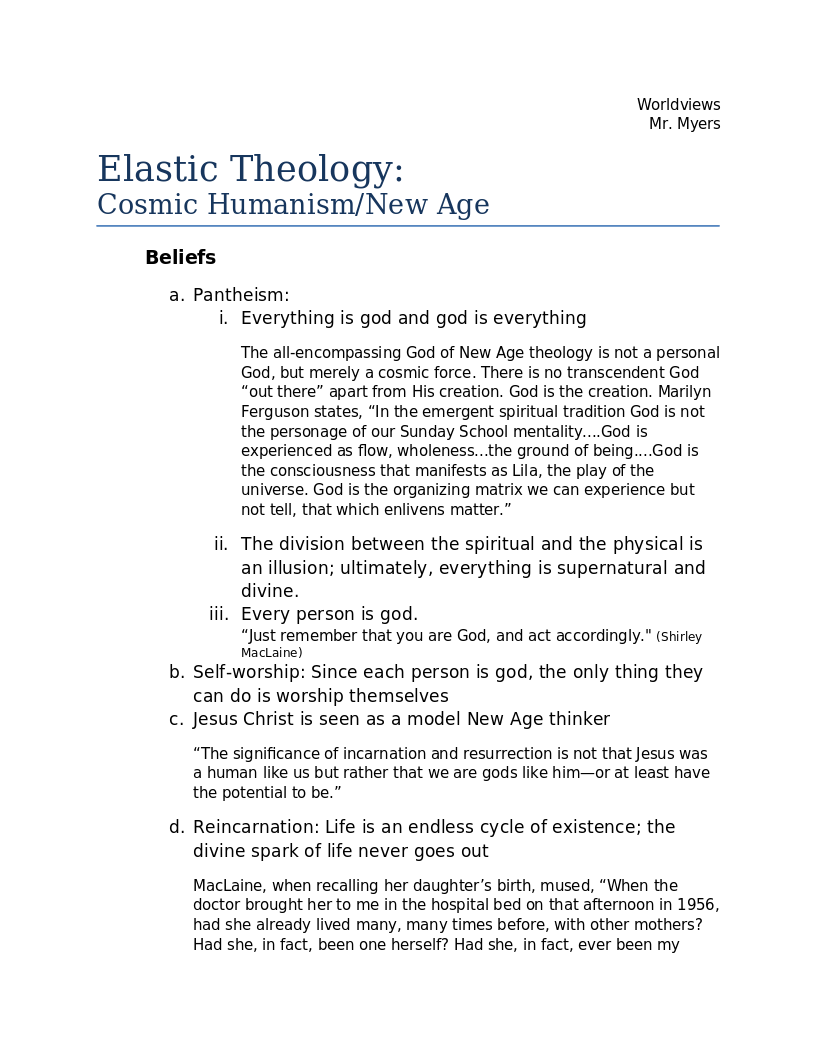
- New Age Theology
New Age Theology Kendall Myers November 15, 2017 Worldviews: Theology New Age Theology Document 00:00 / 01:04 Download Download Teacher's notes on New Age theology. Some of the basic premises are reincarnation, self-worship, reducing Jesus to a model human, and pantheism. Download Facebook X (Twitter) WhatsApp LinkedIn Pinterest Copy link Kendall Myers
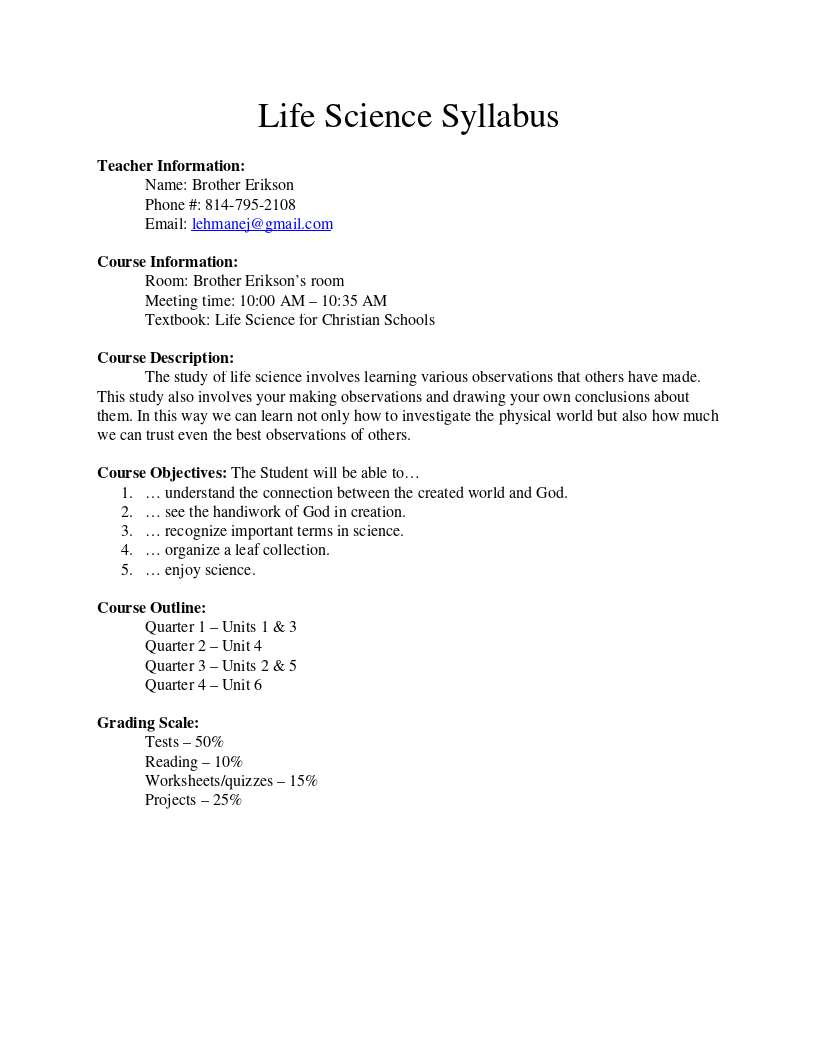
- Life Science Syllabus
Life Science Syllabus Erikson Lehman August 7, 2019 Erikson's Materials for BJU Life Science Life Science Syllabus Document 00:00 / 01:04 Download Download A sample of a syllabus for Grade 7 Life Science published by Bob Jones University. Download Facebook X (Twitter) WhatsApp LinkedIn Pinterest Copy link Erikson Lehman
- Procedures for Managing a Multi-Grade Classroom
Procedures for Managing a Multi-Grade Classroom Conrad Smucker January 7, 2022 Western Fellowship Teachers' Institute 2021 Procedures for Managing a Multi-Grade Classroom Audio 00:00 / 01:04 Download Download Managing a classroom requires clear procedures. This is the key takeaway of this sesssion on classroom management. Download Facebook X (Twitter) WhatsApp LinkedIn Pinterest Copy link Conrad Smucker
- The Seven Laws of Teaching
The Seven Laws of Teaching Jaydon Schrock December 23, 2023 Western Fellowship Teachers Institute 2023 The Seven Laws of Teaching Audio 00:00 / 01:04 Download Download Download Facebook X (Twitter) WhatsApp LinkedIn Pinterest Copy link Jaydon Schrock
- Book Reports
Book Reports Various January 7, 2022 Western Fellowship Teachers' Institute 2021 Book Reports Audio 00:00 / 01:04 Download Download Presenters at WFTI summarize, review, and recommend books of interest to teachers. Download Facebook X (Twitter) WhatsApp LinkedIn Pinterest Copy link Various
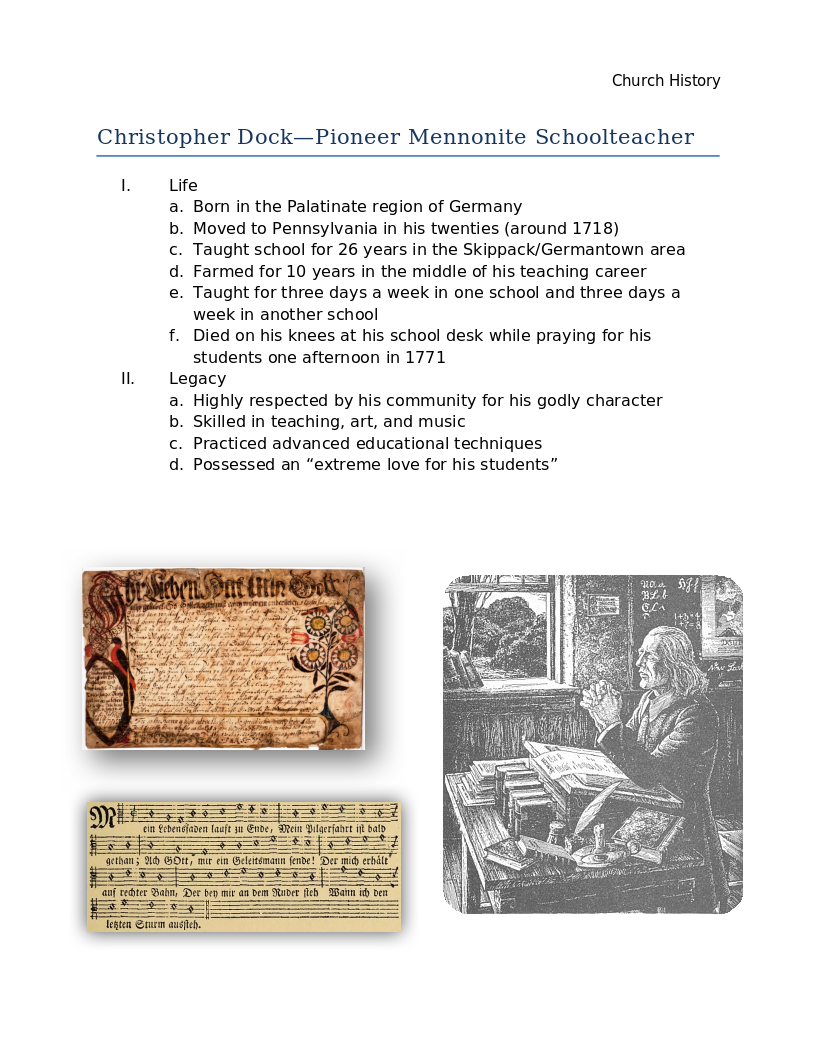
- Christopher Dock
Christopher Dock Kendall Myers October 20, 2017 Anabaptist Church History Class by Kendall Myers Christopher Dock Document 00:00 / 01:04 Download Download Teacher's notes on the life of Christopher Dock and his influence in America. Download Facebook X (Twitter) WhatsApp LinkedIn Pinterest Copy link Kendall Myers
- Dealing with Difficult Parents
Dealing with Difficult Parents Dale Schnupp January 4, 2017 CASBI 2010 Dealing with Difficult Parents Audio 00:00 / 01:04 Download Download Teachers are servants of the parents and the church. It is important to build a partnership with the parents. Dale discusses interacting with difficult parents, and retaining proper focus on the role of a teacher in this relationship. Courtesy CASBI. Download Facebook X (Twitter) WhatsApp LinkedIn Pinterest Copy link Dale Schnupp
- German Anabaptism
German Anabaptism Kendall Myers October 20, 2017 Anabaptist Church History Class by Kendall Myers German Anabaptism Document 00:00 / 01:04 Download Download Powerpoint with pictures of three main Anabaptist leaders in Germany, Hut, Denck, and Marpeck. Download Facebook X (Twitter) WhatsApp LinkedIn Pinterest Copy link Kendall Myers
- Classroom Culture
Classroom Culture The Dock November 17, 2025 Essentials of Teaching Classroom Culture Document 00:00 / 01:04 Download Download Essentials of Teaching provides a growing list of bullet-point summaries of content for Christian educators. Each guide can be downloaded, printed, or viewed as a webpage and includes links to the resources we used to compile the content. Open as PDF Classroom culture is a “hidden curriculum” or atmosphere that influences all aspects of school life and is shaped by beliefs, history, attitudes, practices, traditions, and relationships. Culture is always present, and is influenced by parents, students, teachers, administration, and the community. As a teacher, you play a huge role in forming the culture of your own classroom, but you cannot always do much to change the culture of the school or community at large. Hold students to a certain expectation. They don’t always know what is best for them. Or sometimes, even if they want good things, they will often give in to the human tendency to take the easy way out. How to Build Culture Cultivating a certain type of culture in your classroom starts with you as a teacher identifying what you would like that culture to look like. Spend some time considering what type of people you would like your students to be, what sorts of things you want them to value, and what you would like the environment of your classroom to feel like. For example: God is talked about often Learning is rigorous The atmosphere is one of joy Everyone is respected and included All students are given what they need to be successful After you have determined what sort of culture you desire to have, you can develop practices that will encourage that type of culture. Think of specific things you can do to shape your students in that way or ways you can encourage it to keep growing if it is already present. These may be things that you as a teacher do/say, or they may be things you require of your students. Remember that culture is shaped through small, thoughtful actions and often takes patience and perseverance. Sources Enjoying School, Delighting in God: Classroom Culture by Joseph Shantz Enjoying School, Delighting in God: Classroom Culture - The Dock for Learning Components of Classroom Culture by Anthony Hurst Components of Classroom Culture - The Dock for Learning Cultivating Classroom Culture by Darlene Zimmerman Cultivating Classroom Culture - The Dock for Learning Download Facebook X (Twitter) WhatsApp LinkedIn Pinterest Copy link The Dock
- Intentional Ministerial Involvement
Intentional Ministerial Involvement Arlyn Nisly January 22, 2025 CASBI 2023 Intentional Ministerial Involvement Audio 00:00 / 01:04 Download Download "And he gave the apostles, the prophets, the evangelists, the shepherds and teachers, to equip the saints for the work of ministry, for building up the body of Christ." –Ephesians 4:11-12 Your job as a minister is to be an equipper. As a pastor and a board member you have the opportunity to equip the board to do what it has been tasked with. Use this role to help the board to stay true to the mission of the church and the vision of the school. Join Arlyn Nisley as he explores how this can be done! Roles and Responsibilities for Ministerial Involvement Equip Mentor Maintain the mission and vision Serve as a liaison Help select qualified men Encourage growth Provide resources Offer vision Intentional Ministerial Involvement was presented by Arlyn Nisly at CASBI 2023 held at Pleasant View School, Arcola, IL on March 3-4, 2023." Download Facebook X (Twitter) WhatsApp LinkedIn Pinterest Copy link Arlyn Nisly
- Teaching Math
Teaching Math The Dock November 12, 2025 Essentials of Teaching Teaching Math Document 00:00 / 01:04 Download Download Essentials of Teaching provides a growing list of bullet-point summaries of content for Christian educators. Each guide can be downloaded, printed, or viewed as a webpage and includes links to the resources we used to compile the content. Open as PDF Reasons Why Teaching Math Is Important Math is essential for practical life skills, such as budgeting, building, cooking, and any job requiring precise calculations. Math fosters orderly thinking, logical problem-solving, and careful work habits. Math reflects God’s character, showcasing His order, precision, consistency, and dependability. It is described as the “blueprint of the universe” and the “language of the universe,” revealing God’s glory through its patterns and structures. Studying math allows students to “think God’s thoughts after Him” (Johannes Kepler). Math is not neutral; it is a subject that can draw students’ minds to God’s attributes and foster a biblical worldview. General Guidelines and Teaching Tips Students should be given the opportunity to engage with real problems that require significant effort but are within their ability to solve. Guide your students in rejecting fixed notions of “smartness.” There is no such thing as a “math person.” Instead, foster a growth mindset, encouraging students to remember that anyone can learn math with the right explanation and enough effort. Reframe “math is hard” as “math is challenging.” Struggle is valuable for building neural connections. Let students struggle briefly with problems, but don’t let them struggle alone for so long that they get overwhelmed. Normalize mistakes as learning opportunities, not failures. You can highlight “good mistakes” for discussion, avoiding shame and focusing on why errors occur rather than demanding corrections of all wrong answers. Prioritize skills like logical thinking and conceptual understanding over speed in calculations. Focus on process and understanding, not quickly-gained correct answers. Teach the concept before the skill. You will use repetitive practice to automate skills, but ensure conceptual understanding first. Students often complain that “math is useless.” Whenever possible, use real-world examples to help combat this mindset. Also, emphasize that math develops the mind, fostering discipline and problem-solving. Those things prepare students for life, even if specific equations are never directly applied. Group work can be a powerful tool for high-achieving and low-achieving students alike. Low achievers can benefit from hearing concepts being explained in a slightly different way, and high achievers strengthen their own understanding by helping those who are struggling. Consider allowing students to do their calculations on graph paper, particularly for lengthy processes like long division. The grid helps keep numbers in a straight line both horizontally and vertically. This can improve accuracy dramatically for some students. Elementary Spend time and energy instilling strong number sense into young students. This often comes through lots of hands-on work with manipulatives as well as intentional focus on teaching the concepts of basic math. Only teaching rote memorization of facts with no deeper understanding of the concepts sets students up with a shaky mathematical foundation. Use visuals and stories to help concepts stick. Incorporating imagination helps learning stick for young students. Putting a particular focus on the following topics can help students obtain foundational skills that will be needed for higher-level math: Long division Fractions (especially multiplying and dividing fractions) Decimals and percentages Place value Junior High and High School In the upper grades, math fosters critical thinking and problem-solving skills rather than basic concepts. Emphasize that the purpose of learning math is to foster deeper-level thinking skills, handle complexity, and equip students to serve in God’s kingdom. Require students to show all steps for multi-step problems. While mental arithmetic is useful, solving multi-step problems mentally builds a fragile foundation that collapses with complexity. To manage workload, focus on checking key problems, not every one. Teach standard notation (e.g. variables in alphabetical order with coefficients first) for consistency across curricula and readability in advanced math. Award partial credit for correct processes in algebra, as the process is key. Recommended Resources for Various Topics Methods to learn addition and subtraction: Two Plus Two Is Not Five - The Dock for Learning A Math Teaching Aid: How to String Counting Beads - The Dock for Learning Rekenreks: Rekenreks: A Visual Aid to First Grade Math - The Dock for Learning Show Me a Way to Make Eleven: How I Teach Math with Rekenreks - The Dock for Learning Making Elementary Math Come Alive: Rekenreks and Read-Alouds - The Dock for Learning Methods to learn multiplication and division: A Tip for Teaching Times Tables - The Dock for Learning How to use manipulatives in Math-U-See: The Math They See, the Math They Use: Demonstrating Concepts with Math Manipulatives - The Dock for Learning Math drill sheets for addition and subtraction: Math Drill Sheets - The Dock for Learning Math drill sheets for multiplication: Challenge Math - The Dock for Learning Tricks for teaching a variety of math concepts, such as rounding, fractions, percentages, etc.: Math Tricks - The Dock for Learning Games for math fact review: Games For Math Fact Review - The Dock for Learning A tool for teaching basic algebra: Tipping the Scales to Teach Basic Algebra - The Dock for Learning A system for students struggling with algebra equations: Equation Town - The Dock for Learning Open-ended but solvable challenge questions: Open-Ended Math - The Dock for Learning A way to teach powers of the square root of -1: Powers of the Square Root of -1 - The Dock for Learning Tips on teaching math to girls: Girls and Math: How Going beyond the Rules Helps Students Engage with Math - The Dock for Learning Sources Open-Ended Math by John Mark Kuhns Open-Ended Math - The Dock for Learning What Math Is Important? By Conrad Shank What Math is Important? - The Dock for Learning Why Teach Math? By John Swartz Why Teach Math? - The Dock for Learning Making Math Come Alive by John Mark Kuhns Making Math Come Alive (John Mark Kuhns) - The Dock for Learning Upper Grades Math by Nathan Yoder Upper Grades Math - The Dock for Learning Photo by Chris Liverani on Unsplash Download Facebook X (Twitter) WhatsApp LinkedIn Pinterest Copy link The Dock
- Twenty-Seven Traits of Teachers
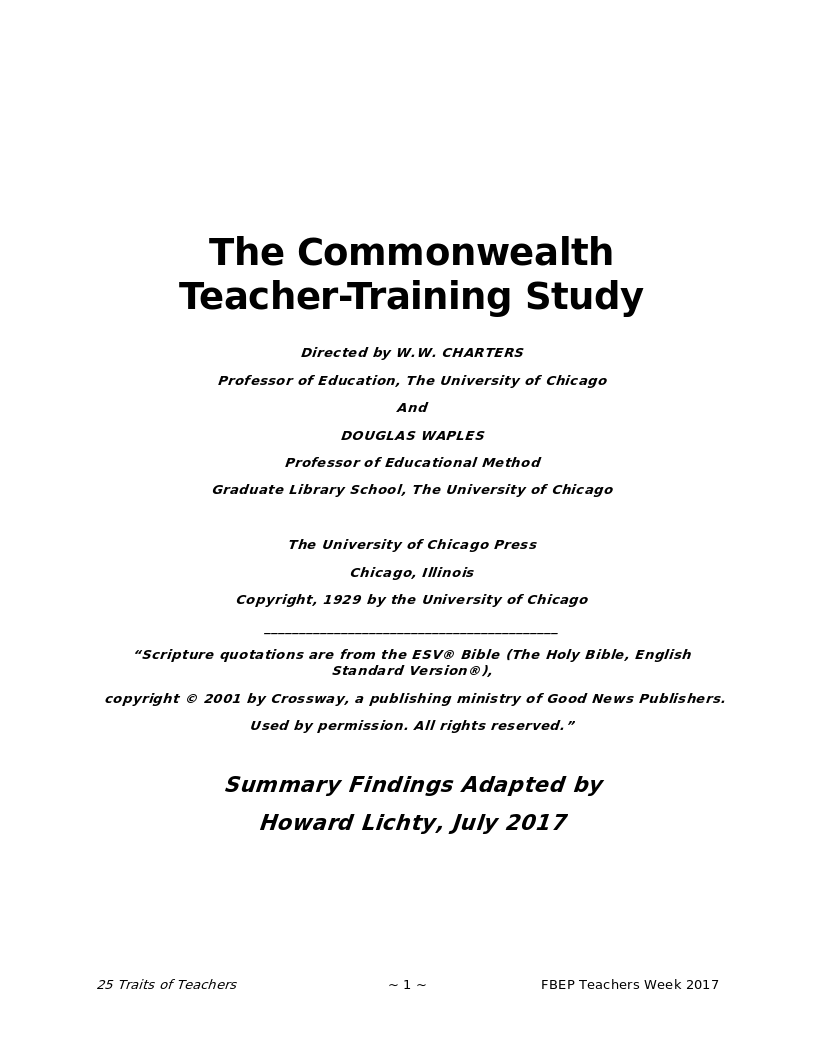
Twenty-Seven Traits of Teachers Howard Lichty December 21, 2018 Identifying and Developing your Strengths Twenty-Seven Traits of Teachers Document 00:00 / 01:04 Download Download Based on the work of Charters and Waples, this tool provides assessments of the strengths and weaknesses of Christian teachers. For more information on how to use this document, listen to Howard Lichty's presentations at Teacher's Week 2017 on Identifying and Developing Your Strengths . Download Facebook X (Twitter) WhatsApp LinkedIn Pinterest Copy link Howard Lichty
- Building on Our Heritage
Building on Our Heritage Peter Hoover January 4, 2017 FBEP Colloquy 1999 Building on Our Heritage Audio 00:00 / 01:04 Download Download Peter probes the fallacies of building on ethnicity or culture, and points to Christ, the only heritage we can build on.Courtesy FBEP. Download Facebook X (Twitter) WhatsApp LinkedIn Pinterest Copy link Peter Hoover
- What Is That in Your Hand?
What Is That in Your Hand? Stephan Gingerich May 13, 2019 REACH 2017 What Is That in Your Hand? Audio 00:00 / 01:04 Download Download Throughout history God has used faithful people to accomplish His will. The parable of the talents demonstrates the potential of each one of us in Gods kingdom. How many talents do you have? Have you doubled them? In this session you will hear stories of modern day disciples using their talents for the Master. You may be surprised to discover how many talents you hold in your hand. Download Facebook X (Twitter) WhatsApp LinkedIn Pinterest Copy link Stephan Gingerich
- The Privilege of Teaching
The Privilege of Teaching Derek Overholt December 13, 2022 Western Fellowship Teachers' Institute 2022 The Privilege of Teaching Audio 00:00 / 01:04 Download Download A series of reflections for novice teachers on the privilege of teaching. Download Facebook X (Twitter) WhatsApp LinkedIn Pinterest Copy link Derek Overholt Jaydon Schrock Jonah Avina
- Grading
Grading The Dock November 13, 2025 Essentials of Teaching Grading Document 00:00 / 01:04 Download Download Essentials of Teaching provides a growing list of bullet-point summaries of content for Christian educators. Each guide can be downloaded, printed, or viewed as a webpage and includes links to the resources we used to compile the content. Open as PDF The Purposes and Limitations of Grading It is important to recognize how limited grades are in showing true learning. Don’t focus more on grades than you do on actual learning. Emphasize to students the importance of evaluating their own work and learning from their mistakes. This will very likely mean not grading some assignments at all, instead focusing your time and energy on creating learning opportunities out of the students’ mistakes. Think about the purposes of tests and quizzes. What are they for ? We often default to giving tests because “It’s time to give a test” or “I’d better get at least one more test grade before the end of the quarter.” There may be times when these statements are valid, but perhaps the better thought would be “We are at a point in the study when it would be helpful to measure how much students have learned.” Purposes of grading: Shows a student’s progress (or lack thereof): An objective measure is needed to confirm learning. Early detection of gaps will make intervention easier.Reveals weak teaching areas: Grading reveals concept areas where overall student understanding is low, signaling the need for reteaching. Provides feedback for parents: Grades are a way to inform parents of their child’s academic performance. Grades must tell the truth. They are like a fuel-gage on a car—only helpful if actually accurate. Make sure grades are explainable. There should be logic and reason behind a grade, and it should reflect reality. Pre-establish standards. Beware of changing the metrics of what you are grading for as you go. Rubrics are helpful in this. Avoid adjusting grades post-grading. Give partial credit when applicable. This is particularly true in math, where being able to follow a process is part of what students were supposed to learn. Ensure you are basing the grade off the actual subject content. For example, taking off points for grammar and spelling on a history test is not giving an accurate grade of the student’s knowledge of history. Formative Versus Summative Assessment Formative assessment is assessment for learning. It’s a teacher checking for understanding of what a student has mastered/hasn’t mastered and giving nearly instant feedback so the student can correct gaps in their understanding. Summative assessment is assessment of learning. It’s a broad assessment of days or weeks of student learning. Examples of practical formative assessments: Traffic lights—the teacher issues each child three craft sticks or stop signs: one red, one yellow, and one green. The student holds up the appropriate stick when asked to do so to represent his current level of understanding. Red implies that the child completely lacks understanding of the concept. Yellow means that he has partial understanding but would not be able to explain the concept to someone else. Green shows that he both understands the concept and could explain it to someone else. This could be tweaked for older students by having them label sections of their papers with the color that corresponds to their understanding. Teacher chart—the teacher creates a chart for the entire class, labeling columns with dates and rows with student names. Throughout the time period assigned to learning a particular objective, the teacher observes each student briefly for the same goal, such as participating in class discussions or reading fluently. The teacher briefly notes the student’s performance and can track their progress. Entrance slips—the teacher gives students a slip of paper at the beginning of class. It may ask a question from the day before, ask a preview question of the current day’s topic, or provide them with a chance to give feedback. Exit tickets—the teacher gives students a question to respond to or a problem to solve related to what was taught in class that day. This allows the teacher to quickly check for understanding and can inform the next day’s lesson. Assessment of objectives—go over the list of objectives for the lesson or the chapter and read them one by one to students. Have them rate their understanding from one to ten or give a thumbs up, thumbs in the middle, or thumbs down rating. How to Approach Difficult-to-Grade Subjects Rubrics are the teacher’s best friend for efficient and fair marking, as well as a wonderful tool to help improve student learning. Rubrics are ideal for subjective assignments or performance-based tasks. Rubrics provide transparency and consistency for students and parents (e.g. “This is a C because…”) Rubrics enable quick, specific, and effective feedback without requiring hours of the teacher’s time. A guide to creating and using rubrics: Grading with Rubrics in the English Classroom - The Dock for Learning A method for grading penmanship or art: stack-sort by quality (best to worst), then assign letter grades in an appropriately descending fashion. A document with helpful tips and methods for grading various subjective subjects: Grading Difficult Subjects - The Dock for Learning Sources The Grading Mountain by Rosalie Beiler: The Grading Mountain - The Dock for Learning A Test Is to Give by Chris Brode: A Hole Is to Dig. A Test Is to...Give? - The Dock for Learning Methods of Evaluation by Derek Overholt: Methods of Evaluation - The Dock for Learning Conquering Subjectivity in Assessments and Embracing the Rubric by Sharon Martin: Conquering Subjectivity in Assessments and Embracing the Rubric (Sharon Martin) - The Dock for Learning Grading Processes and Record-Keeping Part I by Jonathan Erb: Grading Processes and Record Keeping, Part I - The Dock for Learning Quick and Easy Formative Assessment by Karen Birt: Quick and Easy Formative Assessment - The Dock for Learning More Than a Grade: Assessment as Teaching Tool by Brian Martin: More Than a Grade: Assessment as a Teaching Tool - The Dock for Learning Download Facebook X (Twitter) WhatsApp LinkedIn Pinterest Copy link The Dock
- Re-entry: Caring for Returning Missionaries
Re-entry: Caring for Returning Missionaries Henry Blank July 19, 2022 REACH 2019 Re-entry: Caring for Returning Missionaries Audio 00:00 / 01:04 Download Download Leaving the mission field and returning home can be a very traumatic event. Returning missionaries need discerning and caring people around them to help them navigate the challenges of re-entry. This session examines some of the major challenges that returning missionaries face and some practical ways churches and individuals can come alongside them. Download Facebook X (Twitter) WhatsApp LinkedIn Pinterest Copy link Henry Blank
- From Vision to Reality
From Vision to Reality Nathan Yoder January 4, 2017 CASBI 2015 From Vision to Reality Audio 00:00 / 01:04 Download Download Nathan gives practical steps of taking information and vision and making it reality.Courtesy CASBI. Download Facebook X (Twitter) WhatsApp LinkedIn Pinterest Copy link Nathan Yoder
- Mennonites And The American Revolution
Mennonites And The American Revolution Kendall Myers October 20, 2017 Anabaptist Church History Class by Kendall Myers Mennonites And The American Revolution Document 00:00 / 01:04 Download Download Teacher's notes on causes of the American Revolution, the Mennonites' response, and the suffering they endured because of their refusal to bear arms. Download Facebook X (Twitter) WhatsApp LinkedIn Pinterest Copy link Kendall Myers