Bookshelf: Books and Documents

Setting Up the Classroom
Your walls and room organization say a lot about your classroom atmosphere and your attitudes towards academics and your students. There are many subconscious messages that speak into the tone of your year.
Think about what you want to say. You should create a tone that says, “Learning is interesting. Knowledge is valuable. School is work. We work hard to be successful. Success is satisfying.” Write down what you want your classroom to say about you and what you expect from your students. Use this statement to guide your choices on how you set up your classroom.
Let the style of décor match the age level of your students.
Don’t be pressured to go with a theme, unless you find a theme freeing.
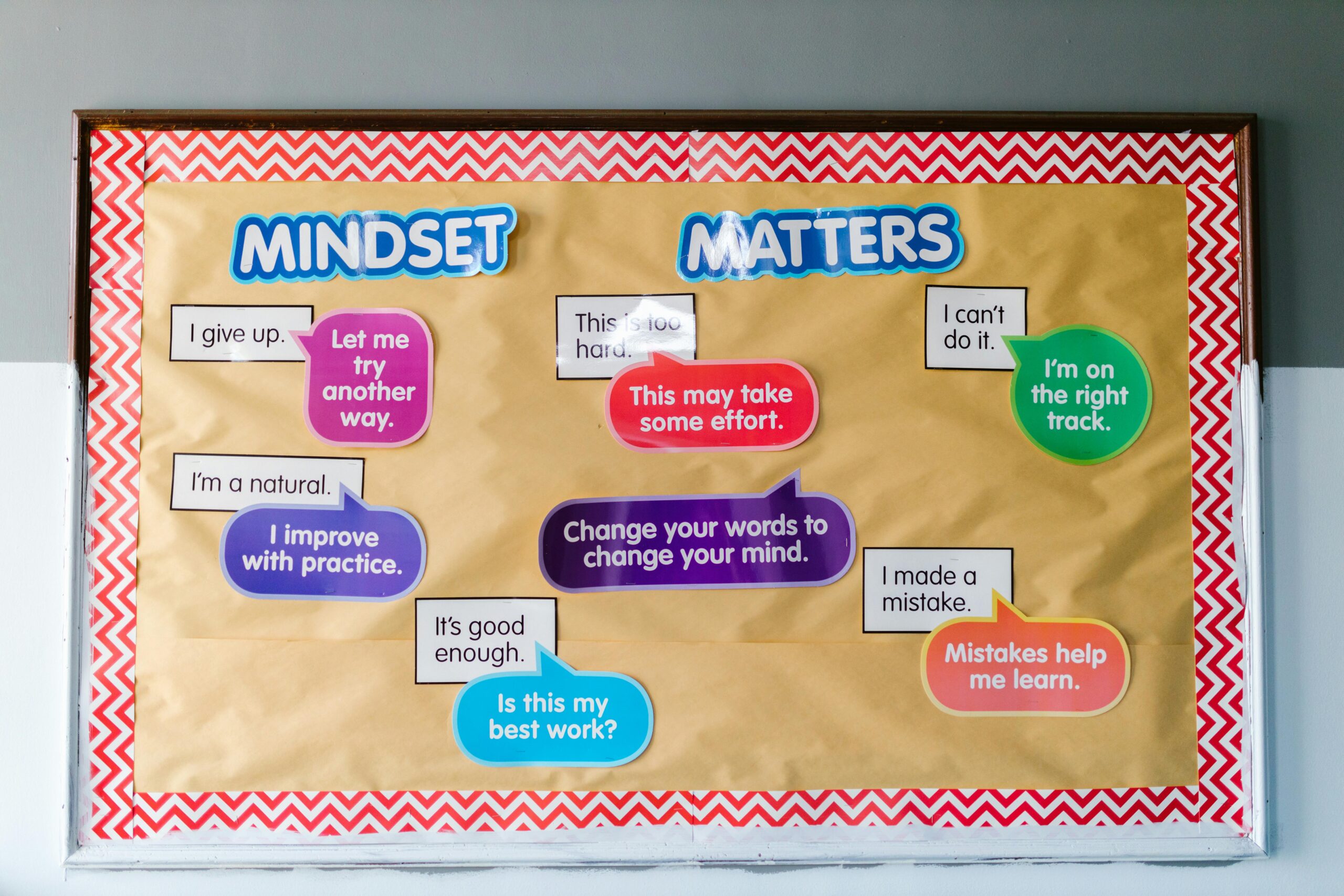
Make displays work for you. Use your bulletin boards to expand on subject material or to display student work. If you have many bulletin boards to fill, having several that don’t need to be changed often (or ever) is a huge time-saver.
Keep the visual clutter to a minimum. If it is just an accessory, maybe it isn’t needed. Students can’t handle too much sensory overload. Clutter makes the important blend with the unnecessary.
Filling blank bulletin boards is an obvious part of preparing the classroom. However, there are some less obvious, but still important décor items you may need to prepare, such as the following:
Job/cleaning chart
Birthday chart
Daily schedule (consider adding magnetic strips to the back, using tacks, or finding some way to make it easily changeable from one day to the next)
Desk/hook/cubby labels
Number lines
Student folders
Behavior systems
Supplies you may want to have on hand:
First aid basket (Band-Aids, cough drops, tissues, etc.)
Basic cleaning supplies for wiping off desks or cleaning the chalkboard/whiteboard
Blackboard/whiteboard markers and erasers
This list contains many more suggestions: Taking Stock: A Classroom Shopping List - The Dock for Learning
The following are some sample to-do lists by various teachers listing the tasks they complete before the first day of school:
Sources
Setting the Tone: Classroom Walls by Carolyn Martin: Setting the Tone: Classroom Walls - The Dock for Learning
Where to Begin: Preparing the Classroom for the First Time by Kendra Martin: Where To Begin: Preparing the Classroom for the First Time - The Dock for Learning

Teacher Overload and Burnout
The Nature of Overload and Burnout
Overload can be defined as excess demands impairing mental, physical, and emotional function. One can sustain short seasons of overload. Burnout, on the other hand, is a loss of enthusiasm and energy leading to cynicism, fatigue, racing thoughts, sleep issues, snappiness, reduced creativity, and relational strain. Once one is in a state of burnout, it is very hard to keep moving forward.

If you are feeling constant tiredness and a “can’t keep up” desperation, this signals a need for action. Remember that deeper holes take longer to recover from. Be alert to early signs. Ask yourself, “Can I sustain this pace?”
Advice for Teaching Sustainably
Taking time to prioritize self-care is not selfish (unless done at the expense of fulfilling one’s duties). Instead, taking time to do things that bring you rest and refreshment helps you to be a better teacher in the long run. This may include things like the following:
Maintain non-school hobbies
Get good sleep/take naps
Take walks or exercise
Embrace Sabbath rest
Spend time with Jesus often and let Him love you
Distinguish fun from obligation
Set boundaries and say “no” politely
Eat nourishing, nutritious food
Ask for help when you need it. Perhaps you can recruit parent volunteers for things like daily checking or reading classes.
A driver in burnout can be unclear expectations or nebulous job roles. Seek clarity from board/admin/principal/co-teachers on what your responsibilities are.
Another driver in burnout can be differing goals and vision, perhaps from your board, parents, or co-teachers. If this is the case, communicate humbly. Talk it out with those involved in respectful ways.
If you find that unresolved personal issues are causing your burnout, remember the importance of bringing your best self to the classroom. Seek counseling for healing and wholeness.
Poor time management and/or procrastination is an issue worth attacking head-on. Assess where you are losing time and put safeguards in place to keep it from happening often. Put energy into building positive habits. Consider making yourself accountable to a co-teacher or administrator.
Establish systems and routines for daily tasks and classroom management. Whenever you can put energy into planning responses and consequences once, it keeps you from needing to spend mental energy deciding in the moment whenever things come up.
Ensure that you have a compelling vision driving you. While you may be teaching out of a desire to serve families and come alongside parents in the important task of educating children, if this is your primary focus, it can easily lead to people-pleasing and burnout. Instead, put your focus on serving Christ, His church, and His Kingdom. You are helping to train and equip more Kingdom workers. Keeping this perspective has the potential to revolutionize the ordinary moments of everyday life in the classroom. These moments become holy as you see them through the lenses of eternity and realize the impact that your work can have.
Remember that things will not always go as you planned and you will not always be able to operate at 100%. Be gentle with yourself when you are tired, hungry, angry, or frustrated. Jesus sustains the teacher who calls out to Him. He is bigger than your sleepless night, your hastily crafted sticky note lesson plan, or your students’ low spelling scores. You can trust Him to fill in the gaps when you have done your best.
Sources
Avoiding Overload and Burnout by Arthur Nisly: Avoiding Overload and Burnout - The Dock for Learning
Help for the Harried Teacher (Remedies) by Doug Kauffman: Help for the Harried Teacher (Remedies) - The Dock for Learning
Workers in the Kingdom by Rosalie Beiler: Workers in the Kingdom - The Dock for Learning
What I Wish I Had Known About Self-Care by Ruth Anna Kuhns: What I Wish I Had Known About Self-Care - The Dock for Learning

Teaching Reading
General Advice and Teaching Tips
Utilize pre-reading activities, which prepare students for what they are going to encounter in the text and get them interested in the story before they even start reading. Pre-reading activities may include:
Vocabulary—make sure that students are equipped to understand unfamiliar words or concepts.
Brainstorming—very quickly allow students to interact with a question that introduces the theme of the story.
Hooks—give a question that has no answer, share a personal anecdote, show a picture prompt, use an object that is related to the story, predict what may happen in the story based on the title, etc.
Graphic organizer—use something like a KWL chart (letting students fill in what they already Know about a subject and what they Wonder about. After reading, they can fill in what they have Learned about the story). Bubble maps or Venn diagrams work well also.
Use questions to explore stories. This leads students to discover the truth for themselves (instead of you simply telling them what you think the meaning of the text is).
Some students struggle to understand what they’re reading. Teaching them the following tools may be helpful:
Think aloud
Model for your students how you can have an internal dialogue while reading a text. Project the first page of a story or a difficult section of a textbook. Read the text aloud, stopping often to share your thoughts. Point to the words in the text that trigger your thinking. Ask questions. Connect information from one concept to the next.
Mark the text
If a student has a personal workbook, the marking can be done directly in the book; if the student is using a shared textbook, the marking can be done on sticky notes and placed in the text.
Have students mark main ideas, background knowledge, or questions they have about the text.
When it comes to vocabulary, be aware that there is a lot of academic-specific vocabulary that students will only interact with in the classroom. In addition, there will be a vast span in the known vocabulary of your students based on their language exposure up to this point. It is the responsibility of the teacher to address these discrepancies so that every child can understand what they’re reading.
Use reading class as an opportunity to develop the following skills:
Summarizing
Identifying the main idea
Inferring (reading between the lines)
Distinguishing fact from opinion
Applying wisdom principals to life
Narrating (retelling the story from memory)
Use a variety of oral reading methods to maintain engagement:
Round robin—students read assigned portions in order, going around the room
Pulling sticks—randomly select readers using popsicle sticks with names
Chain reading—set a timer (e.g. 45 seconds) for each reader
Readers’ theater—assign dialogue or narration roles
Fill-in-the-word—teacher reads, students chime in with specific words
Popcorn reading—students read one sentence each
Group/pair reading—small groups read together
Whisper/blab reading—students read aloud softly and simultaneously
Learning to Read (Kindergarten--First Grade)
Teaching students how to read is a complex and important task. The following concepts should be cornerstones in your teaching:
Develop auditory skills. A student must be aware that words are made of individual sounds. Before you teach children how to blend sounds, they must be able to hear the individual sounds in words. Practice this orally by saying a word like “mat.” The students repeat “mat” and then break the word apart: /m/ /a/ /t/, holding up a finger for each sound. Do this daily for weeks (at a minimum).
Curriculum like Heggerty Phonemic Awareness do this type of training very well and can be added to your reading curriculum (lessons are only ten minutes per day).
Review. Learning how to blend and read words takes more review than you may realize. A child who can fluently sound out words and comprehend them is multi-tasking, which is a very high-level process. Drill the sounding out and blending process again and again until it becomes automatic.
Keep flashcards in circulation until competency is reached. Don’t switch out the words in your flashcard pack too soon.
Develop fluency before comprehension. Focus on teaching students how to read fluently first—developing comprehension and more interaction with the text can happen later.
Elementary
Work to create a culture of reading in your classroom. This can be achieved through the following:
Model a love for reading
Incorporate reading into every school day
Offer a diverse classroom library
Design an inviting classroom that encourages reading through a cozy reading corner or literary-themed bulletin boards
Teach engaging reading lessons
Promote reading at home through reading challenges or setting individualized reading goals
Recommended Resources
Below you will find some general, multi-use application resources. However, the Dock contains hundreds of reading and literature resources shared by teachers, such as worksheets, powerpoints, study guides, tests, and more. Go to https://thedockforlearning.org/ and search for your specific theme or work of literature—you may find that another teacher has shared something that can be useful to you.
Learning to Read Training (CLP)
Guidelines for Oral Reading: Guidelines for Oral Reading - The Dock for Learning
Advice for bridging the transition between CLP’s Learning to Read and I Wonder: From Learning to Read to Reading to Learn - The Dock for Learning
Oral reading rubrics:
Tips for improving reading comprehension: How to Read: Improving Reading Comprehension - The Dock for Learning
List of suggested online resources: Reading/Language Online Resources - The Dock for Learning
Reading comprehension stories (middle grades):
Word games and drills for beginning readers: Word Games and Drills - The Dock for Learning
Songs and rhymes for beginning readers: Phonics: Learning to Read - The Dock for Learning
Strategies for increasing and developing vocabulary:
Sources
Understanding Reading by Karen Birt Understanding Reading - The Dock for Learning
Pre-Reading 101: Strategies to Get Your Students Ready for the Story by Sharon Yoder Pre-Reading 101: Strategies to Get Your Students Ready for the Story - The Dock for Learning
Learning to Read by Karen Yoder Learning to Read - The Dock for Learning
Developing a Passion for Reading by Myron Brubacher Developing a Passion for Reading - The Dock for Learning
3 Components of a Successful Reading Class by Sharon Yoder 3 Components for a Successful Reading Class - The Dock for Learning

Mathematics: Studying God's Greatness
Why study math? This document presents concepts students may not have contemplated. Math points us to the greatness of our Creator. Studying arithmetic, geometry, algebra, and calculus can help us to more deeply appreciate the greatness of our Lord. Although the document discusses calculus, no prior knowledge of calculus is assumed.

Guns or Frying Pans?
“Young man, you put that gun down!" Louise Degrafinried commanded firmly as Riley Arceneaux burst into her home pushing her husband, Nathon, ahead of him at gunpoint. “Young man, I’m a Christian lady and don't believe in violence," she continued. "You put that gun down right here. Son, you must be starving. Now, how do you want your eggs?"
Several days earlier on February 18, 1984, Riley, along with five others, had escaped from the Fort Pillow Correctional Facility in West Tennessee where he was serving a 25-year prison sentence for second-degree murder. He was cold, wet, desperate, and lonely as he stumbled onto the home of Nathon and Louise, a God-fearing couple in their seventies, who were active members of the Mt. Sinai Primitive Baptist Church. The entire community was on edge because of the escaped convicts. Louise was on the phone with a friend of hers about this very subject when Riley and Nathon burst into the house. She simply said, "Well. they're here now," and hung up the phone.
“I haven't eaten in three days," Riley growled as he cooperatively laid his gun by the sofa. Louise quickly whipped out her trusty frying pan and soon the tantalizing smell of African American "soul food"—frying bacon, eggs, toast, and coffee—filled the small house. Louise set out her best napkins and sent Nathon to bring Riley a pair of dry socks. Louise began asking about his family. Riley mentioned that Louise reminded him of his grandmother who had recently passed away. “I have no one who cares anything about me. No one cares if I live or die," Riley lamented.
"Young man, I love you, and God loves you. God loves all of us, every one of us, especially you. Jesus died for you, because He loves you so much," Louise assured him as she patted his leg, and a tear ran down his cheek. As Nathon, Louise, and Riley sat down to eat their breakfast, Louise took Riley by the hand and thanked God for the food and that Riley was safe. She asked Riley if he had anything to say to God. Undeterred by his disinterest, she coached Riley through a simple prayer, "Jesus wept”.[1]
As they ate, the elderly couple entreated him to simply give himself up to the authorities. In Louise's own words, "I went to giving him Bible.” Louise told Riley, "When we do wrong, we have to be punished.”

Unknown to Riley, Louise's friend, who she was talking with at the beginning of the confrontation, had notified the police. As the threesome enjoyed their breakfast, they heard the sirens in the distance. "The police will kill me. I know it!" wailed Riley.
"No, I won't let them. You do what is right, and I won't let them hurt you;' Louise assured him.
Soon the yard was filled with police cars with officers crouched behind their car doors with their guns drawn, fully expecting a criminal to burst out of the door shooting for his freedom. Instead, they were met by a 73-year-old grandmother with her hands on her hips. "Y'all put those guns away, I don't allow no violence here. You put those guns down. This fellow is going to give himself up, but he needs to finish his breakfast first;' she instructed with the same authoritative voice she had used on Riley several moments earlier. The police reluctantly agreed but remained wary.
Several moments later Riley stepped out onto the porch with his hands above his head, Nathon and Louise on either side with their arms around him. He was arrested without incident and taken back to Fort Pillow prison. Newspaper headlines highlighted how this woman with her Bible and frying pan did what all the law enforcement in West Tennessee was unable to do!
Less than 12 hours later, Paul Windrow, a fifty-nine-year-old local tire dealer as well as a church elder, was grilling steaks on his patio. He had also heard about the convicts being on the lam, and he had taken the precaution of carrying his pistol on his belt at all times. Ronald Freeman and James Clegg, who along with Riley Arceneaux had held a family hostage two days before, came bursting out of the kudzu covered bushes behind his house. Paul fired two shots, neither which struck the convicts, before they fatally shot him. Underscoring Jesus' words, "They that take the sword will perish with the sword."[2]
The pair then burst into the house and took Paul's wife Elizabeth hostage, and forced her to drive them several hours to East Tennessee, where they left her at an interstate rest area, and fled. She was unable to cope with the memories of her husband's murder and her kidnapping and had to leave her home. She moved to a new location in an effort to bury the trauma.
While Riley went back to prison, he didn't drop out of Nathon and Louise's life. Louise asked for a picture of Riley which she put in their family album. The police asked them to press charges against Riley, but the Degrafinrieds refused, "Because that boy didn't do anything to us,” they said. Riley still received an additional 20 years added to his sentence for escaping and for his involvement with an earlier kidnapping. Louise continued to visit him in prison and wrote letters in spite of the fact that her arthritis made writing legibly difficult.
Unfortunately, Riley didn't respond to the Gospel immediately. Four years after his initial escape, he attempted to escape from prison again. While he wasn't successful in this attempt, he was sent to solitary confinement for a time. While he was by himself for 23 hours a day, he began to think seriously about the claims that God had on his life. He remembered especially the testimony of Louise Degrafinried, and he realized this was what real Christianity looked like in real life. Louise continued to write letters in which she encouraged him, "I believe in you. Trust God to work in your life. Be patient, study your Bible and look for the good in everybody." Riley said the lack of fear that Louise showed convinced him to become a Christian in 1988. "She (Louise) was real Christianity. No fear;' Riley said. When Louise prayed with Riley on a visit to the prison, she began her prayer by saying, "God, this is your child. You know me and I know you:' Riley knew that was the relationship he wanted with God.
The Degrafinrieds worked to get Riley released from prison, which finally happened in 1995. Riley moved to Nashville, got a job, and began to build life instead of destroying it.
Louise died in August, 1998. Among the crowd of 300 mourners at Mt. Zion Missionary Baptist Church was Riley Arceneaux, who was serving as a pallbearer. He also spoke to the crowd in his eulogy, "This woman was a real Christian. No fear! It was through her that I turned my life around:' He reassured the family that he was staying out of trouble. "It's not just a jailhouse religion like some guys get. It does stick with some people. To me it's how much you really seek after God while you're in there;' he said.
By this time, he was working as a foreman at the Crown Tent & Awning Co. He was living in Nashville with his wife and young son. His was truly a life redeemed.

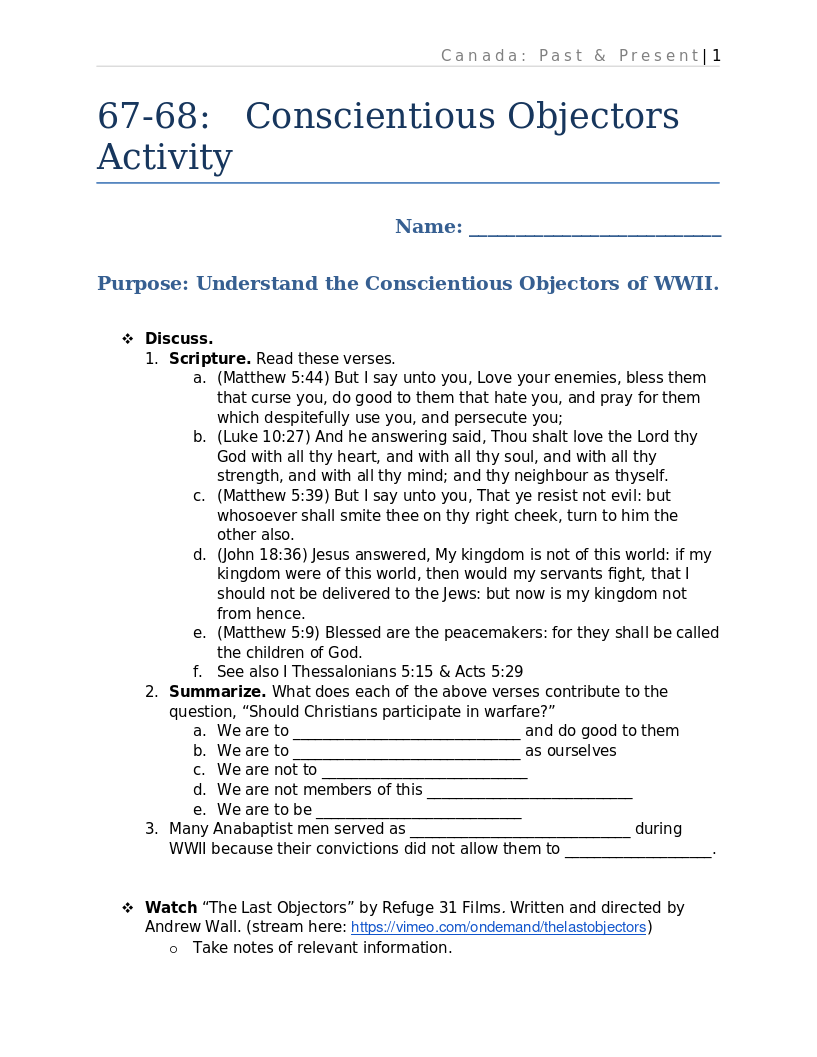
What will be your weapon of choice? Gun or frying pan? Are you willing to beat your guns into frying pans?
[1] John 11:35. When someone asked her later, “Why did you tell him to say ‘Jesus wept’?” she said, “Because I figured that he didn’t have no church background, so I wanted to start him off simple; something short, you know.”
[2] Matthew 26:52
This article first appeared in the October 2019 Calvary Messenger. Published here by the permission of the author. Also see https://jimandnancyforest.com/tag/louise-degrafinried/

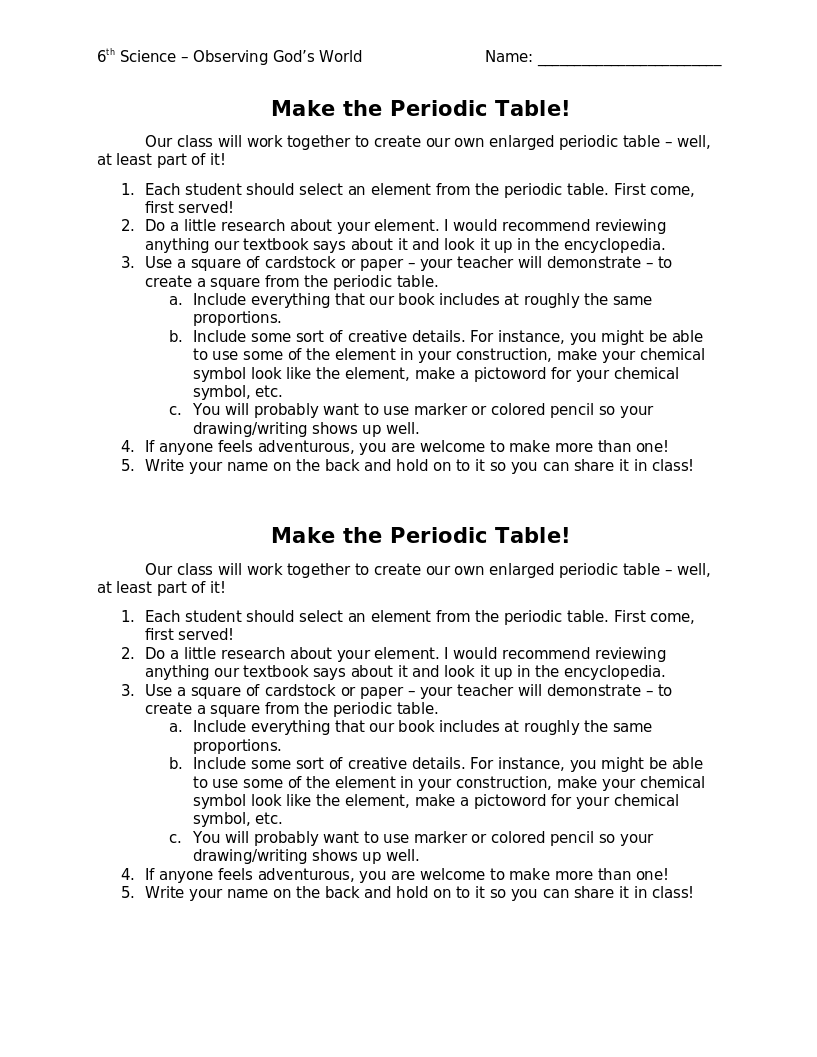
Build-an-Atom sixth grade science assignment
Please pick an element from the periodic table to construct an atomic model of. No repeats are allowed! I would like you to work with 1-2 other students to do this. To keep things relatively simple, no atomic numbers above 20 are allowed, but you will probably want to choose an atomic number less than 10. Do your best to discuss, plan, and divide up tasks. You may use the following materials:
- Whoppers
- Lemonheads
- Spray paint x3
- Fishing line
- Hot glue or pins to bind the nucleus together
- Anything else!
I ask that you make all protons green, neutrons red, and electrons yellow. You can use the spray paint to this effect.
Remember that your nucleus needs to be clustered together in the center of the atom with the electrons circling it.
IMPORTANT: You not only need to include the correct number of electrons but also place them in the correct shells. For simplicity’s sake, let’s all put the first electron shell 8” from the nucleus and the 2nd electron shell 3” beyond that.
Your whole atom should be suspended from the ceiling in some out-of-the-way place of the basement. Next to it, hang a card stating the name of the atom and the number of each subatomic particle.
Image by Gerd Altmann from PixabayThis assignment was stressful, but I do think it was helpful, and the end results were mostly impressive. The main issues were…
- Painting all those Whoppers. Having Gumballs/Fireballs that we wouldn’t have to paint would be really helpful.
- Getting the Whoppers to cohere together was challenging, although the hairnets really helped.
- High atomic numbers were challenging. I wouldn’t recommend using any atomic numbers over 6-8 max to reduce the number of electrons required.
We also might try to size/scale/space the particles more accurately. In reality, the electrons would likely be much further from the nucleus.

High School Spanish Curriculum Reviews
Esther Swartzentruber is instructional coordinator at Faith Mennonite High School and has experience teaching high school Spanish. The following outline offers some of her insights and perspectives on Spanish language curricula.
A few general thoughts:
- No matter the curriculum, I have found that it absolutely does not work to teach language as a half-credit. Language learning courses must be full credit courses and meet every day. Daily exposure is vital to language-learning success.

- Second, students absolutely must commit to memorizing vocabulary on their own and practicing Spanish outside of class every day (10+ minutes per day).
- Third, curriculum does not teach languages; teachers teach languages. Preferably teachers who have clear memories of their own language learning experiences, and who have a clear understanding of the methods and approaches used by their instructors.
- Yes, “spoken-language first” approaches sound amazing! I have seen aspects of that teaching style used to greater or lesser effect. I think what's important, if such an approach is used, is to directly explain that you will be using that teaching method. I have been in college-level language classes where students were unaware that the instructor was using that approach (at least partially), and basically just checked out. Many times in the high school classroom, I used *parts of* this approach where once a week or once a month the entire class was Spanish only, and students had to use context clues to follow along and participate. There is a certain subset of students that can be resistant to that approach unless you coach them through your method and help them find confidence for total language approaches.
Regarding curriculum:
BJU 2018 3rd edition
Pros
- Clear learning objectives at the beginning of every chapter
- Self-evaluation forms at the end of every chapter so students can rate themselves on mastering the objectives
- Organized vocabulary lists at the end of every chapter
- Oral listening exercises, with a number of Spanish voices/accents, so students get used to listening to and responding to native speakers. (These exercises move toward that total language approach, but students should be coached in these in the beginning. May function better as whole class exercises.)
- Helpful verb charts and rigorous activities
- Cultural articles
- Catechism and Bible verse instruction
Cons
- Assessments – the 2018 edition got rid of quizzes, and only includes massive end-of-chapter tests. These tests regularly include vocabulary that students have not learned. Teachers have to be vigilant in choosing/eliminating test questions/sections. (It worked this year for our teacher to break up these tests and use them throughout the chapter.) Also, the tests are insanely long. Could take some students 1 to 2 hours.
- With the BJU curriculum, it’s important to prompt vocabulary retention by requiring a weekly vocab quiz, separate from the curriculum. Students have to memorize vocab, separate from regular quizzes/tests/assessment.
- Instruction on the alphabet, vowels and consonants, and classroom phrases are hidden in the introduction. A wise teacher will create stand-alone lessons around these on the first few days of classes.
Abeka 2021 edition
Pros
- Clear alphabet, vowel and consonant, and syllabication instruction at the beginning of the course, with great activities
- Geography articles
- Bible verses, etc.
- One book approach (no separate activities manual, like BJU)
Cons
- Weird textbook layout with vocabulary on one page, and the picture of the object on the second page/spread, without it being labeled (?)
- Mind-numbing prescriptivist language activities that euthanize the joy of language learning, a la Abeka English grammar
Image by Florida-Guidebook.com on Unsplash

Learning to Read
Learning how to read is based on a few cornerstones.
- Develop auditory skills. A student must be aware that words are made of individual sounds (phonemes). Before you teach children how to blend sounds, they must be able to hear the individual sounds in words. This means you teach “finger-spelling” before you teach blending. This is an oral drill. Make a list of ten words every day for the first two weeks of school: mat, cat, big, sun, Ted, fine, lake, etc. The teacher says mat. The students repeat mat and then break the word apart /m/, /a/, /t/, while holding up a finger for each sound. The teacher says fine. The students repeat fine and then break the word apart: /f/, /long i/, /n/, while holding up a finger for each sound. At first, this is difficult for many, because they are not used to breaking words apart into individual sounds. Throughout the second, third, and fourth months of first grade, once students have succeeded with three-letter blends, increase the difficulty to four- and five-letter blends (bent, drive, plant, etc.). Success in this auditory exercise lays the foundation for pointing to individual sounds in a word, saying them, and blending them together.
- Review. Learning how to blend and read words takes much more review than most beginning teachers realize. Consider how you learned to drive a vehicle; the intensity of focus it took and the incredible amount of practice it took until you could drive a car while carrying a conversation (multi-tasking). A child who can fluently sound out words and comprehend them is multi-tasking, which is a very high-level process. Teachers must drill the sounding out and blending process again and again until it becomes automatic. Whole class exercises build fluency. Sound out and blend word lists chorally. Model what it sounds like to break apart a word and blend it together, then repeat it faster several times.
- Review flashcards until competency is reached. Often teachers switch out words in their flashcard pack too soon. Students should be able to read the words on flashcards and phrase cards fluently before the cards are “put away.” This will likely mean having two flashcard sessions a day. Several shorter sessions are better than one session that lasts too long.
- Develop fluency before comprehension. The key in first grade is teaching students how to read fluently. Drill. Drill. Drill. Blend. Blend. Blend. Review. Review. Review. Any word lists or word boxes that students are asked to read individually to the teacher should be practiced chorally with the class at least two to five times before students read them individually. (These lists are provided daily in Christian Light’s Learning to Read curriculum.)
- Use pre-reading strategies for comprehension. Before starting a reading class, the teacher should introduce the main characters. Do students know if they are boys’ or girls’ names? Draw stick figures on the board to represent the characters and ages of the main characters. What is the setting—similar to what children see out the window or something vastly different? Students need a mental picture and framework out of which to read. Help students make predictions from the title or the picture in the story as to what might happen. When understanding the setting, characters, and possible outcome, students can read more competently. They may have made a wrong prediction which is okay, but at least they are thinking. They are not just reading in a void but are following a journey. Tossing a story to children and saying ‘read’ without prepping them is like tossing them into a pool and saying ‘swim.’
- Ask questions intermittently while reading, beginning in the primers. If students read a story about a wagon going downhill…a few questions such as What were they riding? Which direction are they going? Can you picture this? Would it be scary? Would it be fun? This continues to engage pupils and bring back the “wandering” and it builds comprehension.
Two key predictors of learning to read success are 1.) phonemic awareness and 2.) letter-sound fluency. If after several weeks, when a student has been drilled daily with others in phonemic awareness and letter-sound fluency but continues to struggle in these two areas, this may be an indicator of a learning disability that needs to be addressed with one-on-one tutoring, more strategic teaching, or tailored lessons.
Resources I’d recommend:
- Learning to Read from Christian Light is thorough, has a consistent review system built in with a variety of seatwork, and takes an incremental approach to the phonics program.
- Anna Zehr’s Teaching Reading Class at Summer Term at Faith Builders. We underestimate the complexity of the learning to read process and often poorly equip our young novice teachers.
- The Fluent Reader by Timothy Rasinski. You can listen to him speak online as well. He is a highly proficient and seasoned reading teacher.
- The sound slider from Christian Light. All first-grade teachers should use this tool daily.
- Victory Drill Book available from Christian Light or Christian Learning Resource. As soon as Learning to Read is finished we continue our daily word drills with one-minute timings from a page in Victory Drill working our way through. I’d be happy to explain more of this process.
- Training Sessions
- Each summer, Christian Light offers a week of training specifically geared to teaching the Learning to Read course.
- Faith Builders offers a first-grade learning-to-read track at Teacher’s Week in August.
- Find a seasoned first grade teacher in your local community and “sit at their feet” for a year, before diving in and teaching first grade cold turkey.
- Heggerty Phonemic Awareness (primary level-yellow book). This program is a twelve-minute a day program of breaking words apart, listening for rhyming words, putting syllables together; exercises that build reading fluency. This year, I’ve added it to my learning to read class and am delighted at the strength it is adding to our phonics program.
Image by Josh Applegate on Unsplash

ADHD Checklist
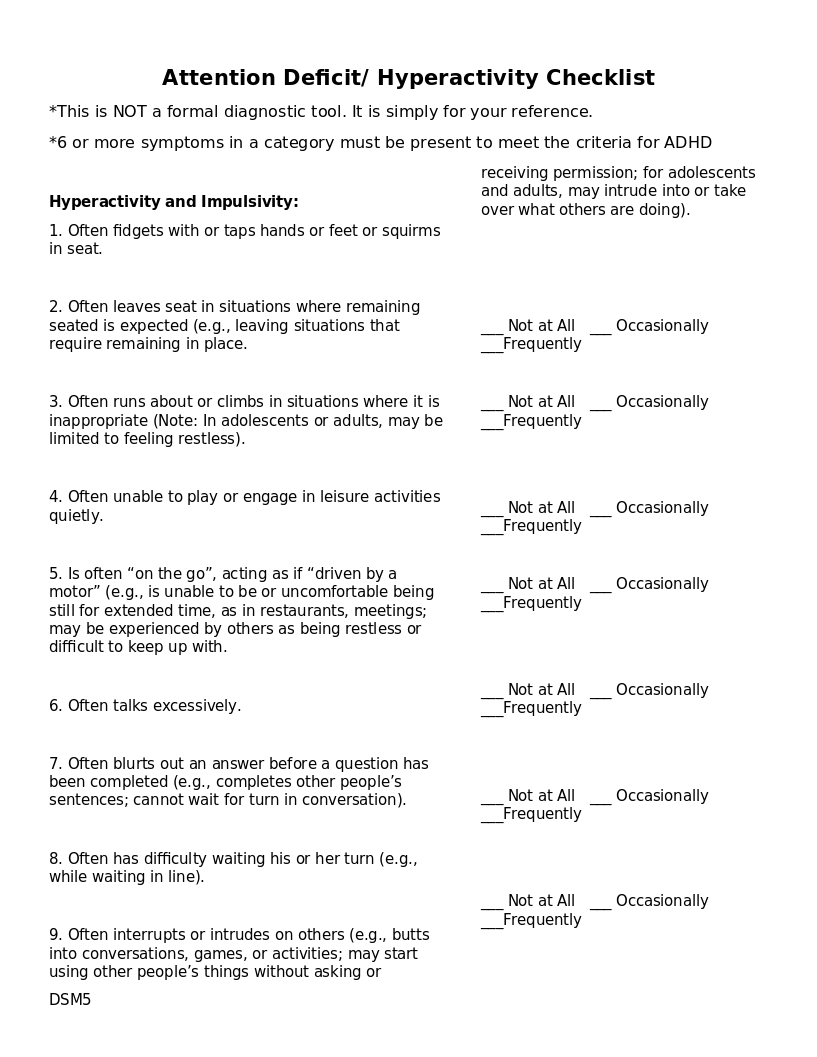
This checklist is similar to what a doctor would give to parents and teachers to assist in determining an ADHD diagnosis. It is not a formal diagnostic tool in itself. The front is for the hyperactive/impulsive type of ADHD; the back is for the inattentive type of ADHD (formerly known as ADD).
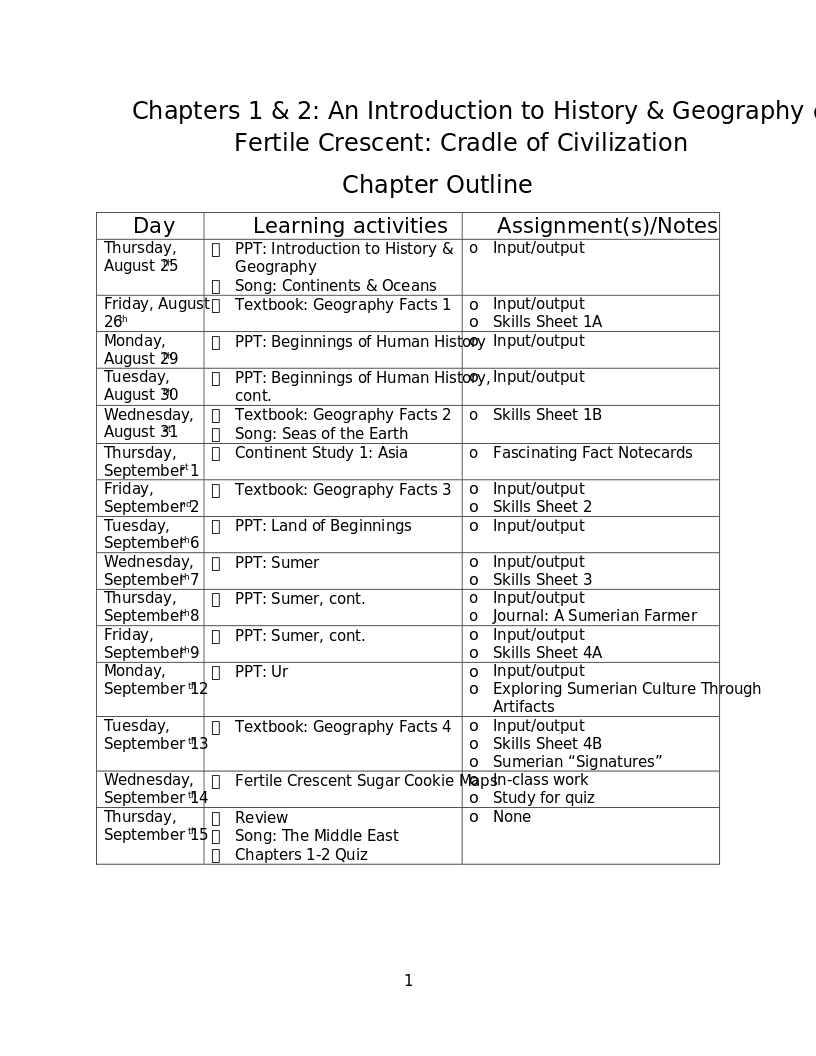
Outline for Abeka 5th History and Geography - Fertile Crescent: Cradle of Civilization
This outline provides a structure for teaching chapters one and two of Abeka's Old World History and Geography. Page 1 suggests a timeline for teaching the content. Pages 2 - 5 contains a study guide for the students. Pages 6 - 8 contain further explanation on using the study guide as well as detailing the projects and the related activates given on page one.