Avoiding the Mid-Year Drift
I had a rather amusing revelation recently. It struck me that my classroom has seemed more peaceful and orderly in the past few weeks than what it did earlier. I wondered why this could be, because the natural tendency is for things to head in the opposite direction if I am not careful. I could not recall any extra effort on my part to keep my students quiet and focused. And then I laughed when I remembered the one thing I had changed: I outlawed slime a few weeks ago.
I may be a more permissive teacher than some, and in general I make very few rules about what students are or are not allowed to have at their desks. Some students are, in fact, able to focus better if they have something small to play with while listening in class. I have also seen countless fads come and go, so I am not quick to outlaw specific things. When slime became all the rage among my students near the beginning of the school year, I thought the craze would soon wear off. Unfortunately, it didn’t. I soon needed to put some limits on when students were allowed to play with it, but I did not ban it entirely. Students still played with it during story time and in various pockets of free time and when they finished all their assignments in study time. If someone had a big container of slime, other students wanted to borrow some, and so passing globs of it around became a distraction. Soon most students were spending all their spare time playing with slime instead of reading books and creating artwork. I knew the slime had to go.
When I realized how happy I was with my newly slime-free classroom, I was reminded of times when this has happened before, not specifically with slime, but with other objects or activities in the classroom that became a hindrance to learning. It is easy to allow a gradual slide into bad habits if I do not keep a constant effort to steer my ship in the right direction. Just because I started the school year with good procedures and routines does not mean I can sit back and let things drift into autopilot. It is my job to make adjustments when I see the need for them.
Making mid-year modifications to rules or routines can be difficult. We may have subconscious excuses: It’s too much work to enforce this. I don’t want to upset my students or take away something they enjoy. We’ll do better after all the excitement of Christmas. We’ll do better after our schedule stops being disrupted by snow days and delays. I write this as much for myself as for anyone, because know that I am proficient at making excuses like this, and I know that my classroom is a better place if I do not give in to those excuses.
I like to have little talks with my students now and then about how we are doing, prompting them to think of ways to adjust their habits and to make our classroom a better place for learning. Sometimes I am surprised at the things they point out. Together my students and I can renew our awareness and recognize ways we have become blind or indifferent to what we ought to be doing.
At the same time, we need to allow grace—for ourselves and for our students. We face realities of sickness, disrupted schedules, and various external factors over which we have no control. This year I repeatedly need to make peace with the fact that my classroom is often noisier than I would like it to be. I have many students in a small space, and my class contains some big personalities. While I do need to stand guard and not let noise hinder learning, becoming a control freak over this would serve no purpose. My expectations need to be realistic.
If you have been on the fence over whether to implement a new routine, ban a particular activity that has been bothering you, or establish better habits in your classroom, perhaps now is the time to do it. Each day you can take small steps to urge your students to excellence.


TEACHERS NEEDED, 2026-2027
Do you want to make a difference in Childrens Lives??
At Bethel Dunkard Brethren School (located in Bethel, Pennsylvania) we have several teaching position open for the 2026-2027 school year. Kindergarten position which has classes Tuesday, Wednesday and Thursday.
We also have teacher openings in First, Second, Third and Fourth grade.
We use the Abeka ciriculum.
Our goal is to equip our student with quality academics and Bible teaching.
Please feel to reach out for my info: contact Jeff Eberly, 717-821-7433 or Eberlyjeff@gmail.com


When the Students Become Teachers
I am a teacher. That means my main job is to teach things to students, isn’t it? I teach and they learn. Perhaps this is true, in a way. But I have found that one of the first requirements for being a good teacher is to be a life-long student, and sometimes that means that my students are my teachers. And no, I do not teach high school. I teach third grade. These children were babies only eight years ago, and yet I have gained a wealth of knowledge from these little teachers.
What have I learned from my students over the years? Here are a few things that come to mind:
My students teach me wonder and delight. In her lovely poem “My Work is Loving the World,” Mary Oliver says, “Let me keep my mind on what matters, which is my work, which is mostly standing still and learning to be astonished.” It is a shame that somewhere in the path to adulthood, most of us forget how to be astonished by the incredible world that surrounds us. One of the best cures for cynicism is to look at the world through the eyes of a child, and my students teach me this continually. We watch caterpillars turn into butterflies, and for them it is complete magic. I let them look at things under a microscope, and they are enthralled. I teach them to sing round songs, and they are thrilled by the wonders of harmony. When I feel weighed down by the daily grind of the ordinary, I need my little teachers to remind me that everyday life is a gift to be savored.
My students show me generosity. Children are the best givers. My students sometimes put me to shame in how quick they are to share with each other. A student who accidentally left his lunch at home may end up with more food than he needs, as his classmates rally around and share what they have. When students give me gifts, I love to see the light in their eyes. They are learning the joy of giving, and I am constantly learning it with them.
My students exemplify forgiving and forgetting. A friend of mine recently switched to teaching second grade after working with high schoolers for several years. She said that one big difference in teaching young children instead of teenagers is that second graders don’t hold grudges. I have much to learn from this wonderful trait of children. They tend to forgive and forget and move on much more quickly than adults. Two students may have a huge disagreement one day, and the next day they will be the best of friends and behave as though nothing had happened. Earlier this year, I had a difficult day with one student. I was not sure that I had used the right approach in correcting her behavior, and I was afraid she might be upset with me. But at the end of the day, she gave me a hug on her way out the door and said, “I love you. Thanks for teaching!”
My students have taught me to slow down. We live in a hurried world. Children are adept at teaching us the art of slowing down. Unfortunately, this can often be annoying and inconvenient. I read John Mark Comer’s book The Ruthless Elimination of Hurry recently, and an important point he makes is that it is hard to love when you are in a hurry. I see the truth of this in my classroom. The times when I am most likely to be exasperated with my students are times when I am in a hurry to get through a lesson or to finish a project. Then I view their neediness as an interruption instead of an opportunity to show love and patience.
My students often show me ways that I relate to God. Sometimes I have recognized that the words coming out of my own mouth while talking to a student were really God’s words to me. It seems that every year I have at least a few students who are constantly rushing ahead and are so concerned with getting the next thing done that they miss important instructions in the present. As I considered why this is so frustrating to me, I realized that it is precisely the way I relate to God sometimes. I can think of many instances where I may never have gotten through to a student, but God got through to me.
What are you learning from your students? As we take time to listen and discover, our students can lead us to become better teachers.

6th and 7th Grade Teacher at Maple Grove Mennonite Academy in New Holland, PA
Maple Grove Mennonite Academy in New Holland, PA, is looking for a 6th and 7th grade teacher for the 2026-2027 school year. We are a Waldorf-esque school in our sixth year and have around forty students from diversified backgrounds and a variety of conservantive Anabaptist churches. Responsibilities include teaching math, English, spelling, science, and history. Perks include four field trips a year, as well as choir, band (including a marimba ensemble), and art classes every day. Please contact Deana Swanson at littleflock7@gmail.com for more information.

Recess Games for Upper Elementary and Middle School
Group recess games are a staple of every school playground, but sometimes teachers and students alike can grow weary of playing the same ones over and over again. Here are a few recess games you might consider adding to your rotation.
FRISBEE/TENNIS BALL GOLF
Materials needed: A frisbee or tennis ball for each student. (Using tennis balls instead of frisbees makes the game easier, especially if students are not proficient at throwing frisbees.)
Considerations: Works best outdoors.
The aim of the game: Like golf or disc golf, to complete the “course” in the least number of throws.
Instructions: This game is, quite simply, disc golf without fancy tees or baskets. Create a plan for a course that stretches around your school property. You will want to choose a succession of starting points (tees) and ending targets (holes). This will be things like “start by standing on first base of the baseball diamond and try to hit the second maple tree beside the playground.” You can either instruct your students about the “tees” and “holes” verbally or create a little map for them.
Students start on the tee and try to throw their frisbee/ball to hit the hole. Wherever their first throw lands is where they will stand to throw their second shot and so on, until they hit the final target. They keep track of their number of throws.
If you have a small number of players, you could travel through the course as a whole group. With a larger number of players, you will want to divide them into small groups and have them start at various places along the course.
POST TO POST
Materials needed: A large outdoor space with 3-5 “posts.” These posts are merely stopping points in the game; they could be a tree, a base on the softball diamond, the corner of a building, a strategically-placed cone, etc. You will want these posts to be arranged in a somewhat circular pattern around the property.
The aim of the game: To be the first player to complete the route three times.
Instructions: Start by choosing the posts and making sure each student understands where they are and what route they must run in order to reach each post in succession.
Choose several players to be “it” (probably around 10-15% of the players). They are trying to tag as many players as they can.
The other players will go to any post to start the game. While on the post, they are safe and cannot be tagged. Their goal is to run from post to post without getting caught. Those who are “it” may hide around corners, behind trees, etc., in order to catch players unawares as they run by.
Each player is attempting to be the first to run three complete circuits (at which point they are declared the winner). If a player is tagged, they must return to their starting point and start that circuit all over again.
If a player gets tagged three times, they also become “it.”
Options for variation:
We used to play that players were allowed to take seven steps from a post and still be considered “safe.” This allowed for them to get a bit of a start from the post without being in danger of getting tagged, which helped the game keep moving. Once a player took an eighth step, they were then able to be tagged from that point onward. This is an optional rule.
You might choose to allow students to reverse their course throughout the game and run around the route in the opposite direction. However, specify that they may only change directions at the post on which they started the game. That way, students can easily keep track of how many complete circuits they have made.
WAVE
Materials needed: A cone or landmark (such as a step, post, tree, etc.) to be the home base.
Considerations: Works best as an outdoor game.
The aim of the game: To be among the last players to be caught and to help free those who have been caught.
Instructions: One person is chosen to be “it.” They close their eyes and count to fifty (or some other chosen number) while everyone else runs and hides somewhere nearby. The person who is “it” may circulate freely to try to find people. If they see someone, they catch them simply by calling out their name.
If a player’s name is called by the person who is “it,” they must go to the home base. They will stay there until they see any player who has not been caught waving at them. If they see someone waving, they may run away and hide again. If the person who is “it” is nearby and sees them escaping, they may call out their name again, in which case the player must return to the base and wait to see another wave.
You will want to make it clear that players need to escape within around thirty seconds of seeing a wave, otherwise the wave is “too old” to count anymore.
Choose a certain number of students that the person who is “it” must have caught at one time before the game is over. It usually works best for that number to be around 50-60% of the total number of players.
TUBES
Materials needed:
An assortment of balls; dodge-ball type balls work best, though soccer balls could be used as well. You will want somewhere between 10-20 balls.
“Tubes.” You need one tube for each player. These can be created out of a wide variety of materials. My school had large PVC pipe (around 4-5 inches in diameter) cut into chunks, each creating a free-standing tube around 12 inches tall. The same could be done with stiff cardboard tubing. Another option would be going to a department store or flooring store and asking for old carpeting tubes.
Alternatively, you could collect large empty jugs (at least gallon-sized or larger) and use those as your tubes.
A rectangular playing area with a central dividing line.
Considerations: Could be played inside or outside, though a contained space like a gym will more conveniently keep errant balls from getting away.
The aim of the game: To keep your own tube standing and knock down the opposing team’s tubes.
Instructions: The group is divided into two teams. Each team goes to one side of the dividing center line and sets their tube upright on the ground. The balls are placed along the center line. Players are not allowed to cross the center line.
Once the game begins, players may run to grab the balls. They then try to throw them at the opposing team’s tubes and knock them over. Each player is also trying to stop balls from hitting their own tube. If a player’s tube is knocked over, they are out of the game and watch on the sidelines until the game is over (which happens once all the tubes of one team have been knocked over).
Options for variation:
You could also play that once a player’s tube is knocked over, they join the opposing team.
Another variation is to delineate a narrow section at the back ends of the playing zone. When a person’s tube is knocked over, they go to the back end behind the opposing team and try to knock down tubes from there. If they successfully knock a tube down, they may return to their side and set up their tube again.
MANHUNT
Considerations: This game works best if played outdoors on the whole school property.
The aim of the game: To be the last player to be caught.
This game is essentially like tag, though it is played in a very large area. One or two people start as “it.” As each player gets tagged, they become “it” as well and help to catch as many players as they can. The game continues until every player has been caught.
SPUD
Materials needed: A dodgeball or soccer ball
Considerations: Can be played indoors or outdoors, though if you have a lot of players a gym will not be enough space.
The aim of the game: To be the last player to spell SPUD.
Instructions: For this game, you will want to have the students in groups of approximately 5-7 players. For the purposes of explanation, I will assume a group of 5. Start by giving each student a different number from 1-5. (These numbers should be a secret from the other players. Either let them choose a number written on a piece of paper in a dish, or whisper it in each student’s ear, being sure to assign the numbers randomly so that initially the players don’t know who has which number.)
The game begins with all the students standing in a clump, with one student holding the ball. They will throw the ball straight into the air as far as they can. As soon as the ball is in the air, the person who threw it will yell a number from 1-5 (not their own number). As soon as the ball is thrown and the number is shouted, all the players scatter, except the player whose number was called. That player tries to catch the ball (or grab it as soon as they can). Once the ball is in their possession, they shout, “Spud!” At this point, all the other players must freeze exactly where they are.
The person with the ball may take three steps in any direction towards a frozen player. They will then try to hit the player with the ball (only shoulders and down). The player who is being thrown at is allowed to try to catch or dodge the ball, but they may not move their feet.
If the person throwing the ball doesn’t hit the other player or the ball gets caught, they “receive a letter” (the first time they get an S, the next time a P, and so on until they have received four letters and spelled SPUD). If the person being thrown at gets hit by the ball, they receive a letter instead. Each player must personally keep track of how many letters they have and does not have to reveal that information to anyone, even if asked.
The game then continues by everyone gathering in a central spot again. This time, whoever’s number just got called is the person who throws the ball up and calls a new number.
To add a fun twist, once a player has received all four letters of SPUD, they are then “poison.” Anyone who calls their number when throwing the ball in the air or who hits them with the ball receives a letter themselves.

"I'm All Done!" (But I Didn't Understand It)
In today's educational climate, much emphasis is placed on reading decoding with the science of reading. While being able to read the actual words is vital, understanding what they mean is just as important. "Being a mindful reader involves not only reciting the words, but also understanding what those words mean in context," say Zimmermann and Hutchins (155). So if Sarah turns in incomplete and uncomprehended activities about World War II aftereffects, the teacher may need to re-teach the lesson, guiding her through comprehension activities.
Source Cited: Zimmermann, Susan and Chryse Hutchings. 7 Keys to Comprehension. New York, Three Rivers Press, 2003.
Washing Feet
Ah, the challenges in gaga ball.
Justin sorrowfully reported after recess, “They were ganging up on me and trying to get me out! I asked them why they were ganging up on me, and they said, ‘Because you’re the littlest.’”
Curt and Derek immediately chimed in, “We saw it happening and we stuck up for Justin.”
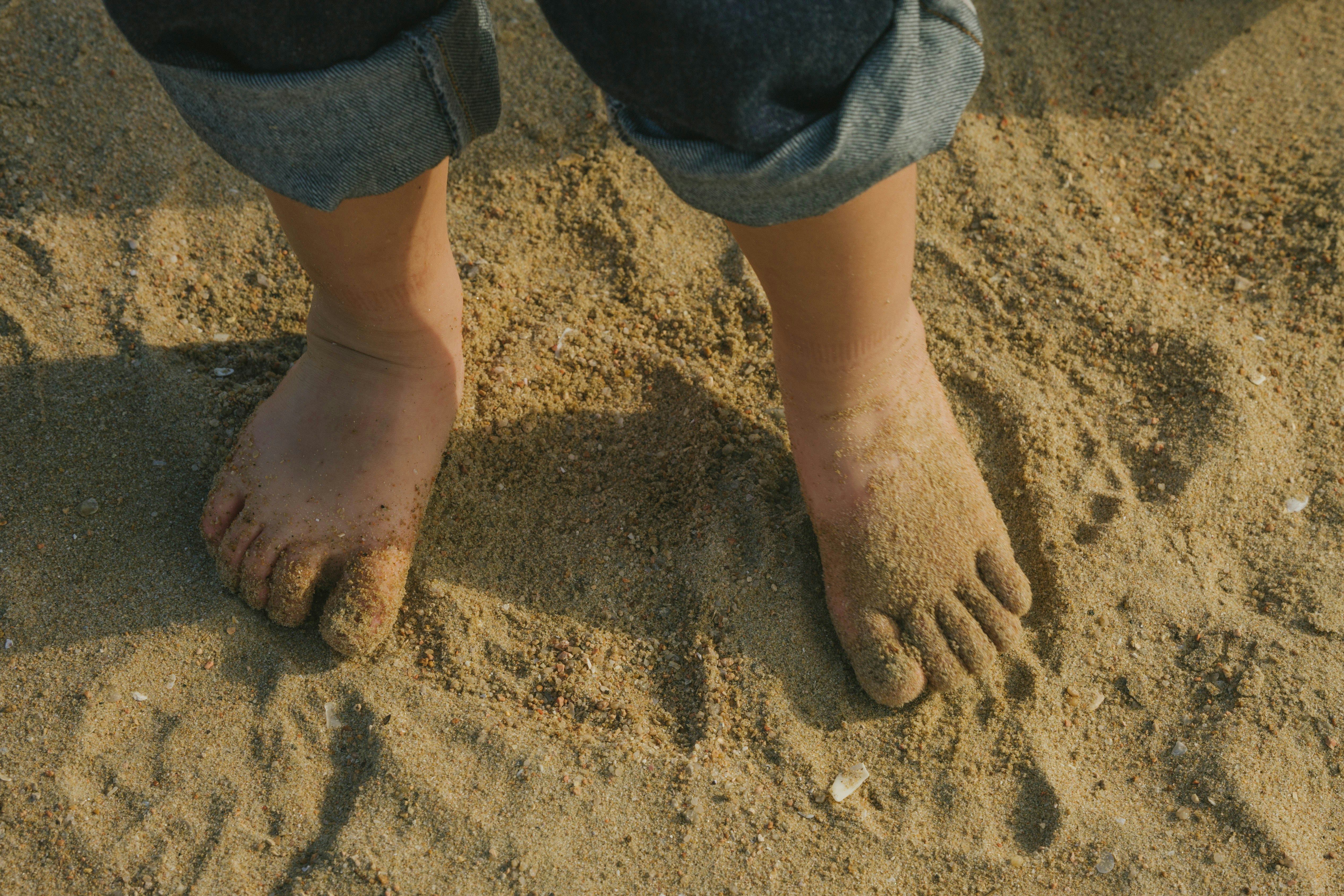
I was blessed to hear that they cared for and championed Justin. We talked about being kind and about playing at recess, and so on. What I’m thinking of is how Curt and Derek “washed” Justin’s feet. Literally washed his feet in a gaga game? No, but they served him by sticking up for him.
What does it look like to “wash feet” at school—students’ feet? parents’ feet? colleagues’ feet? I’ve pondered this since our faculty devotions on this topic. We read from John 13 about Jesus washing the feet of the disciples. How can we apply this example at school? We may give physical service, academic help, or behavioral guidance as our washing of feet. It may be encouragement, parental support, or coaching a new teacher.
Feet washing will be different for different people. This is going to be different for a first grader than for a coach. It will be different for a struggling 7th-grader than for a fellow teacher.
Parent-teacher conferences were approaching at the time we studied this topic in staff devotions. So how can I wash parents’ feet? I can listen during the conference. Sometimes parents just need to talk with someone and share their concerns and worries for their children. I think of Joanne, who related how she had difficulties in school, and is concerned now that her child is having challenges. I will show that I care about their child. I listen as the parents discuss a physical need of their child, and I make a note to myself to remind this child to go to the bathroom (and make sure I do this). I offer a spelling retest for the three children who missed many words on the latest test. I agree to find and print off books for a child to read at home after father says they don’t know what to have him read. (This is washing feet, because I don’t care for this task.) I will communicate with parents, sharing positive aspects of their children as well as areas to reinforce and work on.
I should wash the feet of my fellow-teachers. I may do this by sharing supplies, giving advice and ideas, or planning and taking care of all the parts of a shared field trip. I leave my door open before and after school so I am accessible for a colleague who needs to talk, has questions, or wants advice.
I’ve written before about serving students, but I want to include them, as well. How can I wash the feet of my students? For my first graders, it may be sharpening their pencils, helping them with band-aids, or comforting the homesick child. This one lasted all day. Kari was very “sick” in the morning, and after a while I said, “I know what’s wrong—you’re missing your family.” She agreed and cried. Her parents were on a trip and she was staying with friends, without any of her siblings staying with her. I told her she could come to me when she needed to that day, and she came often for reassurance. I washed her feet many times that day! I may “wash feet” by keeping patience with the child who rarely knows the directions yet confidently goes ahead and does things wrong.
For teachers of older students, you may be listening, advising, helping with a project, tutoring, consoling, working out “girl drama,” attending events in which your students participate, or helping with friendship issues.
Washing feet is thought of as a lowly job. This is a job for the servant! Serving others can be a lowly job. Let’s follow the example of Jesus, as he said, “If I then, your Lord and Teacher, have washed your feet, you also ought to wash one another’s feet. For I have given you an example, that you also should do just as I have done to you.” (John 13:14-15 ESV)
(Credit to Paul Harrison for getting my thoughts going on this topic, and for some of the thoughts in the second and third paragraphs.)

Recess Games for Lower Elementary
Group recess games are a staple of every school playground, but sometimes teachers and students alike can grow weary of playing the same ones over and over again. Here are a few recess games you might consider adding to your rotation.
Johnny Johnny
Materials needed: Two end zones, either opposite walls of a gym or cones/other markers to delineate two safe areas. Ideal spacing depends on group size and age of the players.
Considerations: Can be played inside or outside.
The aim of the game: To be the last player to be caught.
Instructions: Choose one player to be “it.” They will stand in the middle of the playing field, halfway between the two end zones.
The rest of the players will go to one of the end zones. They will then call out in unison, “Johnny, Johnny, may we cross your bridge today?”
The person who is “it” will then respond, “Only if you’re wearing the color ___.” At that point, anyone who is wearing the specified color may cross to the other end zone, unhindered. Anyone who is not wearing the specified colour must wait until the person who is “it” says “Go!” At this point, they must try to get safely to the other side without being tagged. Anyone who gets tagged will then join the person who is “it” in the middle and help them tag players in consecutive rounds.
This repeats until everyone is caught.
Options for variation:
If your group size is large, you may want to choose two people to be “it” to start.
Another twist on this game is to allow the person who is “it” to allow crossing based on something other than color of clothing. They may make up whatever stipulations they want to, such as, “Only if you had cereal for breakfast” or “Only if you have a dog at home.”
Freeze Tag
Materials needed: If outside, a way to mark a contained area, such as the boundaries of a baseball diamond, or a rectangular area marked with cones.
Considerations: Can be played inside or outside.
The aim of the game: To be the last player to be caught and to help free those who have been caught.
Instructions: This game is like regular tag, only when someone is tagged, they must freeze in that position until another player comes and “frees” them by touching them. If a player runs out of the boundary lines, they need to freeze on the line and wait to be freed.
In order to keep the game from extending into infinity, it works well to instill a rule like “If you’re caught three times, you also become ‘it.’”
Options for variation:
If your group size is large, you may want to choose two people to be “it” to start.
Young children may enjoy a twist called “Chicken Tag” (or cow tag or dog tag or whatever animal you want), in which they must cluck like a chicken the entire time they’re frozen.
23 Skidoo
Materials needed: Two end zones, either opposite walls of a gym or cones/other markers to delineate two safe areas. Ideal spacing depends on groups size and age of the players.
Considerations: Can be played inside or outside. We also used to enjoy playing this one while skating on the rink during the winter.
The aim of the game: To be the last player to be caught and to help free those who have been caught.
Instructions: In this game, players try to run from one end of the playing field to the other without being tagged by the one or two people who are “it”. While in the end zones, they are safe and cannot be tagged. If a player is tagged, they must go to the middle of the playing field and stand with their arms outstretched.
Other players can free those caught in the middle by touching their hand or shoulder and counting aloud to twenty-three. If there is danger of being tagged while they are counting, they may run off at any time. At that point, the player who is caught in the middle may call out whatever number the counting left off at (for example “sixteen!”) At that point, any other player who comes to free them may continue counting from sixteen until they get to twenty-three. After the person counting gets to twenty-three, they must say “Skidoo!” at which point the caught person is free to run back to a safe zone and continue playing.
Option for variation: You can instill a rule like “If you’re caught three times, you also become “it.” This helps the game move faster and doesn’t tax those who are “it” as much.
Wave
Materials needed: A cone or landmark (such as a step, post, tree, etc.) to be the home base.
Considerations: Works best as an outdoor game.
The aim of the game: To be among the last players to be caught and to help free those who have been caught.
Instructions: One person is chosen to be “it.” They close their eyes and count to fifty (or some other chosen number) while everyone else runs and hides somewhere nearby. The person who is “it” may circulate freely to try to find people. If they see someone, they catch them simply by calling out their name.
If a player’s name is called by the person who is “it,” they must go to the home base. They will stay there until they see any player who has not been caught waving at them. If they see someone waving, they may run away and hide again. If the person who is “it” is nearby and sees them escaping, they may call out their name again, in which case the player must return to the base and wait to see another wave.
You will want to make it clear that players need to escape within around thirty seconds of seeing a wave, otherwise the wave is “too old” to count anymore.
Choose a certain number of students that the person who is “it” must have caught at one time before the game is over. It usually works best for that number to be around 50-60% of the total number of players.
Tennis Ball Softball
Materials needed:
Tennis racket
Tennis ball
Baseball diamond
The aim of the game: For your team to get the most runs.
Instructions: This is simply a twist on regular softball where the bat and ball are replaced by a tennis racket and tennis ball. This has several advantages, particularly for young students. One is that ball gloves are not needed. Another is that young students can hit a tennis ball with a racket much more easily than they can hit a softball with a bat. This keeps the game moving much more quickly (and makes it much easier for a lone teacher who is often trying to pitch and give batting assistance at the same time!)
This is a perfect way to introduce young students to the concepts of softball rules (how to run around the bases, how to play outfield, etc.) with less stress and hassle than a bat and softball create.
Tubes
Materials needed:
An assortment of balls; dodge-ball type balls work best, though soccer balls could be used as well. You will want somewhere between 10-20 balls.
“Tubes.” You need one tube for each player. These can be created out of a wide variety of materials. My school had large PVC pipe (around 4-5 inches in diameter) cut into chunks, each creating a free-standing tube around 12 inches tall. The same could be done with stiff cardboard tubing. Another option would be going to a department store or flooring store and asking for old carpeting tubes.
Alternatively, you could collect large empty jugs (at least gallon-sized or larger) and use those as your tubes.
A rectangular playing area with a central dividing line.
Considerations: Could be played inside or outside, though a contained space like a gym will more conveniently keep errant balls from getting away.
The aim of the game: To keep your own tube standing and knock down the opposing team’s tubes.
Instructions: The group is divided into two teams. Each team goes to one side of the dividing center line and sets their tube upright on the ground. The balls are placed along the center line. Players are not allowed to cross the center line.
Once the game begins, players may run to grab the balls. They then try to throw them at the opposing team’s tubes and knock them over. Each player is also trying to stop balls from hitting their own tube. If a player’s tube is knocked over, they are out of the game and watch on the sidelines until the game is over (which happens once all the tubes of one team have been knocked over).
Options for variation:
You could also play that once a player’s tube is knocked over, they join the opposing team.
Another variation is to delineate a narrow section at the back ends of the playing zone. When a person’s tube is knocked over, they go to the back end behind the opposing team and try to knock down tubes from there. If they successfully knock a tube down, they may return to their side and set up their tube again.
Photo by Elizabeth Dunne on Unsplash

Union Center Christian School - Teachers needed for 2026-27 School year
Union Center Christian School UCCS is located in Nappanee, Indiana. We are a growing school in the middle of our 3rd year (2025-26) with 65 students enrolled in K-12th grade.
The school is operated by Salem Mennonite Church. It is open to area church families and the community around us. Our goal is to provide a good Christ-centered education for our church families and the families in our community.
For 2026-27 we are in need of a high school teacher and a learning support teacher.
The learning support teacher works in cooperation with the home room teacher to provide specific support and tutoring as required by the student. This includes using the Barton reading program and more.
For more information contact Ken Miller (board chairman) 574-847-1369 or fill out an application here: https://form.jotform.com/231857891291164
Lighthouse Christian School
2026-2027 term
Now Hiring: Inspiring High School Teacher
Join Our Mission. Shape Tomorrow’s Leaders.
Are you a passionate educator who believes teaching is more than a job—it’s a calling? Our private school is seeking a dedicated High School Teacher who is committed to academic excellence, character development, and creating a positive, engaging learning environment for students.
What You’ll Do
• Teach and mentor high school students in a supportive, faith-centered environment
• Inspire curiosity, critical thinking, and a love for learning
• Build meaningful relationships with students and families
• Collaborate with a team of caring, mission-driven educators
• Contribute to school events, activities, and a vibrant campus culture
What We’re Looking For
• A passionate teacher with strong classroom management and communication skills
• Ability to connect with teens and motivate students of varying abilities
• A heart for serving, leading, and helping students reach their full God-given potential
• Energetic, dependable, and committed to excellence
Why Join Us?
• Supportive leadership and a family-like atmosphere
• Small class sizes that allow you to truly invest in each student
• Competitive pay and opportunities for professional growth
• A safe, faith-based environment where values matter
• The chance to make a lasting impact—every single day
⸻
If you’re ready to teach with purpose, we’d love to meet you!
Submit your résumé to [office@crf.farm] or call [618-218-5397]
🎶 Full Time Music and Drama Teacher 🎶
We are looking for a full time music and drama teacher to lead our K-12 students. We would be looking to this staff member to lead a refreshed arts program to instill in our students a love for music and drama. This would include teaching music theory, leading upper school choir, directing drama performances with upper and middle school students, and more! This would be a first full time position at our school so growth and development opportunities would abound. Starting compensation for a qualified candidate would be around $40,000.
2026-2027 High School Teaching Position
Zion Christian School is a small K-12 school located in beautiful Mesopotamia, OH and operated by Zion Christian Fellowship. The projected enrollment for the 2026-2027 school year is sixteen students. We have an experienced teacher who will teach grades two through four. The high school room will have eight high school students and two students in junior high.
We are looking to add to the team of involved parents, school board members, and teachers by hiring a high school teacher. Zion Christian School offers a competitive compensation package and is a well established school that has been operating for over 60 years. If you are interested in this opportunity, we would love to have a conversation with you. Please reach out to Steve Kaufman at (330) 647-1290 or Kenneth Petroski at (216) 502-5287. Email us at kenneth@zcsmiddlefield.org.
6196 results found with an empty search
- The Classroom Melting Pot
The Classroom Melting Pot Leroy Wiens December 13, 2022 Western Fellowship Teachers' Institute 2022 The Classroom Melting Pot Audio 00:00 / 01:04 Download Download God made all these personalities and abilities that walked through your classroom door and into your heart. He is the one that will give you the wisdom and the recipe to make a delectable stew without it boiling over. Download Facebook X (Twitter) WhatsApp LinkedIn Pinterest Copy link Leroy Wiens
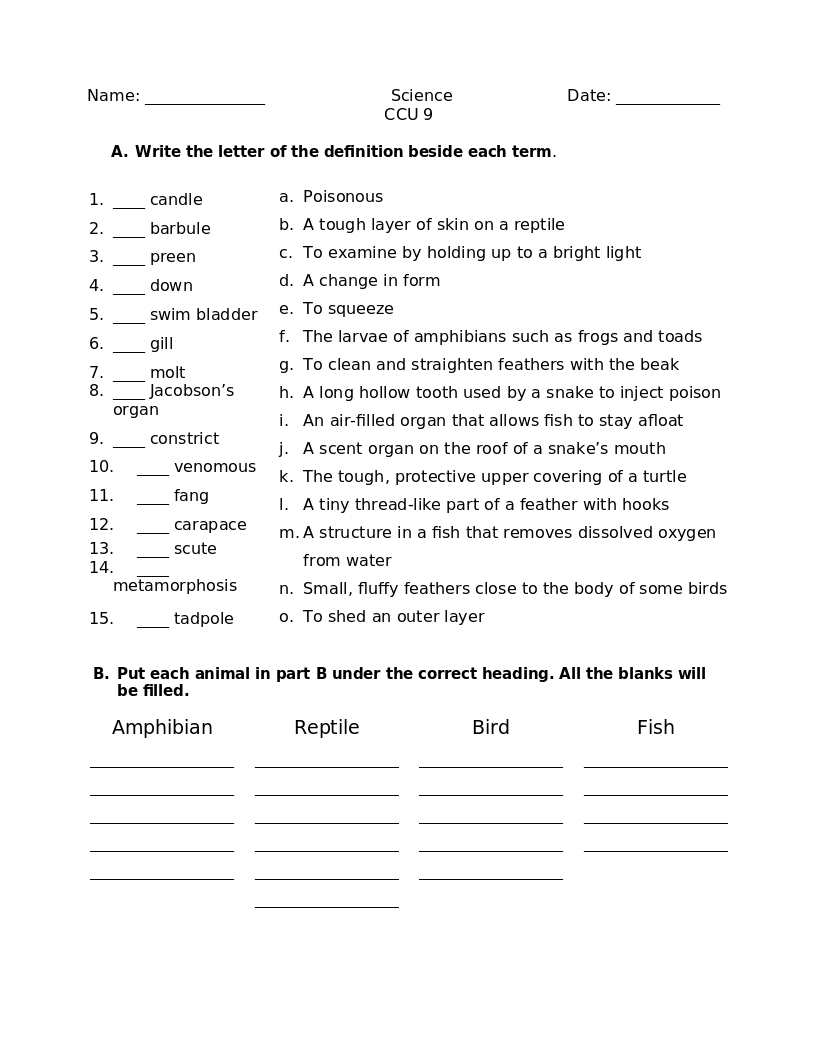
- A Beka 5th Grade Science Chapter Checkup 9
A Beka 5th Grade Science Chapter Checkup 9 Karen Nolt February 12, 2020 Materials for A Beka Grade 5 Science A Beka 5th Grade Science Chapter Checkup 9 Document 00:00 / 01:04 Download Download A chapter checkup worksheet for A Beka 5th Grade Science, chapter 9. Whileit is mostly dependent on the student textbook, it includes additional review of terms and definitions. Download Facebook X (Twitter) WhatsApp LinkedIn Pinterest Copy link Karen Nolt
- Review for Grammar and Composition Test 25
Review for Grammar and Composition Test 25 Lucy Miller July 16, 2020 Study Guides for A Beka Grammar and Composition Review for Grammar and Composition Test 25 Document 00:00 / 01:04 Download Download This study guide prepares students for two quizzes and a test in A Beka Grammar and Composition on grammatical terms and definitions. Download Facebook X (Twitter) WhatsApp LinkedIn Pinterest Copy link Lucy Miller
- Building Reading Skills
Building Reading Skills Susan Hofer January 7, 2022 Western Fellowship Teachers' Institute 2021 Building Reading Skills Audio 00:00 / 01:04 Download Download Reading is an extremely important part of our education. How can lower-grade teachers and middle grade teachers give students tools they need to be good readers? Download Facebook X (Twitter) WhatsApp LinkedIn Pinterest Copy link Susan Hofer
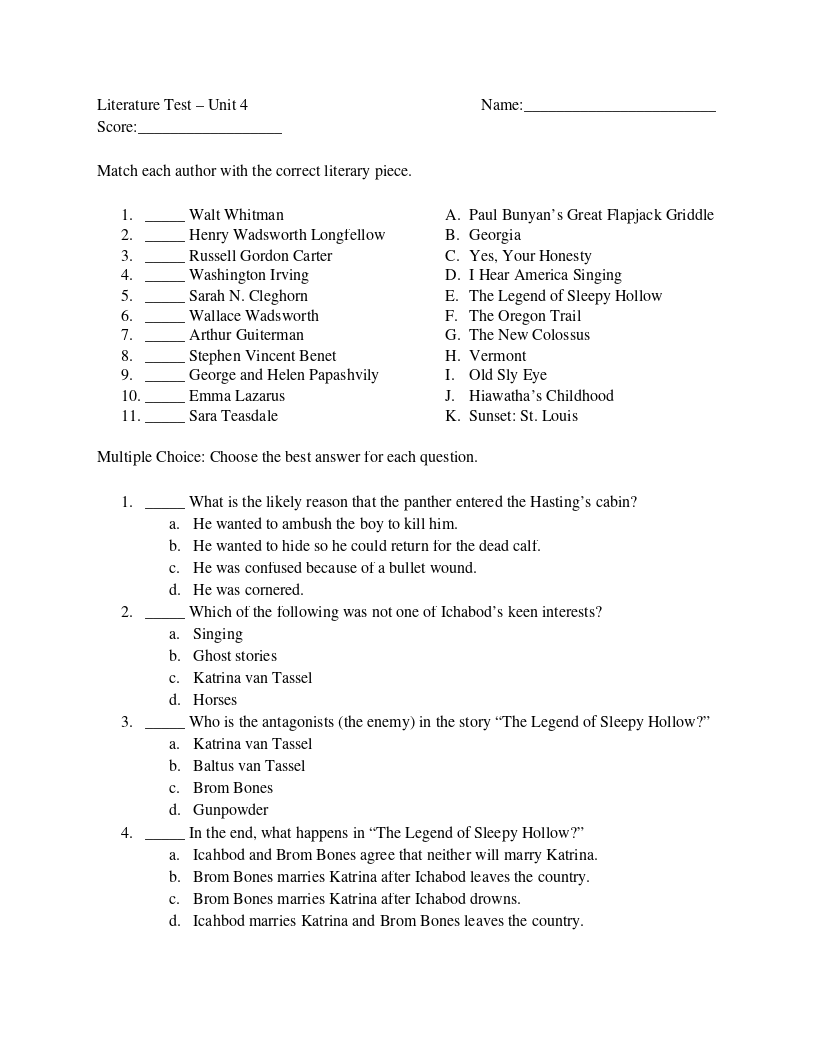
- Literature Test Of Places Unit 4
Literature Test Of Places Unit 4 Erikson Lehman August 7, 2019 Tests for A Beka Of Places Literature Test Of Places Unit 4 Document 00:00 / 01:04 Download Download A test for eighth grade Abeka Literature, unit 4. Students are tested on literature stories and poetry that happened in America. Download Facebook X (Twitter) WhatsApp LinkedIn Pinterest Copy link Erikson Lehman
- Establishing School Absence Policies
Establishing School Absence Policies Mr. Wesley Gingrich, Administrator March 8, 2018 CASBI 2018 Establishing School Absence Policies Audio 00:00 / 01:04 Download Download Wesley discusses fair and understandable school absence policies, and walks through responses to possible scenarios. Download Facebook X (Twitter) WhatsApp LinkedIn Pinterest Copy link Mr. Wesley Gingrich, Administrator
- May 2024 Progress Report
May 2024 Progress Report The Dock May 17, 2024 May 2024 Progress Report Update 00:00 / 01:04 Download Download The Dock was first released in 2016, and after an initial growth burst has seen mostly steady year over year increases in traffic. That trend continues, with modest increases in the use of the site over the past quarter. Part of this increase seems to be driven by more people finding helpful content that was published years ago. We released two new videos during this period: Teachers are Mentors and Wonder through Science. We are grateful for the work of our bloggers' group: Rosalie Beiler, Arlene Birt, Karen Birt, Chris Brode, Carolyn Martin, and Deana Swanson. Trent Clugston recently joined this group, and we look forward to his insights on school management. Looking ahead In the coming months, watch for an announcement of a new podcast for administrators. We also anticipate releasing more videos and experimenting with highly usable summaries of key teacher information. Analytics Financial report Fiscal year-to-date summary (July 2023–March 2024) Year to date Budget % of Budget Beginning balance ($2,009) Income $31,074 $35,000 88.78% Expenses ($34,715) $35,000 99.19% Net income ($5,650) Due to rounding, numbers may add up differently. Expense breakdown (January–March 2024) Payroll $9,609 Blog posts $235 Developers $32 Tech infrastructure $258 Office expenses $610 Total $10,744 Due to rounding, numbers may add up differently. Download Facebook X (Twitter) WhatsApp LinkedIn Pinterest Copy link The Dock
- TEAM Week
TEAM Week Kendall Myers October 3, 2017 TEAM Week Blogpost 00:00 / 01:04 Download Download Every February, our school takes a week to focus on an idea, value, or skill that we want to develop in our school. Our regular classes continue throughout the week for the most part, but we make room in each day for some special activities that are designed to cultivate awareness and skill in the area of focus. This past year, we chose teamwork as our special emphasis. We used TEAM with this acronym: T -together with God, together with each otherE -everybody mattersA -accept yourself, accept othersM -maximize the people around you We recited these ideas collectively often throughout the week and discussed their implications in a number of different sessions. However, believing that experience shapes people more deeply than words, we put more emphasis on group activities that would teach these lessons rather rely on talks and lectures. Some of the activities that we used to communicate and reinforce the values of teamwork were lowering the hoop, blind men’s egg hunt, faith fall, unity line at lunch, running laps together as teams, burning boat activity, blindfolded wheelbarrow race, photo scavenger hunt, and cracking the code. Each of these activities was tied to specific values and skills that are essential to teamwork. They were concepts such as: everybody matters everyone is included we do things together we listen to other people we are willing to help and be helped we look out for each other we serve each other we hear from other perspectives before making decisions everyone talks and everyone listens we submit to one another we follow instructions we recognize that everyone needs to play their part and sometimes that is leading, sometimes that is following. We learned that encouragement and affirmation is critical for progress. Many tasks require extensive brainstorming and creative thinking. It is important to stay on task without complaining even when the job becomes tiresome and frustrating. Everyone needs to stay with the group even when they feel like being alone or checking out. We must choose and support leaders. What we discovered was that the week of focusing on TEAM was one big lesson in church brotherhood. As we practiced the activities, we became aware that these skills are just as vital to successful living as anything academic in our curriculum. This is an area that we knew our school needed to major on. The intense emphasis for a short period of time left us looking other opportunities to develop in this area. If you are interested in more information about our experience, please contact me. Schedules, descriptions of activities, and written procedures are available for your use. Contact Kendall Myers via private message (you'll have to be logged in), or email him at myerskendall at gmail dot com. Download Facebook X (Twitter) WhatsApp LinkedIn Pinterest Copy link Kendall Myers
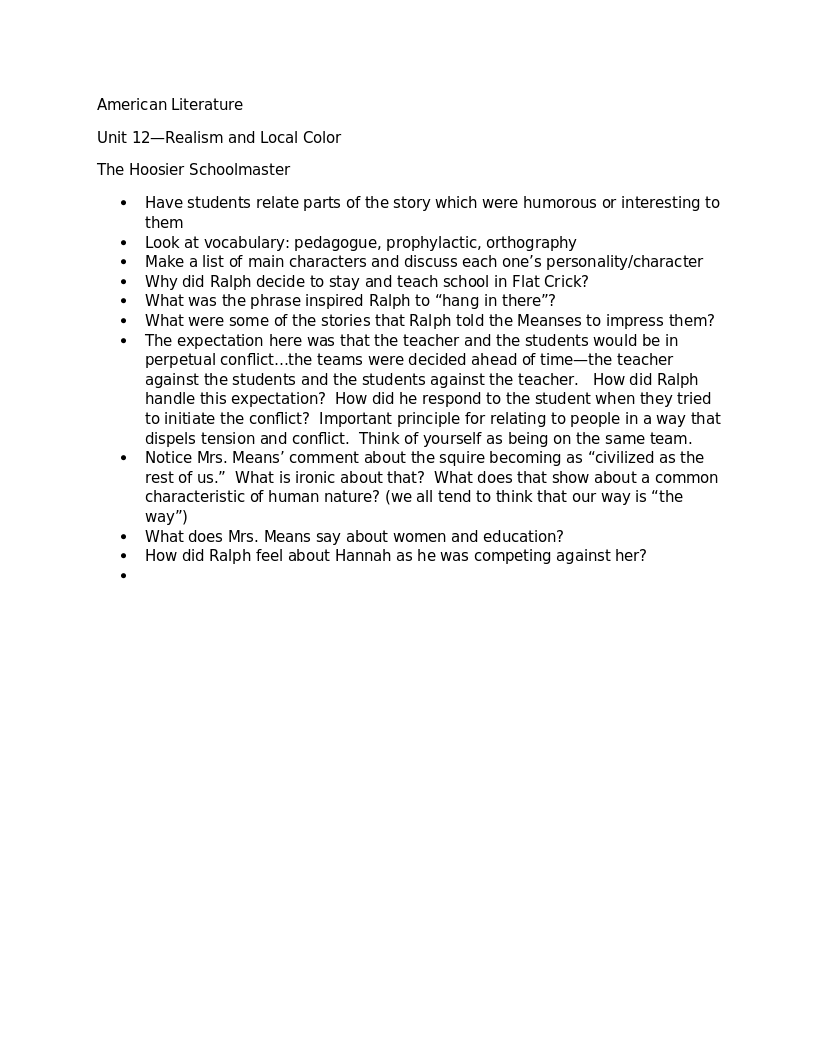
- Notes for Unit 12 of A Beka's American Literature
Notes for Unit 12 of A Beka's American Literature Kendall Myers May 10, 2017 Notes for Unit 12 of A Beka's American Literature Document 00:00 / 01:04 Download Download These are teacher's notes for "The Hoosier Schoolmaster" in A Beka's 11th grade American Literature. Download Facebook X (Twitter) WhatsApp LinkedIn Pinterest Copy link Kendall Myers
- Yukon PowerPoint
Yukon PowerPoint Delores Mast July 7, 2021 Provinces of Canada PowerPoints Yukon PowerPoint Document 00:00 / 01:04 Download Download A PowerPoint presentation on the Yukon Territory. Presentations in this series were created with the Living History Threads curriculum (Level 43) in mind, but they can also be used more generally. Each presentation covers a single Canadian province or territory, including quality photos of primary geographical features, capital city, and one or two visuals for a key historical event or other item of interest. Download Facebook X (Twitter) WhatsApp LinkedIn Pinterest Copy link Delores Mast
- Respect: Its Building Blocks
Respect: Its Building Blocks Neal Hackman September 27, 2019 Western Fellowship Teachers’ Institute 2019 Respect: Its Building Blocks Audio 00:00 / 01:04 Download Download In spite of current trends, respect is not out of date. All of us are called to treat one another with respect. In these three sessions, Neal explores practical and motivational aspects of this basic principle of relationships. Download Facebook X (Twitter) WhatsApp LinkedIn Pinterest Copy link Neal Hackman
- Wonders of the Deep (Pete Peters)
Wonders of the Deep (Pete Peters) Pete Peters April 10, 2017 CLE Workshops 2015 Wonders of the Deep (Pete Peters) Audio 00:00 / 01:04 Download Download Pete explores the glories of God displayed under the surface of the world's oceans. Courtesy Christian Light Education (CLE). Download Facebook X (Twitter) WhatsApp LinkedIn Pinterest Copy link Pete Peters
- A Slice of the Pie
A Slice of the Pie Marcus Kauffman July 20, 2022 REACH 2019 A Slice of the Pie Audio 00:00 / 01:04 Download Download We women have many competing demands for our time and emotional energy. Relationships are important to us. Family, church, ministry, and community responsibilities stretch us thin. How do we enjoy our pie, one slice at a time? Download Facebook X (Twitter) WhatsApp LinkedIn Pinterest Copy link Marcus Kauffman
- Defining Integrity (John Coblentz)
Defining Integrity (John Coblentz) John Coblentz October 16, 2012 Teachers Conference 2012 Defining Integrity (John Coblentz) Audio 00:00 / 01:04 Download Download Integrity begins with the God who embodies truth. We show integrity when our words and actions come out of the truth of our soul. Download Facebook X (Twitter) WhatsApp LinkedIn Pinterest Copy link John Coblentz
- Twice Freed Chapter 06: Visual on Temple and School
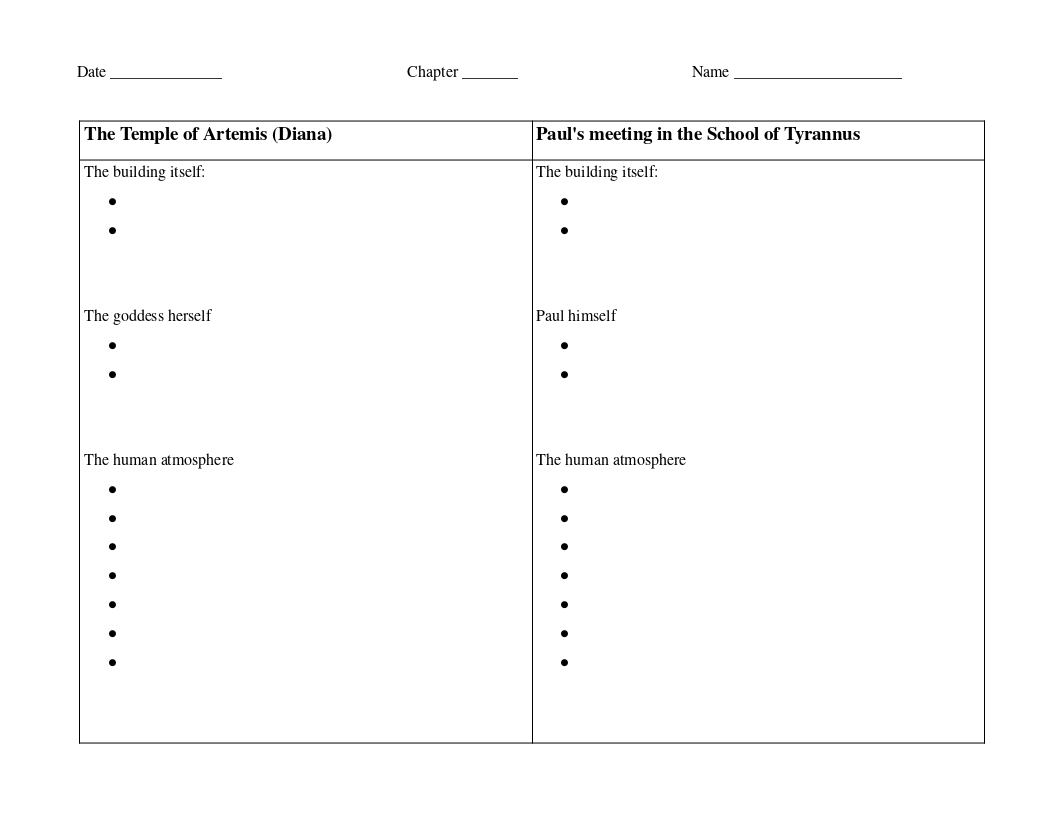
Twice Freed Chapter 06: Visual on Temple and School Betty Yoder February 8, 2017 Resources for Twice Freed Twice Freed Chapter 06: Visual on Temple and School Document 00:00 / 01:04 Download Download A chart to help students compare and contrast the temple of Diana of the Ephesians with Paul's teaching sessions in the school of Tyrannus. Download Facebook X (Twitter) WhatsApp LinkedIn Pinterest Copy link Betty Yoder
- Twice Freed Chapter 03: Who is Guilty?
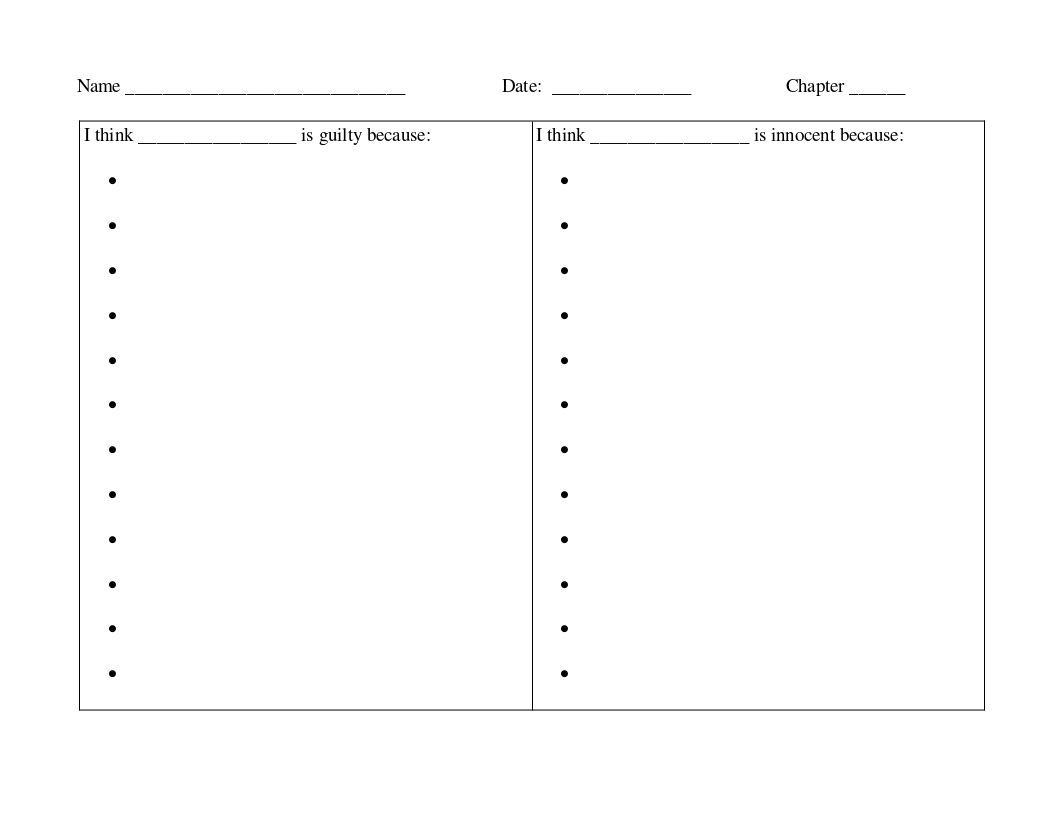
Twice Freed Chapter 03: Who is Guilty? Betty Yoder February 8, 2017 Resources for Twice Freed Twice Freed Chapter 03: Who is Guilty? Document 00:00 / 01:04 Download Download A simple "Who is Guilty?" activity chart for chapter three of Twice Freed by Patricia St. John. Download Facebook X (Twitter) WhatsApp LinkedIn Pinterest Copy link Betty Yoder
- I Have a Question!
I Have a Question! Arlene Birt October 22, 2020 I Have a Question! Blogpost 00:00 / 01:04 Download Download “Mrs. Birt, I have a question!” Nelson called out. Nelson has many questions. When is God’s birthday? What does God look like? What is your name? (It is not Mrs. Birt!) I appreciate when children ask questions as they are learning and show that they are curious and wondering about their world. Children sometimes ask questions when I am reading aloud. “What is a coyote?” “What does ascend mean?” They ask questions related to our lessons. “Why does ‘know’ have a ‘k’?” Asking questions helps them learn, aids in clarifying information, and gives information. How do teachers handle questions from children? Sometimes I will ask them to find the answer. Renee asks, “Where do I put this paper?” I tell her to read the morning list: “You will find the answer.” I may direct students to reread a page or story to find the answer to a question. I may say the answer. Maybe I don’t know the answer, so I tell them I will look it up. (I need to make a note of the question, so I remember to do that!) We can then have a brief lesson on what I find. Currently I have it on my list to find out how large zebra’s eyes are! Questions are also a good teaching tool. Teachers ask high-quality questions of their students to spur thinking, begin discussions, direct understanding, and engage students. Questions are a great method of assessing knowledge retention. We are studying “Questions and Questioning” in our staff professional development sessions and thinking about the kinds of questions we ask and how we can use questions to grow in our teaching. Some questions are used for classroom management, while other questions ask for information recall, and we need these types of questions. However, for learning purposes, we want to have higher-level questions to develop deeper thinking. Looking at Bloom’s Taxonomy (table below) can help in developing higher-level questions. The words in the taxonomy can be used to plan quality questions and aid in higher level thinking. On the Evaluation level, use the “trigger words” to create questions of assessing, evaluating, or defending. You can ask students to support their answers with evidence from the text, as on the Analysis level. Table from Doherty, J. (2017). Skilful questioning: the beating heart of good pedagogy. Impact Journal of the Chartered College of Teaching. One of our PD activities was reading a text and coming up with good questions. We then asked a colleague to evaluate our questions. I realized that I need to plan ahead on questions. I need to write the questions ahead of class and not try to come up with good questions while I’m teaching. Teachers may write questions on the board and have students discuss them with a partner for a few minutes before writing or sharing their answers. The students may be required to give evidence to defend their answers. Questions may be used to drive a class discussion, or be included as part of a test or used for morning work. Students may be directed to write the questions. Here are some strategies for using questions (adapted from Doherty, 2017): On the Hot Seat: Students take turns sitting in the ‘hot seat’ and answering questions. Ask the Expert: The teacher asks questions of a student on a given topic, and encourages other students to also ask questions. Ask the Classroom: Display questions to encourage thinking about pictures or objects in the classroom. Phone a Friend: A student calls on a fellow-student to answer the teacher’s question. The first student also gives an answer. Eavesdropping: The teacher circulates in the classroom, listening in on groups, and asking questions based on their discussions. Question Box: The teacher has a box containing a series of questions. At the end of the day, or end of the week, take some time to choose a few questions for class discussion. What is the question? Provide the answer, and encourage students to determine the question. High-quality questions are powerful teaching tools. Let’s learn how to use them well! Download Facebook X (Twitter) WhatsApp LinkedIn Pinterest Copy link Arlene Birt
- Sexual Addiction among Us and the Way Forward
Sexual Addiction among Us and the Way Forward Arthur Nisly October 6, 2025 REACH 2022 Sexual Addiction among Us and the Way Forward Audio 00:00 / 01:04 Download Download Arthur Nisly addresses the pervasive issue of sexual addiction within conservative Anabaptist communities. He describes it as a powerful "tsunami" and a hidden "internal bleeding," emphasizing its devastating impact and the urgent need for action. He offers a message of hope, drawing on biblical teachings and his mentoring experiences to advocate for compassionate support, open dialogue, and practical steps toward freedom and restoration for those struggling. "Sexual Addiction among Us and the Way Forward" was presented at Reach 2022 by Arthur Nisly. Download Facebook X (Twitter) WhatsApp LinkedIn Pinterest Copy link Arthur Nisly
- Outline 49 Student
Outline 49 Student Peter Goertzen November 25, 2017 Church History 7: The Church in Modern Times Outline 49 Student Document 00:00 / 01:04 Download Download This student handout ties with the lesson outline focusing on American Christianity in the 21st centry. Because of increasing secularization in mainstream churches, many people have become disallusioned with Christianity. Evengelicals have become the most visible church, offering a firm spiritual foundation and promoting traditional morality. The emergent church movement has arisen emphasizing loving relationships with God and with others. Download Facebook X (Twitter) WhatsApp LinkedIn Pinterest Copy link Peter Goertzen
- Refreshments Will Be Served
Refreshments Will Be Served Arlene Birt July 20, 2018 Refreshments Will Be Served Blogpost 00:00 / 01:04 Download Download “Refreshments will be served.” Sometimes we hear this announced in regards to a meeting or event. Refreshments are not something I’m very good at. I don’t always think ahead, or I wonder, “What can I do quickly?” Serving refreshments can be a good means of fellowshipping or making the event a little more special. How about refreshment of the soul? I love my job and the work that goes with it, but it is good to have a time of refreshment. My mind and spirit need to be refreshed after a busy school year. One of my friends commented, “I’m sure you’re enjoying your summer break from school. It’s always good to have that time of refreshment.” I’ve been pondering this kind of refreshment. Yes, the summer should be a time of refreshing. What is this kind of refreshment? It’s easy to think, “Oh, I must do this—I need to get that done,” and just keep going with a busy schedule. One day during this summer vacation, I thought, “I’m tired. Maybe I’ll take a nap.” My next thought was, “No, I shouldn’t do that. I need to do ___________.” I stopped, and told myself, “It is summer vacation. I can take a nap!” So I did. I don’t mean to endorse laziness, but teachers do need to take some time for refreshment, for rejuvenation, for reviving. We work hard through the school year, and I had a goal of going strong until the very end. Now I need refreshment so I can be motivated to start the new school year well. I especially need the time of spiritual refreshment. I think of the verse from Acts 3:19, “when the times of refreshing shall come from the presence of the Lord.” I am refreshed as I take time for prayer and Bible study. I am refreshed as I stop working outside, sit on the bench, and just enjoy the lovely evening with its vibrant colors. Praising God in song or prayer as I enjoy His creation is refreshing. How can I find times of refreshment? At one point today when I looked at the clock, I realized, “It doesn’t matter what time it is. I have nothing scheduled for today.” I think that is refreshing, to lay aside the deadlines and schedules, busy-ness and appointments, and just go through the day. I am refreshed by being outside and working in the dirt and with the flowers. I like to pull weeds (except for that poison ivy!) and plant flowers, and watch the growth in the gardens. Often in the evening I walk around the yard and look at all the blooming plants and enjoy my Father’s creativity. Being outside watching the sky, clouds, breeze, moon, sunrise and sunset, a storm rolling in—these are times of refreshment. I keep an “Inspiration” file and it is refreshing to look back on the notes, letters, stories, quotes, and verses that I have collected. I find it refreshing to organize my folders and files at school and find ideas that I want to try and to feel like I have it together if only for a few weeks! Now I will “serve” some refreshments, a list of ideas for refreshment for your summer! Physical activity: mowing the yard, doing some extra cleaning, taking the dog for a walk Work on a hobby: coloring, making cards, sewing, painting, woodworking, gardening. Listen to music, podcasts, video clips. Travel! See a new part of the country, interact with a different culture, visit friends and family, take a personal retreat. Help someone: babysit, do chores, share advice and ideas, do something extra for Sunday School. Work ahead on a school project (This might not sound like refreshment, but it is nice to know that I have this ready prior to school beginning, so that is refreshing!) Take a nap, and don’t feel guilty. J Go for a drive and notice the surroundings. Read a book that is not about teaching or school. Plan a new unit and gather materials for it. Test a new field trip destination. Reflect and remember from the past year: the blessings, how God brought me through, what I want to do better next year. Learn something new: a hobby, a different skill or strategy for school, a new recipe. Spend time with friends and family. Today was refreshing for me. I slept in a bit, caught up on a number of little odd jobs that don’t get done during the school year, reviewed some Bible curriculum, sewed, worked outside, read, made scones for lunch, and now I’m baking chocolate chip cookies. I’ve been home all day, which doesn’t happen too often, and that was refreshing. Chocolate chip cookie, anyone? Download Facebook X (Twitter) WhatsApp LinkedIn Pinterest Copy link Arlene Birt