
All Content
Effective Instruction in the Classroom
�Effective instruction practices are an integral part of effective behavior management practices� (Sprick, 2006). Effective instruction influences student behavior and will prevent much misbehavior. When students are engaged in meaningful tasks, they have no time for misbehavior. When students succeed, they feel a sense of accomplishment which motivates them to behave in a responsible manner (Sprick, 2006).
A behavior problem may be an instructional problem. A good behavior plan can prevent many problems, but teachers need a good lesson plan, which will help prevent misbehavior from boredom or frustration (IRIS Center). Students with higher levels of problem behaviors may have difficulty meeting the academic and social requirements of the classroom, which leads to their inappropriate behavior. The teacher should make the demands in the classroom environment more learner-friendly to help decrease problem behavior.
Teachers must consider students� individual interests, talents, personalities, and motivation levels when planning instruction. In choosing an activity, teachers should think through its qualities and appropriateness in terms of management, and make sure it contributes to learning and engagement. It needs to involve students in a meaningful way (Maclennan, 1987). Teachers can use differentiation to ensure that students at all levels grow in learning. Teachers should seek to understand students� readiness, use flexible instruction and continual assessment, and remember that students learn at different rates and in different ways. They might use an alternative method of doing a standard activity, alter the sequence of activities, or adapt an activity (Maclennan, 1987).
The teacher can implement effective instruction in their presentation style and require active involvement of students, which encourages a high success rate for students. Varying your voice tone, using humor, varying the intensity, clarifying the purpose of the lesson, and clarifying the information presented will aid the presentation. Keeping students engaged by using questions, brainstorming, working in pairs, assigning small independent tasks, sharing personal examples, doing role-play, and using visual aids and guided practice helps students to stay involved. Students should receive immediate feedback on their performances (Sprick, 2006).
Some strategies that can be used effectively with all grades and in all areas and are backed by research are:
- Compare/Contrast strategy
- Jigsaw strategy
- Window Notes
Teaching students to identify similarities and differences is the single most effective way to raise achievement (Silver, 2007). The Compare/Contrast strategy assists in this as students compare and contrast two separate objects, concepts, or readings. The purpose is established, points given for analysis, and criteria used in describing each item. The teacher establishes a purpose, gives points to analyze, and gives criteria to describe them. Students use a comparison organizer to distinguish between the two objects and record similarities and differences. The process is discussed with synthesis questions and students are led to do this independently.
The Jigsaw strategy is an effective cooperative learning strategy and teaches research, communication, planning, and cooperative skills. The students are put in teams with each child becoming an expert in one aspect or subtopic of the content. The experts in each area work together to research their subtopic and work within their expert groups to plan to teach what they have learned. They teach their parts to their Jigsaw teams and learn about the other subtopics from their Jigsaw team members.
The Window Notes strategy helps with comprehension as students think while they read and learn. When they use Window Notes, students draw a window shape and place one topic in each �pane� of the window, using this form to take notes. They write in panes topics such as �Idea�, �Feeling�, �Question�, and �Fact� (Silver, 2007 ). �They reflect on and improve their performances as learners and give words to their own ideas, feelings, questions, and associations. Window Notes does away with the boredom of copying or taking notes and helps students to be actively engaged in collecting and recording ideas. It also gives the teacher insights into students� minds and learning.
A nonstrategic approach to instruction is unfair to students, bringing on boredom, frustration, and needless difficulty in achieving success (Silver, 2007). Teachers must use a variety of strategies so all students can get what they want and need.
Professional Development Questions:
- What strategies will actively involve students in their lessons? Choose a new strategy to try this week.
- How can you design the curriculum of the classroom to enable student learning? Consider sequence, pacing, student needs, group needs, content, learning activities, and media.
References
Maclennan, S. (1987). Integrating lesson planning and classroom management. ELT Journal
Silver, H., Strong, R., & Perini, M. (2007). The strategic teacher. Alexandria: ASCD
Sprick, R. (2006). Discipline in the secondary classroom. San Francisco: Jossey-Bass
The IRIS Center modules. Retrieved from The Iris Center
The Summer Bucket List for the Teacher
At the end of a school term, I sent off my students with a list of fifty tasks to complete over the summer. Certainly they were all optional, and some were more educational than others. This year, I want to give you as a teacher a bucket list for the summer. It will not include fifty tasks, and you will find yourself being drawn to some of the tasks more than others. It is an optional list to stimulate your thinking about ways that you can refuel before the new school term starts.
Relax & Rest
Teaching is a demanding vocation. While some may consider it an 8:00 AM to 3:00 PM job, anyone who has had the responsibility of educating young people on their shoulders knows that teachers are constantly planning, thinking, and preparing. You spent evenings attending parent teacher meetings and conferences and compiling report cards. You spent mornings in prayer, running through your day mentally as you drove to school, and double-checking to make sure that you had all your supplies and props on hand for the lessons that day. You spent afternoons checking student’s assignments, planning lessons, and agonizing over accommodations and support for your struggling students.
To successfully pass students on to the next grade level is an accomplishment. It is worth taking a break to simply relax and have no one to worry about except yourself. On that final day of school, you suddenly went from being responsible for twenty (more or less) students’ education to only being responsible for yourself.
Bask in the weight being lifted off your shoulders.
Refocus: What Is Your Purpose?
Certainly, we are all called to be Kingdom builders. We all have that broader purpose. However, what is your individual purpose within the Kingdom of God? What talents, gifts, passions, and personality has God given you in order to accomplish a certain role in His Kingdom? Take some time to focus on yourself—not for the sake of becoming self-centered, but so that you can better fulfill God’s purpose for your life.
If you do not already know the following, take some time to delve into each of these areas. If it has been more than five years since you analyzed these areas of yourself or if you have encountered a career/area of residence change, take the time to re-assess now. Your new situation may be calling out new giftings, a slight change of personality, or a different purpose for this season in your life. Find others who know you well to give you input as well, because you may find that others are able to assess you more accurately than you are able to assess yourself.
- Spiritual giftings. What are your top three? How are these gifts evident in your classroom? What is a gift that you would like to have? Are there ways in the next school term that you can work on developing this gift?
- Personality. Take a personality quiz or assessment such as the DISC, Enneagram, or the four temperaments test. What are your strengths? What are your weaknesses? How does that play into your current vocation as a teacher? Who do you find yourself communicating well with/not so well with? What can you do about it?
- Passion. What do you care deeply about? Who has God given you a burden for? What dreams, desires, and visions has God placed on your heart? Is there a step that you can take during this coming school term that will kindle that passion and draw you closer to that dream?
- Past Experiences. What has God called you to so far? What have you been involved with? How have those experiences grown and shaped you into the person you are today? What assets do you have because of those experiences? What in those experiences has been detrimental to you?
After taking some time to consider the above areas, can you complete the following statement?
“I am called to ______________ (action word) using _________________ (your spiritual gifts) in order to focus on _______________ (your passion) expressing through _____________________ (particular ministries that I am involved with) so that ______________________ (what is accomplished) in the Kingdom of Heaven.” (Showalter, 2018)
And if you have not chosen a life verse or a verse for this season of your life, now is the time to find it.
Refill and Receive
Go on an adventure. Travel. Take a road trip. Visit a continent that you have not explored yet. Visit a local museum. Become a tourist in your home area. During the school term, you focus on the education of your students. Now is the time to focus on your education. You have spent nine months out of the year investing in others’ brain development. Now is the time to invest in your own brain development. How do you plan on teaching your students about both the Kingdom of Heaven and the world the King has placed you in if you are not a life-long-learner of them yourself?
You have spent the majority of your days giving—instruction, correction, encouragement, and reproof. Now is your time to receive.
Ideas for refilling:
- Spend ten minutes a day learning the language of your choice via Duolingo
- Attend your church’s revival meetings or Summer Bible School as a student
- Go to music camp
- Spend six weeks out of your summer at Faith Builders to develop yourself as a teacher
- Find someone local to teach you how to play an instrument
- Take a cooking course
- Read books geared toward teacher growth and development
Revise and Renovate
Now that you have taken some time to relax, refocus, and refill, now is the time to revise. What worked or did not work from the past year? What should you tweak or completely revamp? What can you do differently to approach the math concept that most of the students never truly mastered last year? When you are in the middle of the school year, there is little time and energy to invest in thorough curriculum development and revamping. Now is the time to tackle that project. Is there one unit or one subject matter that you could rework now?
While changing the décor or organization of your room is more evident to the eye on the first day of school, true teacher growth comes about in the critiquing, editing, and revising of the content that you will be teaching throughout the year.
After you have spent adequate time revising what you will teach, then you can spend time renovating where you will teach.
Renovate your classroom:
- Organize and Declutter. Are you still keeping filing cabinets full of lesson plans or extension activities that the teacher fifteen years ago filed away in hopes that some day maybe you will find them useful? If you have taught two or more years and have not used an item that is taking up space in your classroom, now is time to either use it or let it go.
- Analyze your space. Are you making the best use of the space available to you? Could your classroom benefit from a more open plan? Do you need an additional bookcase or storage area? Is there any way to minimize the eye-sore in the corner? Where will your visiting parents sit? Where is the ideal spot for your desk? If your desk is in the back of the room, would a podium or rolling cart be the best for you to teach from? Organize the desks. Will your students work best in individual rows or as pairs or in groups? Can you arrange the seating areas in such a way that you can easily alternate between individual seating, paired seating, small group, and large group?
- Critique your classroom décor, posters, and bulletin boards. A mixture of aesthetic and educational is preferable. But often, classrooms can tend to be more aesthetic than educational or more educational than aesthetic. Which of those two areas does your classroom need more of?
- Give your students something to look forward to entering. I well remember the palpable excitement of the great revealing as an elementary student. There were several teachers who always had the most eye-catching rooms, and I looked forward to seeing how they had transformed the classroom for the year. And, as a teacher, I loved to watch the students excitedly roam from room to room during the first week of school commenting on the changes since they last saw the room in the spring.
We have heard it said that teachers teach for three reasons. Some for the enjoyment and love of the content that they teach, some teach for the relationships and interactions with students, and some teach for June, July, and August! I sincerely doubt that you are a teacher who teaches only for the love of summer vacation. However, it is here now, and it is a good thing. Use it to your advantage and personal growth.
Source:
Showalter, C. L., & Showalter, N. D. (2018). Discovery Handbook. Lancaster, PA: LMC.

Line by Line: Memorization as a Daily Rhythm
The other day, I heard one of my students out on the softball field. He was kind of repeating lines from the poem we had just said.
Recently, I read an article about poetry memorization. Last year, I had read poetry some to them so I thought about how I could use it more in my classroom this year. I started out with thinking about the importance of reading poetry to my students and modeling it being read well.
Well, it doesn't work well when you have a poem and you say, "All right, everyone. I want you to memorize this poem," and you hand out copies of the poem. Students are typically more or less excited about sitting down and memorize the poem. Like, "I have homework tonight. I have to sit down and memorize this piece of poetry."
So the way I do it in my classroom is I find a poem that I would like to have my students memorize and I hang it from my classroom door. During transition times, I will say a line of the poem and they repeat it after me. What I find is that they typically will respond in the same way that I have said that line. They're using my voice inflections, expressions, and so forth, which they enjoy because they get to say it like they're crying or say it loudly, and it's a part of doing it together. I would think about it as an"I say, you say," type of thing.
The poem that we're working on this month is called How The Leaves Came Down by Susan Coolidge. It's one that goes with our season right now. They think about how the leaves came down from the great tree and how they were sad.
So, I have my students line up before we go out for recess, before we go anywhere pretty much, we line up and get ready to go. So, we might be waiting on a student yet, and then I'll just start saying lines from the poem, and they'll repeat them after me. It's a way of using those down times where things can degenerate quickly if we're not doing something profitable. They use them to memorize poetry, and it's amazing how well they can memorize. They don't even think about it that: "I'm memorizing a poem."
My goal this year is to have about one or two pieces of poetry per month that we memorize. Then we occasionally come back and repeat the one from the month before. Then after that, what I did this past month was, I opened it to my students and I asked them if any of them would like to come up front and recite the poem for the rest of the class, and I had various volunteers that wanted to do that. I'm thinking more about, “How can my students present what they've memorized?” It could be at a parent event, or even to have some of my students go into the first and second-grade classroom and recite the poem that they've learned.
Living History Threads Worksheets
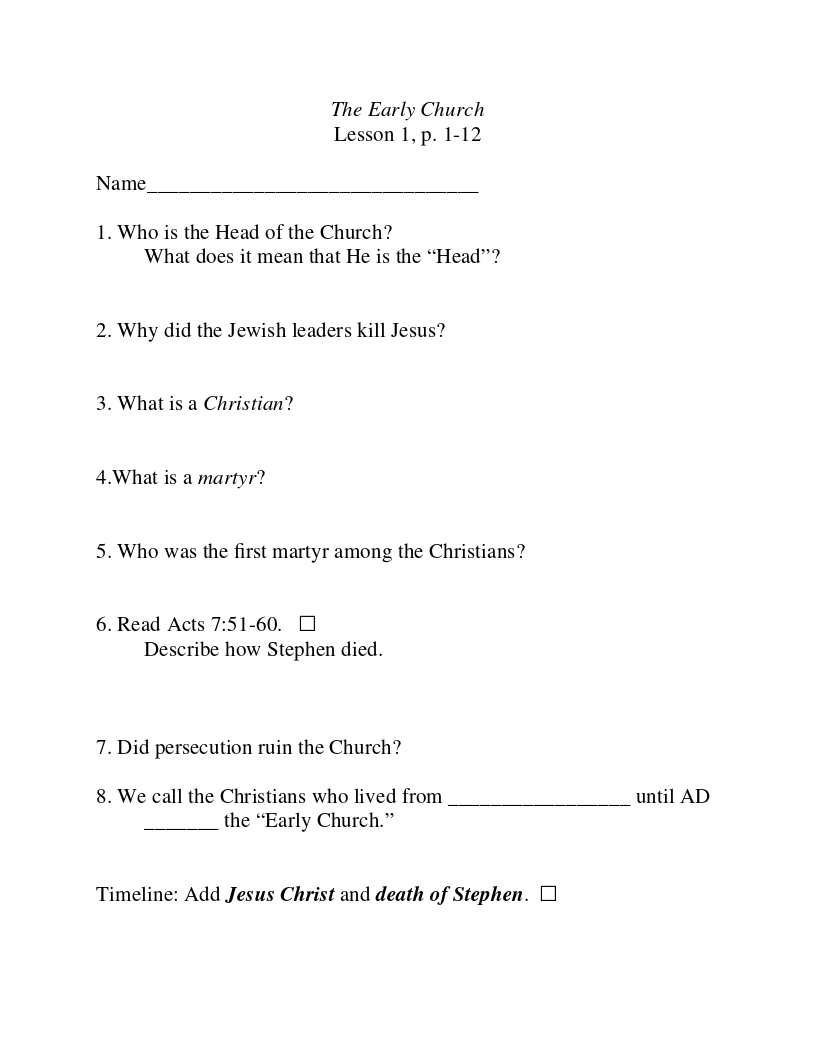
Libby made these worksheets to go with five Threads booklets written and published by Faith Builders. She writes, "My school (in Ireland) couldn't afford the whole curriculum, so I just purchased the booklets and then divided them into lessons and made worksheets for them, as a church history study. The worksheets are probably about 3rd grade level (could be used by any lower grade, I would say, according to teacher discretion.)
The books and divisions are as follows:
- The Early Church—4 lessons.
- Medieval Church and the Bible—5 lessons.
- Anabaptist Beginnings—6 lessons.
- Mennonites in the Netherlands and Russia—8 lessons.
- Revival and Missions—8 lessons.
Each student will need to create a timeline at the beginning of The Early Church, which they add on to as they proceed throughout the booklets. They will each also occasionally need access to maps similar to (or copies of) maps in the booklets, so they can fill things out on a copy of a map.
At different times throughout the course students will need access to a set of encyclopedias; the Martyr's Mirror; and a hymnal.
I had originally done these worksheets with British spellings, since I was teaching in Ireland; I tried to change them all, but I may have missed a few.
Download the documents now or preview below
Doodle Greeting Cards
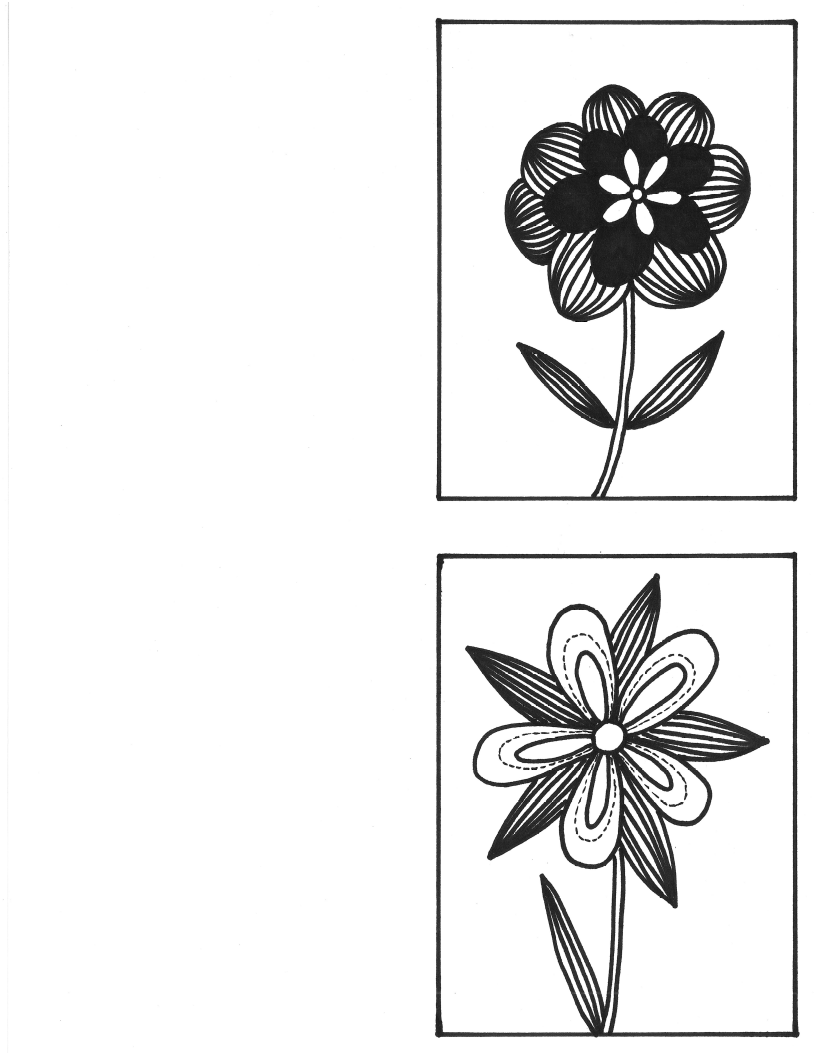
Use these pages to print your own single-fold cards. Add some color with markers, crayons, or colored pencils. Or use these as inspirations to create your own doodles.
Download the cards now or preview them below.

June, July, August, and the Teacher
Every teacher has seen the sentiment that the best months of the school year are June, July, and August. Every teacher knows the inaccuracy of the witticism but there are ways that we can use June, July, and August to make us better teachers.
Summer vacation provides us with a break in routine and the stress and demands of school life. This break is necessary but we can use it or waste it. June, July, and August should not be months to just forget about school and enjoy life. Many of the ways we enjoy life can also enhance our teaching in the next term and beyond.
Summer vacation provides time to do the extras for school that we don’t get done during the year. We have time to clean out our closets, organize the flashcards, books, and boxes, make those worksheets or tests we’ll need, and mend text and library books. A wise teacher cleans and organizes the classroom at the beginning of summer break. Then in the middle of August, he is ready to launch into the new preparations for the year.The summer months provide a time to focus on other priorities besides school. Some of us may hold another job. Some of us are able to catch-up on things around home. Some of us will be able to do things such as travel that we couldn’t during the school term. Refocusing on other priorities lets us rejuvenate from the demands of teaching.The break also provides time for continued learning. We may choose to enhance our teaching in a formal learning environment such as classes in our local area or Faith Builders’ Summer Term. However, continued learning does not have to be about school to help us become better teachers. Taking a class in horticulture, or blacksmithing, or photography adds to our life experience, giving us a larger teaching repertoire. Informal continued learning should also be a part of our summer break. Many summer activities are opportunities to learn.We can use the summer months for travel. Travel can help us re-focus, provide opportunities for learning, and build relationships. In the summer, teachers have the time to work with disaster relief projects, go on short-term mission trips, visit out-of-the-area family and friends, or learn about other cultures, geography, and historical moments. Travel can be as close as the next town or half-way around the world.Several summers ago, my co-teachers and I spent ten days in Ireland. Not only did we come home with nuggets of Irish history, culture, and geography, but we also built relationships and a new appreciation for each other.
Spend time learning about local features. Summer is a good time for us to explore places and stories connected with our local area. Some of what we learn will make it into our classrooms in the fall. Take the summer months to visit museums, geological features, natural history, historical events and places, manufacturing—all the many features of the local area that enhance your learning. Summer can also be a good time to scout out places for next year’s field trips.We live in an area surrounded by Civil War history. Summer gives us the opportunity to explore battle sites, preserved historical buildings, and other places connected with the Civil War. We have time to hike the mountain trail to Potter John’s cabin; the hiding place of the Mennonite man who allegedly walked backwards in the snow over the mountain to escape from the Confederate army.
Summer allows us time to visit people. Brighten up an older person’s day by taking time to visit. Make a point of visiting people with skills you’d like to learn about such as beekeeping, quilt-making, or bird-watching. Not only do you build good relationships; by listening, you acquire knowledge of a wide variety of subjects.Take the time to learn new skills. Use this time do something you’ve always wanted to do. Last summer, I learned to make soap. Not only have I gained a useful hobby, I’ve also become fascinated with the chemistry process that turns oil into something that combats oil.Summer is a good time to catch up on reading. Read books that interest you and will help you be a better teacher in the fall. This may include books such as Teaching with Love and Logic by Jim Fay and David Funk, different by Sally Clarkson and Nathan Clarkson, Seeking Allah, Finding Jesus by Nabeel Qureshi, Church History by Keith Crider, Vera’s Journey by Judy Yoder, Please Don’t Feed the Bears by Gary Richmond, or good fiction books. Read through the new social studies textbook you will be teaching this fall. If you have never picked up the book The First Days of School by the Wongs, plan to do so this summer.Teachers, unlike most job holders, have the gift of several months of summer vacation. What we do in those months can help us become better teachers in the next term. It is up to us whether we use that time or waste it.
***
Companion post: June, July, August, and the Student
June, July, August, and the Student
School is out. The students have closed their books and taken the last tests. The books have all been sent back to the school house. It�s time to forget math and language and reading for a few months!
Whoa, not so fast! Summer is a time to let school simmer on the back burner, but do let it simmer and not grow totally cold. When a cook lets a pot simmer, she is letting the contents cook together and become a flavorful dish. Summer simmering of school work can be a time for students to take their book learning and turn it into practical learning. If the cook turns off the burner once the ingredients are in the pot, the dish will be cold and not very tasty. If a student leaves his books and their ideas in the school room all summer, he will find a cold return to school in the fall. Students should allow their learning to simmer this summer.
Depending on the age of the student the simmering may take different forms. For the child who has just completed first or second grade, parents may need to take an active role in stirring the pot once in a while. The young student who plays away his summer hours without picking up a book will find himself disadvantaged when he re-enters the classroom. Older students should make practical applications of reading and math as they help out at home. Following are some ideas that enable summer simmering.
Students need responsibility. It will vary according to age but children should be required to complete chores in a timely manner. Willingly sticking at a task until completion aides attention and focus back in the classroom. Summer is a good time to work in added responsibilities to a child�s daily routine.Students need word encounters. All students should be encouraged to read during the summer months, but some need more encouragement than others. The child who is reluctant to pick up a book is the very one who should spend extra time reading. Usually, good readers need no encouragement. Create space in every day, maybe a half hour before they turn out the lights at night, for children to read. Have students read stories to entertain younger siblings. They can take a turn reading in family devotions. And parents, continue to read stories to your children. Especially in the early grades, a child�s listening level is much greater than his reading level. Reading to your children provides stretching their vocabulary and encountering ideas beyond what they will read themselves.For the reluctant reader, provide an incentive for reading. Some libraries offer summer reading programs, or you can develop your own. An incentive should be something worth working for. It could be as simple as read ten books and we�ll have pizza for supper, or read ten books and we�ll get an ice cream cone at the ice cream stand, or take an afternoon and go swimming at a friend�s pool, or take a picnic to the park, or have a friend over to play. Find a goal that interests your child. Whatever you do, purpose to make reading a necessity.
Continue working at math concepts during daily life. Math surrounds us in all we do. Take the opportunity to keep math concepts alive. Young students often need practice with telling time and counting money. Throughout the day use the clock. Ask students what time it is. Tell them at 3:00 they may have a lemonade break and have them watch the time and let you know when it is 3:00. (Having at least one analog clock in a main living area is a good idea. We are seeing students who never encounter analog clocks except in their math text.) When they go with you to the store, use cash and let them count the change you get, or better yet have them pay for the purchase from your wallet. (This is not exactly practical for Walmart shopping, but choose shopping encounters where this will work. We are also seeing students who don�t see actual cash and change very often.) Following a recipe uses math, so does helping dad change the lawn-mower wheel by handing him the correct size wrench. Planting and harvesting the garden provide many opportunities to practice math concepts. And don�t forget good old-fashioned flash card practice for the younger students who are still learning the facts. Even five minutes a day will do wonders in keeping the facts in their minds.Children need to play. �Play is the work of childhood.�1 For the younger child, summer should also be a time for play, the outdoor-use-your-imagination kind of play. Even older students should spend their recreation time with non-electronic, non-screen activities. Give the screens and phones a break. Go outside, get hot and sweaty, run around, soak up Vitamin D, grow muscles, and improve your imagination. Organized play, such as softball games with friends, has its place. They learn valuable life lessons when playing by the rules. Unorganized play, such as building a fort in the woods, also has a place. (And in play, students are also using what they have learned whether they realize it or not.)Add geography, science, history, art, and music to the summer pot for extra flavor. Are you traveling this summer? Students can learn to read the map as you go. (A GPS is handy, but map-skills are also essential.) Fishing can be an excellent biology lesson. Making your own compost for the garden and growing plants with the compost is also science. Listening to Grandpa tell stories about by-gone years is a good history lesson. Enjoy singing together as you work. Students can make a card for Grandma and then write her a letter to put with it. The possibilities are only limited by your ingenuity.The summer months provide many opportunities for learning to simmer. If students make use of these opportunities, they will find that they�ve cooked up a wonderful appetizer for the next school term. Happy simmering!
�1Jean Piaget
The Last Words of Nokseng: The Story Behind "I Have Decided"
Harnai port, India by Cj.Samson/Wikimedia Commons
Lucinda continues the series of stories of Christian martyrs and heroes from the past. We hope you will be inspired by these histories and perhaps find them helpful in preparing for school devotions and other lessons.
- Year: mid-1800’s
- Place: Assam, India
- Person: Nokseng
- Event: A man’s last words convert a village
In the days when fierce headhunters inhabited the jungles of Assam in India, missionaries traveled to the land to tell the Garo people about Jesus. Now the Garo in those days “were looked upon as bloodthirsty savages,” (Playfair 1909, 76-77) the hills they roamed were covered with impenetrable jungle, and the climate was so deadly it was considered impossible for a white man to live there. Nevertheless, missionaries inspired by revival in Wales came to share the gospel, and a Garo man named Nokseng, along with his family, gave his heart to Jesus.
The chief of the village was angry and summoned the man, his wife, and his two sons. In front of the entire village, he demanded that the family renounce their new beliefs or be executed. Moved by the Holy Spirit, Nokseng replied, “I have decided to follow Jesus. No turning back.”
Enraged, the chief ordered his archers to shoot the two boys. “Now give up your faith,” he ordered Nokseng. “You have lost both your children, and I will kill your wife next.”
“Though none go with me, still I will follow Jesus,” Nokseng replied. “No turning back.”
Even more furious, the chief ordered his archers to kill the wife, and when she was dead, he turned to Nokseng. “If you don’t renounce Jesus, you will die, too.”
“The cross before me, the world behind me. No turning back,” Noksung declared.
The chief’s archers shot the man where he stood, but the chief was deeply moved by his faith. “Why should this man, his wife and two children die for a man who lived in a far-away land on another continent some 2,000 years ago?” he wondered. “There must be some supernatural power behind the family, and I too want that supernatural power.”
The chief declared publicly that he too would now belong to Jesus, and the entire village, after seeing the family’s faith and their chief’s conversion, also decided to follow Christ.
An Indian Christian missionary, Sadhu Sundar Singh, formed Nokseng’s last words into the hymn which we still sing today.
***
Several versions of this story are told, all similar but with some differences in details. This story is based on the account by Indian Christian evangelist Dr. P.P. Job in his book Why, God, Why?
Avoiding the Summer Slump: Staying Connected with Your Scholars
Due to COVID-19, many of us are experiencing a longer summer vacation than normal. And even if your summer vacation has not come early this year, many of us have not been able to have a normal classroom with our students over the past several months. With rumors of schools not opening normally in the fall, many are wondering if an entire generation of scholars within America will have academic repercussions when students do eventually return to the classroom. What measures are your staff putting into place to ensure that your students will not fall “behind”?
While our students will not be spending their summer vacation within the walls of our classroom, they are still in the best classroom of all: the big, wide world that God designed which is full learning opportunities. This classroom may not be traditional, but with a bit of prompting, your students can make great headways over the summer months in discovering more about math, literacy, communication, and science.
Create a Summer Challenge: 50 Things To Do This Summer
Miss Anna Zehr was the first one to introduce this challenge to me. Tweaking her list and adding some of my own, I sent my students home in the summer with a list of fifty tasks to complete. I offered a prize at the beginning of the next school term for those who completed more than half the list.
Ideas for your list:- Keep tally of all the books you read! When you have read 50 books, give (teacher’s name) a call (teacher’s phone number).
- Keep a journal of what you do during the summer. Write in it at least 2 times a week.
- Use a paintbrush and water and write the numbers from 1 – 500 on your blacktop, porch, or sidewalk. Don’t worry if the number disappears soon after you write it.
- Make something in the kitchen involving the use of measuring cups.
- Pull out your math flashcards. Practice them on Mondays, Wednesdays, and Fridays.
- Cut out words from a newspaper or magazine, one for each letter of the alphabet.
- As you read, try to picture what’s happening in your head. Stop and wonder about what you’re reading. Ask yourself “why?”, “how?”, and “what do I think will happen next?” questions.
- Ride your bike.
- Go outside. Collect natural objects and organize them into these categories: smooth, soft, hard, dry, prickly, and wet.
- Find an object in your house that begins with each letter of the alphabet.
- Find the answer to these questions: How long does it take an ice cube to melt outside in the summer heat? In the refrigerator? In an air-conditioned room or basement?
- Make a scrapbook of mammal pictures.
- Go to the library. Find a book that we read this year at school, check it out, and read or look through it at home. What was your favorite part of the book?
- Play the alphabet game with your family as you are driving. Who can see something first that starts with each letter?
- Make little signs to name things in your room. Put them up in your room.
- Math in the car: Decide on a number of points for each animal that you might see (cow = 1 point, horse = 1 point, pig = 2 points, etc.). As you drive, add up the points. You can race by playing until someone reaches 10 points, or you can work together to see how many points you can get in one car ride. Were you able to find more or less on the next car ride?
- Go outside and collect ten different sticks. Put them in order from smallest to largest.
- Play store. Make price tags for things in your room. Use real or pretend coins to buy the things.
- Gather six different items that you think might sink in water and six different objects that you think my float. (For example: soap, sock, bottle of shampoo, rock.) In a pool or the bathtub, test your hypotheses and see if you were correct.
- Cut words from a magazine. Make sentences out of them.
- Write the numbers from 501 to 700.
- Make a sandwich. Cut it in halves, then in fourths. See if you can cut it into eighths too.
- Make a list of everything you can find that is orange.
- Go on a hike outside. Collect something from nature that represents each primary color and each secondary color.
- Go outside. Ask your mom or dad to help you learn which direction is north, south, east, and west. Walk 10 steps south and 5 steps west. Where are you? (Stay off the street!)
- Make up a song that has all the number facts in the 10 family.
- Write a story about one of your pets or stuffed animals and read it to your family.
- Ask your mom or dad to take you to a senior’s nursing home with your friends so you can read a story to the people who live there.
- Write numbers by 10’s to 1,000.
- Look at a United States map. Find Virginia, Ohio, Florida, and California. Find your state.
- Go outside and find 3 different kinds of leaves. Make a Venn diagram explaining how are they alike and different.
- Write all the names of the animals you know and have a friend do the same thing. Set the timer for five minutes and see who can write the most.
- Plan a picnic for your family. Make a list of the food you want to take and the games you want to play. Then help your mom or dad get ready for the picnic. If it doesn’t suit them, have a pretend picnic with your friends and stuffed animals.
- Keep track of the weather for a whole month on a piece of paper. Are there more sunny days, cloudy days, or rainy days where you live? Can you predict what tomorrow’s weather will be?
- Draw a map of your house and label all the exits you could use if there was a fire. Call a meeting with your family to discuss what you would do if there was a fire.
- Find objects around your home that begin with the consonant digraph Write or draw them on paper.
- Cut out food pictures from magazines. Arrange the pictures into 4 categories: 1. Fruits and Vegetables 2. Dairy 3. Meats 4. Bread and Cereal. Arrange the pictures under the correct category.
- Sit quietly outside and watch for birds. Use chalk to make tally marks on your driveway/porch/sidewalk for each bird that you see.
- Get a book about birds and mark the ones you have seen this summer.
- Make a paper airplane.
- Play the What’s Missing? Find 5-10 objects. Put them on a tray or table. Have someone look at them for several seconds then close their eyes while you take one away. Can they guess what is missing? Then let them remove an item so you can guess what is missing.
- Write the days of the week on a piece of paper. Beside each day write down the fruits and vegetables you ate.
- Use a ruler to measure things in your house.
- Memorize a poem or Bible verse and recite it to your family.
- Read a book. Close the book and try to remember what happened at the beginning of the book, the middle of the book, and the end of the book.
- Look for rocks in your neighborhood. See if you can find ten unusual rocks.
- Imagine that you have an alligator as a pet. Write a story about it, then read it to someone else.
- Volunteer! Ask your mom or dad if they have a job you can do.
- Take small objects like cereal or stones and make addition and subtraction problems with them. If you are outside, write the problems with a stick in the dirt.
Are there items that you could add to the list that are specific to what you studied in your classroom this year? Did you study about the cloud types? Or memorize a Bible passage that they could recite to a grandparent? Or try different types of writing—informative, fiction, biography, etc. Try to add several things to your list that are unique to your classroom this past year.
Send them a Postcard about One of Your Summer Adventures
Whether you go camping, traveling out of the country, or studying for a week at Music Camp, you will be doing something in your summer that you do not normally do through the school year. Take a picture while on the adventure, make it into a postcard at Walmart or snapfish.com, write several sentences about your adventure, and send it off to your students.
Not only will they love the fact that you remembered them, but they will also feel the inclination to write you back.
Give Them a Call
Everyone loves to receive a phone call from a friend. And, I found that my first graders were more than thrilled to hear “Miss Stoltzfus” on the phone line. It gives them a chance to practice their “speaking-on-the-telephone” skills, and it gives you a connecting point with them over the three months of not seeing them.
Ideas of what to discuss:
- What has been their highlight of the summer
- Where have they visited/travelled
- Who do they get to play with
- Why do they like summer time
- When have they last seen their classmates
The Satisfaction of Learning: Affirmation, Correction, and Guiding Students to Discovery
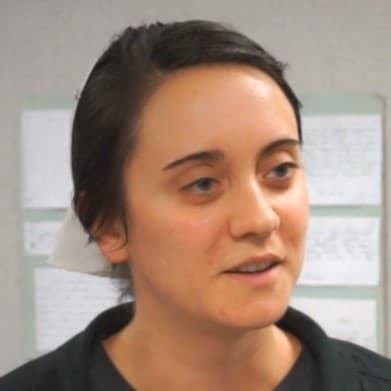
I feel that affirming a student is very important to their success. I think it's important because for a student to feel successful, they need to feel built up. I generally don't say, "No, that's the wrong answer", but instead, I try to steer it in a way that gives them a way to think toward the right answer.
After his marriage in February, 1522, Conrad came to the end of themselves. What does it mean when you come to the end of yourself? Does it mean you come to your toes or what does it mean? When you come to the end of yourself. Sometimes you guys are a fan of yourself, but before that, if you come to the end of yourself, it means that you are at the lowest place and you're feeling like you can't do it anymore and you decide that you should do something different. That's what he did.I don't like to say that an answer that is incorrect is correct, but taking their answer and guiding it toward a more correct answer, if I can do that in a way that doesn't negate what they said, then I feel like that's a good way to affirm them.
Very nicely done. Lots of you did very, very well with that. Something I noticed is that some people’s eyes came off of this and you lost track of where you were so we're going to do it one more time and make sure that your eyes are following the trail so that you don't get lost on your way out of this.Chris: On one occasion, one of the students gave you an answer or didn't have an answer ready for when you asked her, I think you said something like, “Look that up and then we'll come back.” Is that something you do regularly, and why?I like to vary the way that I have students find answers. Sometimes they will say, “I don't know the answer.” In a case like that, I would have them either go and look up the answer if they have it close by or there's a place where they can go to look for it, or sometimes I will have a student in the same class help them out. Sometimes I'll say “Malachi, or another student, can you help this person out?” Most often, I would rather have them go and look it up if they can.
I think just the importance of that is so that they can retain it longer in their memory, not just for the test, but beyond that, just so that they can also feel the satisfaction of having found the answer but then it also sticking better. The thing of finding satisfaction for themselves, I just feel like that will stick with them if they can feel like they have achieved something themselves rather than a teacher just telling them or them just guessing an answer. I feel like it will boost their confidence more if they can feel like, “I found this myself.”
Tools for Classroom Management
Motivation
My sixth-grade teacher pulled me into the hall for a conversation. “I know you can do better than this. These pages are sloppy and this is not your best work,” she said.
The workbook pages she was referring to were not neat. I had filled them drawings, swirling figures, and doodles. The writing was not done carefully and the o’s and a’s had been colored in. I had been bored in class, as the reading lessons came easily to me, so I entertained myself with this designing. My teacher’s comments motivated me to do better and to take more pride in my work. She had noticed my poor work and cared enough to challenge me to do better.
Teachers must value motivation in classroom management, as it is important to students' academic success. The teacher needs to be aware of motivation levels in students and make changes in instruction or the classroom as needed (Selig, 2010).
Teachers should present tasks in a way that builds enthusiasm by saying how the task will be useful, giving a vision of what the students will be able to do, relating it to skills they already know, and generating enthusiasm, especially for challenges (Sprick, 2006). High expectations and effective instruction let students see that they can be successful if they apply themselves (Sprick, 2006), which leads to motivation and positive behavior. The teacher needs to use engaging and meaningful learning activities to build motivation and higher-level thinking skills (Jones, 2011).
Professional Development Activities
- Discuss your students’ engagement and list strategies to capture their attention. Plan to use one of the strategies this week.
- How are high expectations for students beneficial? How can you develop and maintain high expectations for your students?
Feedback
Feedback is important in behavior management. Teachers should monitor their feedback to ensure they are not always negative or critical of children with behavior challenges. The child should not be receiving the teacher’s attention and help only when he is off-task or breaking a rule. Studies have found that children with challenging behaviors received four times as many negative interactions with teachers as they did positive interactions (Cicantelli, 2011).
Feedback should inform students of what they are doing that is appropriate and helpful in learning or relationships. Teachers must support appropriate behavior rather than reacting to inappropriate behavior. Students may need explicit instruction in positive behavior and guidance in how to meet their own needs without jeopardizing the needs of others. Giving concrete and specific feedback to students will help, as teachers may show a child when he behaved inappropriately, explain what he should have done, and help him speak or act appropriately.
I told a student, “You need to behave!” and then realized this student was still learning English and did not know what “behave” meant. I realize now that telling any student to behave is not good feedback. I must make sure students know what action I am talking about. They may need my specific directions and guidance. I can model the behavior I want to see and we can practice the appropriate actions together.
Students need challenges, but they may become discouraged if they always face only challenges and continue to make mistakes. The teacher must give clear instruction and opportunities to practice. He may need to give more instruction and adjust lesson plans. Discouraged students may misbehave if they are not engaged. Students need prompt feedback so they know what they are doing correctly or what they are missing and can learn from their mistakes (Sprick, 2006). Feedback should be given in a variety of ways, and should be accurate, descriptive, and age-appropriate (Sprick, 2006).
As I remember the feedback of my sixth-grade teacher, I can gain lessons for myself as a teacher as I give feedback and motivation. One lesson is to be aware: notice student work, think about their motivation, and realize that the child can do better. It is important to remember to give admonition or correction privately, not in front of other students. Give correction in a helpful manner and acknowledge the capacity of the learner. Also, prepare challenges for bored students.
Professional Development Activities
- Determine a method for tracking the feedback you give. Perhaps you will make a checklist, jot notes, keep track on a shared Google document, or use sticky notes.
- Implement your method of recording feedback, then analyze the types of feedback and plan how you can use feedback to encourage and instruct the students.
References
Cicantelli, L. & Vakil, S. (2011). Case study of the identification, assessment and early
intervention of executive function deficits. International Journal of Early Childhood
Special Education (3)1. Retrieved fromhttps://www.int-jecse.net/files/MOZ80VRTAOGOO34J.pdfJones, V. (2011). Understanding effective classroom management, chapter 1. Upper Saddle
River: Pearson. Retrieved from https://ptgmedia.pearsoncmg.com/images/9780137082117/
downloads/Jones-ch01.pdfSelig, G., Arroyo, A., Jordan, H., Baggaley, K., & Hunter, E. (2010). Loving our differences for
teachers. Boston: Pearson Learning SolutionsSprick, R. (2006). Discipline in the secondary classroom. San Francisco: Jossey-Bass.

Technology Detox
As a foster parent, I regularly come into contact with children who have been raised with technology as their wet nurse. They may have been born on a screen, for all I know—certainly under the sight and sound of one. When they were tired, or bored, or hungry, or restless, or wakeful, or alone, they found comfort and excitement in the constant novelty of a flickering television or PlayStation.
They could say PS4 before they knew who Jesus was, and discuss the intricacies of Fortnite and Call of Duty before their moral formation knew what to say about it.
I will not propose for a moment that technology toxicity is to blame for who they are, and who they became, for the gaps in their minds and hearts. By the time they land in my home, most of them have had enough trauma, isolation, unmet needs, and heartbreak to work measureless damage on its own. But I will add that technology didn’t help.
Toxicity is not a word I use lightly. Current science shows that early screen time in frequent doses damages a child’s development. In baby and toddlerhood, his eyes and heart and brain crave human interaction and responsive connection. Sedentary screen time at this age is detrimental, across the board.
Are you enjoying my categorical statements? Here’s another:
The content my children have seen should not be enjoyed by any human, much less a preschooler. When I look up the titles they cite, I have no words. Who thought unleashing this on innocents was anything less than criminal?
They are hollow-eyed and restless, unable to focus on anything for long. What are books? Books are boring. Their hands are soft little flabbypads, noticeably weaker and less coordinated than those of children half their age—unable to open a jar of peanut butter or press an eraser effectively to a page, much less perform the intricate muscle movements required to write their name, use a scissors, or build a craft. I am not making this up. I’ve watched it.
What do they do, little urban citizens of virtual worlds, when they arrive in a home where the only screen time for preschoolers is an hour video with the family on Saturday night? How do they live?
Here are some of the strategies we use for detoxing.
1. We communicate.
Children raised on excessive technology have not learned the most basic rules for talking and listening to other humans. To answer a question. To respond physically when their name is spoken (turning a head, calling a reply). To stop rattling after a while, and let another speak. Especially, to look into the eyes.
We are big talkers and listeners in this family; it’s our best strength.
So without thinking about it, we step closer when they call. We get down on our knees and we look into their eyes and we listen. We say each other’s names dozens of times a day. We sit in a circle and eat our dinner facing each other, and we chat. We request verbal responses to verbal instructions. When we are not sure what a child is telling us, we stop and wait and ask questions and put on our detective hats and sometimes call in another family member for help, until the Ah-ha! moment breaks. The child looks into our eyes and smiles a little, startled by the satisfaction of difficult communication resolved. You heard me.
Within days, we see a change in a child’s ability to communicate meaningfully. Eye contact improves. Automatic responses pop out. Enunciation sloppiness cleans up because someone is listening, and it matters that he understands me.
2. We listen to the monologues, then change the subject.
We don’t forbid discussions of video games, and what level my cousin was on, and the superninja demigod who just about got us at the intersection blah blah blah. We listen peacefully while we drive to a family visit or church or the grocery store, and then we say, “Oh look! A robin!”
We don’t force engagement in the here and now—the real. We just make it as tantalizing as we can.
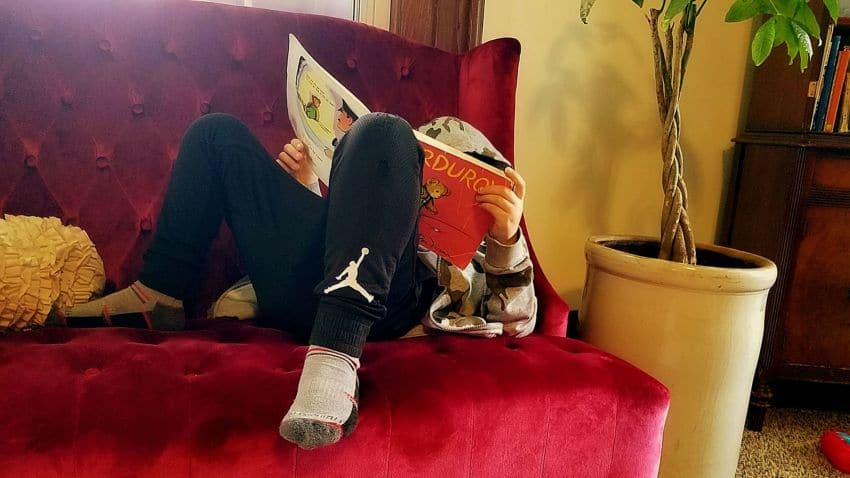
3. We invite engagement with books.
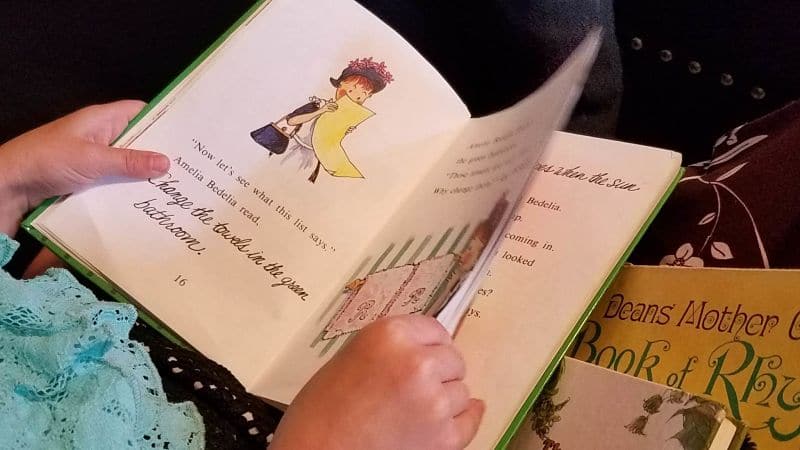
Again, we do not require involvement. But books are always lying around our house. At any moment, someone is usually sprawled on the couch, lost in the pages. Dad or Mom sits down for story time, and invites each kiddo to bring two books.
For techie children, it usually takes a few days. Maybe weeks. Books don’t move and flicker and change and glow. But we’ve never met a child yet who didn’t come around—who didn’t find that + + + + + equals quiet peace and great pleasure.
Then one day, they are too silent, and we go flying to check on them, and find—miracle of miracles—they are lost in a book of their own.
4. We wear clothing free of advertisements and digital characters, with few exceptions.
Don’t underestimate it. We quietly tuck away the Hulk shirts and Loot Llama hoodies and Spiderman shoes. We choose the stripes and the polka dots and the pretty colors. We are no longer identifying ourselves with that set, and certainly not performing free advertising for them.
My husband made this choice early in parenting, for our own family’s sake, and we do not regret it.
5. We play and play and play and play and play and play and play and play. Outside.
“I made a snow angel once,” my newly-arrived foster child says, in his soft squeaky voice, “and I almost froze to my death from cold.” The woods are scary, because “that time when I lived in the trailer there were mean kids hiding there, and we ran away and got scratched by the thorns.”
Perceptions can change.
When shared with siblings who know the magic (how to light a fire and build a fort and push the swing and bounce us really high and pull the wagon), the outdoors is a place of endless delight, discovery, and imagination. Not so much alone. Because while you would think that living in fantasy worlds enables imagination, it actually kills it. All the imagining was done for my foster children. They didn’t have to ask questions. They didn’t have to invent or create or fill in the details. They were splashed and bombarded and choked by endless stimulation.
The school questions that drive my son to tears are not, “What is four plus six?” but, “If you had a clean-up machine like The Cat in the Hat, what could it do?” Or “What do you think will happen next in our story?” How am I supposed to know?
Play is education. And nature is incredibly therapeutic. It’s dynamic and wholesome and earthy and huge and robust. There are chickens in it, and darling new kittens. There are pinecones to turn into people, and daffodils to pick for Mom. (Sorry they came out of the flowerbeds, but LOOK AT THESE FLOWERS RIGHT HERE IN MY OWN HAND!) My children come inside rosy-cheeked and filthy, full of stories.6. We have fun as a family – as real live people.
We invite our new kiddos into the joy of family togetherness.
- Going out for ice cream.
- Cooking supper on sticks in the backyard.
- Planting the garden.
- Baking cookies with Mom.
- Cleaning the house, three M&M’s per job completed.
- Taking a long walk to the park.
- Sharing “Family Time” just before bed, sitting around the couches singing and talking about our day.
- Best of all, what my kids call “Wrestling/Tickling Matches” on the living room floor with Daddy. Nothing else brings so much joy, and our foster kids, who hang on the fringes and watch and declare they don’t like being tickled… and then edge in a little closer… are soon shrieking and tackling with the rest. (I personally will have none of it. But my husband is a boss.)
Maybe this doesn’t feel like detoxing from technology. But the joy of the one doesn’t compare to the other. There are people! Who like me! And we get up and do stuff!
7. We provide tactile toys.
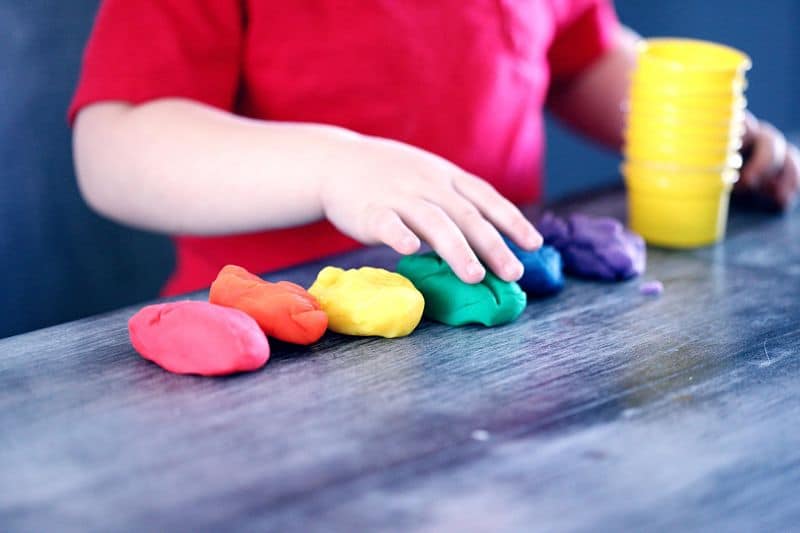
Building and manipulating objects happens with the hands, not the controller. We offer a big bin of Lego, and a huge car blanket with roads and houses, and Matchbox cars to drive on it. We keep a large stash of crayons, and child-friendly scissors. We love Play-Doh. It strengthens the hands and pleases the fingers and engages the mind. We do a lot of giant floor puzzles. Magnetic tiles to build into cars and structures. Bubbles to blow. Sidewalk chalk for writing it big. Watercolor paints. Mr. Potato Head pieces to assemble. A toy kitchen with lots of pots and pans.
8. We remain what we are, and the majority wins.
The lovely thing about adding one or even two people to a home is that they can add their glorious personhood and diversity and interest and flavor and uniqueness and joy to our family, without us being overcome by it. We add it in. And gently, we dismiss what we cannot permit. But our family, our core unit of constancy and change, remains the same. New children are the raindrops. We are the river, always receptive but not easily diverted into fresh streambeds.
If our new big brother isn’t into Xbox games, and we never play them anymore, our interest kind of peters out. Maybe it revives when we meet birth grandma at the visit; we may talk as animatedly as ever about the fifth level and our dangerous escapes, but with the Zooks we begin to merge into new paths.
Kids adapt. They are not as resilient as we’ve always been told, but I’ll hand it to them – they are highly adaptable. Detoxing can happen. Harmful effects can be mitigated.
And guess what? Our big brother has a really cool whistle made out of an acorn cap.
Sources and Further Reading
- Screen-Free Parenting – Have You Spoiled Your Child Today? Meet S.P.O.I.L.
- BBC – No Sedentary Screen Time for Babies
- American Academy of Pediatrics – Children and Media Tips
- Kids Health – Screen Time Guidelines for Babies and Toddlers

Optical Isomers: Chemistry's Right Hand and Left
An understanding of optical isomers helps us to better appreciate the amazing work of the Creator. This article is designed for high school chemistry students who have a basic knowledge of elementary organic chemistry. The endnotes provide extra information for those who want to enrich their understanding of optical isomers.

My Vision for My Students
Now that school is over for the year and summer lies ahead, my students have tremendous opportunities before them. What will they do with themselves this summer? Getting more sleep, sleeping in, playing outside, baking cookies, helping Dad with some projects, getting together with friends�these are all things they might be anticipating.
One time Pooh and his friends went on an expedition to look for the North Pole. None of them, of course, knew what the North Pole actually was. They ended up finding something that they thought was the North Pole, but it actually was not. Often when we look to what lies ahead, we have only a vague impression of what we hope to find. Summer can feel like an endless possibility, but we don�t have a clear idea of what we hope to do with our summer. Heading into summer without clear direction is a bit like trying to steer a ship without a compass through a foggy sea. Without a goal in sight, we randomly hit whatever comes along.
In the following paragraphs, I present to my students my vision for their summer. I write it in the present tense, not in an effort to predict the future, but to make the vision more accessible and compelling.
My students eagerly anticipate their summer vacation, and they have some definite goals for themselves to accomplish before the beginning of the next school term. They are forward thinkers. They don�t passively wait for things to come their way. They understand that if they aim for nothing, they will hit nothing. They want to make the most of the several months that lie ahead.
My students are helpful people who contribute to the lives of those around them. They are thinking of ways they can be of help to Mom and Dad. They actively do what they can around the house, even before they�re asked to. They don�t always feel like taking out the trash or doing the laundry or cleaning out the garage, but they still do it cheerfully. Sometimes they surprise their family by doing something extra, such as washing the car or cleaning out the dog kennel.
My students exercise self-discipline. Sleep is a delightful, wonderful, sweet thing, but my students realize that sleeping too much can dull their senses like too much sugar can make them sluggish. They have developed their self-discipline so that they get up early without needing their parents to wake them. Their morning schedule looks something like this. They get up around 7:00 � 7:30 and tidy their bed. They spend approximately thirty minutes doing exercises similar to what they learned in Health this year. After exercising, they take a shower, read their Bible or some other inspirational book, and eat breakfast. If their parents prescribe something different, they willingly do as their parents ask. Whatever their morning schedule is, they consistently get up on their own and follow a set plan of action.
My students make good use of their time. Much of the typical day is likely planned and dictated by their parents, but my students do have a significant amount of time for their own plans. They don�t need to plan every minute of it; but they do have specific goals they want to accomplish, which means that that they are intentional about how they spend their time.
My students read. They read some for entertainment, but they also read thicker stuff that makes them think. They take great delight in learning from books. They spend very little time in front of a screen, because they know that watching things on a screen (even if it�s a video game) has a negative impact on their brain. Instead of watching videos and playing video games, they stick their nose into a good book regularly and frequently.
My students write. Most days they keep at least a short diary of what they did and learned that day. They write down things that they notice. Periodically they write letters to friends and grandparents. A few exceptionally ambitious ones even write stories from time to time.
My students make things. They use their imagination and creativity to make some really neat and functional stuff. When making things calls for measuring and calculating, they either do the math in their heads or on paper; they rarely use a computerized calculator. The following is a list of ideas:
- Building a birdhouse or bird feeder
- Crafting model vehicles such as cars, boats, or airplanes out of wood, cardboard, etc.
- Making a doghouse
- Practicing cooking and baking skills � perhaps making a meal or part of one
- Making a trebuchet
- Building a fire without matches or a torch of any kind
- Building a teepee or some other shelter and spending the night in it
- Starting a collection
- Rocks
- Insects
- Minerals
- Feathers
- Etc
- Making a bookshelf
- Building a windmill
- Learning how to crochet and/or sew
- Building a generator out of an old electric motor and a bicycle
- Making a handbag or purse out of leather
- Making a journal or sketchbook, using Coptic stitching
- Building picture frames
- Making a roadside stand from which to sell homemade cookies and lemonade
- Making trails in the woods
- Building a �house� among the trees � making little trails, outlining rooms with rocks, etc.
- Growing flowers and/or vegetables
My students share what they learn. While they�re working with Mom in the kitchen, helping Dad with a project, or eating together at the supper table, they ask their family members what they are learning; and they share their own discoveries and observations.
My students thoroughly enjoy their summer vacation. They lie on their backs with a hat to shield their eyes as they watch puffy clouds and imagine dragons and lions. Sometimes they camp out under the stars, where the crickets serenade them to sleep. Evenings after the sun has set on a clear, hot day, they sprawl out on the warm grass and breathe in its languid freshness. They watch beautiful sunsets and appreciate God�s thoughtfully prepared masterpieces.
I could further develop my vision for my students, but I want them to think for themselves, too.
God has blessed them with wonderful minds with which to develop their own plans and ideas.
The summer lies ahead. The possibilities seem endless. But summer won�t last forever.

To Grow as a Teacher, Embrace the Unusual
How can you become a better teacher? In Intentional Growth, Melvin explores a range of steps you can take to develop your understanding and your ability to communicate. In this excerpt, he highlights an uncomfortable strategy: teach in unusual situations.Although Melvin doesn't mention Meet, Zoom, or Teams, his advice highlights the opportunities for growth during the COVID-19 pandemic.

Be Respectful and Break It Down
There is an attribute that lubricates relationships and mechanics of home and classroom. It allows learning to flourish and exhausting power battles to diminish. The word itself sounds austere, yet it shows up in small ways, multiple times in a single day. The attribute?
Respect.
We value respect. Each child needs it to serve God and people well, yet how do we teach and train respect?
It is helpful to break these large areas of training into smaller bits. Here are three areas in training respect that have significant payoffs.
1. Always ask an adult—never command.
“Please, sharpen my pencil."
“Check this for me, please.”
While these are polite commands, there are three assumptions happening here.
First, there is an assumption of expected service. The child assumes the adult to have the time to help. Teaching children to ask services from adults forms in them an understanding that services are a gift. They should never assume that someone has the time or interest but instead ask if they do.
Second, the child assumes who is responsible for the task. A command puts the responsibility of a task on a specific person. A child who says, “Get me some paint,” has placed the responsibility of that job on the adult. By asking, rather than commanding, the child is not presuming it is the adult’s responsibility but allows room for it to be someone else’s, maybe their own.
Third, the child is assuming the power to command. Requesting help or items reminds the child they live in a hierarchy of power. We as adults also have people in our lives to whom it would be out of place to give a command: God, elderly, peers, parents, school board, administration, and policemen. It is amusing when a three-year-old gives instruction to an adult, but we blush for the teenager or adult who has not learned the skill.
How can we train this? When they give a command, simply ask them to rephrase as a request. All it takes is sharp ears and a three seconds.
2. A respectful person responds verbally.
A head nod, staring at the desk, breezing past the teacher’s goodbye – why does this behavior not suffice?
Responding verbally is an act of the will. Can you remember when you were a teen struggling to respond to your parent’s conversation or question because you were standing up inside? I do. There is something in the act of uttering words to another person that bends your will to them in a way that a head nod or a grunt can’t do.
Responding verbally is polite. A child may have a heart of respect, but if they do not have the social skill to respond when spoken to, they will appear disrespectful. I noticed a group of students in the library restocking their book stash and I asked if they had found any good ones. They were a bit nervous and quiet natured, so they chose to ignore my question and kept talking among themselves. I don’t doubt their heart, but this type of response is a breach in respectful social decorum. A simple “Yes, ma’am,” and a shy smile would have been perfect.
How can we build this skill?
Prep them for the experience. Before I take my crew on a field trip we talk about what the interactions will look like on this outing. I give them tips on how to respond in the setting.
Show them how. At the beginning of a school year I have a student help me demonstrate how to enter the classroom in the morning. Watching me ignore their classmate’s greeting at the door opens their eyes. Every town run with your child is a chance for them to observe and learn from you skills of responding and carrying conversations.
Field trips, church events, guests over for dinner, town runs—so many chances to hone the skill of respect!
3. A respectful person corrects carefully.
We make mistakes, lots of them. We welcome children’s input, yet children too free to correct adults can lead to nitpicking, a false sense of their own perfection, and an unhealthy view of making mistakes.
First, show them what areas validate correction.
In the classroom if my mistakes lead to confusion, I want them to let me know. If everyone knows what I meant to say, no correction is needed. If I write a math fact incorrectly or misspell a word, I welcome correction. This begins to show the difference between nitpicking and giving valuable input.
Second, shape the attitude in which they correct.
In the classroom, I found thanking them for catching errors normalizes mistakes and makes the students less aggressive.
I listen for prime examples of students correcting me and publically note it. “Thank you for catching that, and I also appreciate how you pointed it out.” Do a few rounds of this and most students get it.
To those who remain aggressive, giving them phrases to use may help. When correcting someone say, “I think you meant….” “I thought that…..” After using phrases like this for a while, they usually can transfer to saying “It its spelled with ee not ea,” in a tone that has no arrogance or disrespect.
Respect. It’s a heart issue. We cannot implant it into their life as easily as we can a math fact. We are just one of the tools of the Holy Spirit. May the gift of respect allow joy and learning to thrive in our home and classrooms!
Enjoying Oral Reading
School prepares our students for life in the adult world. So why bother with oral reading beyond first or second grade? Most students can read faster silently than orally. Some students find oral reading embarrassing. Other students become impatient with slower readers. Is it necessary to have students spend time with a special oral reading class?
I propose that an oral reading class is important and should be taught in all grades. We teach speech as a high school course, but in many ways an oral reading class can be considered a type of speech class. In the adult world, people who read orally are usually reading to someone. They have something important to share. A teacher reads to her class. The minister reads the scripture to his congregation. A mother reads to her children. Teaching students to read orally is a very practical adult skill.
For most oral reading classes, you might follow a routine of assigning parts, practicing, and presenting. Adding variety to the routine occasionally can spice up the routine. Many of the following ideas work best with second graders and higher. Most first graders do not yet have the reading skill needed to use these ideas well.
- For a story with a variety of characters and conversation, assign a character to each student and the part of narrator to one or two students. Students read the words of their character with the narrator filling in the unspoken parts. Take this idea further and allow props for the characters to present the story to a younger class. This gives the students a purpose to read the story and provides a pleasant break for the younger class.
- Divide the class into two groups. One group will act out the story while the other group reads the story. This will require some planning on the part of the students. They will need to decide who reads/plays each part. Both groups need to be familiar with the story in order to present it well. Again, they can use props.
- Have students choose their favorite part of the story. Ask them to read this part orally. This works best with a small class because you may have students choosing the same part each time. You may also want to give them parameters on the length of the part they choose.
- Use choral reading. This is a great way to read poetry, scriptures, or other pieces that have a rhythm or cadence to them. Depending on the age and ability of the students, you may want to first read the piece to them to set the pace and structure of the reading. They should practice it themselves several times, so they are familiar with the words. Then read it together several times�a few times to get the feel for the piece and once they become competent, have them read it one more time so they can just enjoy it.
- Have students find and read the part of the story that answers a question you ask. This method will not give the students time to practice their own part but they should be familiar with the text, so they have an idea of where to find the answer.
- Younger students often just need to read! And, many of them need to read aloud. Allow them to bring a stuffed animal or doll to school for a few days. These are their reading buddies. They should read their stories to the animals. Several years ago, a co-teacher brought her large mastiff pup to school as a special treat. He made a good reading buddy.
Does all oral reading need to come from their reading books? No, students can enjoy sharing from other sources, as well as their readers. The important idea is to have students reading orally to share information.
- Follow Christopher Dock�s example and allow students to read the morning Scriptures as a reward for work well done. Students should be taught how to read Scriptures well. Use the oral reading strategies of expression and clarity to bring God�s Word to life.
- Older students enjoy reading picture books to younger students. They need to practice the best way to convey the story to the students to which they are reading. They should make eye contact and show the pictures in the book. Often picture books require more use of expression than longer stories. This is a good way to practice correct expression. And, the younger students enjoy a story well read.
- Students may bring a story or article of their choice to read to the class. This was a favorite exercise of our junior high teacher. The students enjoyed listening to a variety of readings and the teacher enjoyed seeing the personalities of her students come alive in their chosen pieces.
- Take a class to visit a nursing home and the students can share a story with the residents. They will need to practice enunciation, volume, and clarity to make the presentation worthwhile.
Don�t neglect the skill of good oral presentation. You are laying the foundation for the next generation of ministers, teachers, speakers, and story-readers!
Finish Line
Perhaps the only thing worse than flubbing the end of a project is not being allowed to complete it at all. You find a measure of satisfaction in crossing any finish line, no matter how exhausted you are, how badly you stumble, or whether your effort ranks as a personal best.
What if the finish line is removed? Or the race cancelled when you are three-quarters of the way through?
For teachers in many communities, the final quarter of the school year found the classrooms empty. The hall lights dimmed themselves. The gym sat vacant. The parking lot refused to fill. Oh, the work continued! Parent packets needed to be stuffed, and then emptied and graded and refilled. Plans made. Tests distributed. Treats awarded. Promises kept. Online forums manned. Assignments collected.
All this without all the things that made it worthwhile – the faces of children, the progress of teens, the final celebrations.
The school year of 2020 will be over, but it will not exactly Finish. You may not hear that click of a door closing for the last time, breathe the satisfied sigh of reaching an expected ending.
Instead of finishing the race yourself, you have handed the baton – to parents, and perhaps to students themselves. Here, take this. I am not legally permitted to finish the task I set myself last fall. Take the baton, and run for the endgame. Suddenly you’re not running with the pack, in the same way as before. You become the friend cheering on the sidelines, the support station offering cool water. You can do it! instead of, Let’s do it together!
There is more pleasure, more resolution, and more glory in finishing yourself. More endorphins, frankly. Who wants to hand off when the finish line is in sight?
But I commend you teachers for doing what needed to be done: for sharing your grit and grace with others, for working faithfully behind the scenes while parents taught the lessons you prepared, and for staying supportive when your students lost ground, or gained it, outside of your reach.
That’s the thing about passing a baton: it’s passed. Your hand isn’t on it anymore.
Perhaps this is how God feels, sharing His work with His children, self-limiting His power to intervene, allowing us to stumble and blunder and take the wrong path by mistake and double back to find it again. He could race better, Himself. But He chooses to let others join His efforts, and He takes a step back and lets us learn to run.
Perhaps the only thing worse than flubbing the end of a project is not being allowed to complete it at all. But you have, through trusting and enabling the steps of others. You’re almost there! We’re almost there!
Well done.
Faithful to the End: A Web Meeting for Administrators and High School Students
On April 24, a group of teachers and school leaders met to discuss: How can teachers support struggling students at a distance? How can you and a disappointing school year positively? What does the future hold for our schools?

Tired and Cynical
I love teaching. I find Jesus there.
I watch rude students become gentle and stumbling readers become book lovers. We set goals and celebrate victories. I relish those split second incidents that thrill: the moment of wonder that crosses the young, hardworking choir as they hear the tough chord reach harmony, or the shout of joy when we take the final count of Christmas money– and it met our goal! Yes, I love teaching.
But sometimes I get tired. Tired of saying no. Tired of holding a firm line. Tired of cheering and then witnessing defeat. Tired of petitioning Jesus for the same need every day for weeks, for months, sometimes years.
Too many tired days can lead me to guilt. Where is God’s power? I am missing something here. I am not holy enough, smart enough, organized enough, creative enough, social enough, or something enough. Along with guilt can come cynicism. I am not sure why I am teaching. Is there any good happening in this school, in my classroom?
This semester I had two moments that helped me refocus. One morning the students worked together to compile our prayer requests from the year into three categories: answered with yes, answered with no, still waiting for answer. I was going to be happy with at least a few in the "yes" column, but God and the students were thinking of more. Our "yes" column was long! God is present in my classroom.
The second moment happened as I filled out Christmas cards for my students. I decided to mention one skill or character quality connected to each one. “I can see that you have a heart for the hurting. I wonder how God will use that gift.” When the job was about half completed, I realized I was seeing my crew with fresh eyes. There is good in my classroom.
Tired?
Take time to document God’s presence. I find that doing this with staff or students is helpful. My own list often feels small and hesitant. Other perspectives can boost your faith and open your eyes.
Take time to assess your students. What good is happening in your classroom?
Who is organized?
Who notices the trash on the ground or balls left out?
Who can you send to do an errand?
Who do you put in charge of a poster? Why?
Who does well with the younger students?
Who cheers others on to success?
Who can handle heavy loads without buckling?
Who wrestles until they get it?
Who loves learning and seeks to grow?
Who loves what is good and right?
Who puts thought into life and thinks things over?
Who can win a game with no effect on their ego?
That’s your crew. God grace is with you! Carry on with joy!