

Lighthouse Christian School
2026-2027 term
Now Hiring: Inspiring High School Teacher
Join Our Mission. Shape Tomorrow’s Leaders.
Are you a passionate educator who believes teaching is more than a job—it’s a calling? Our private school is seeking a dedicated High School Teacher who is committed to academic excellence, character development, and creating a positive, engaging learning environment for students.
What You’ll Do
• Teach and mentor high school students in a supportive, faith-centered environment
• Inspire curiosity, critical thinking, and a love for learning
• Build meaningful relationships with students and families
• Collaborate with a team of caring, mission-driven educators
• Contribute to school events, activities, and a vibrant campus culture
What We’re Looking For
• A passionate teacher with strong classroom management and communication skills
• Ability to connect with teens and motivate students of varying abilities
• A heart for serving, leading, and helping students reach their full God-given potential
• Energetic, dependable, and committed to excellence
Why Join Us?
• Supportive leadership and a family-like atmosphere
• Small class sizes that allow you to truly invest in each student
• Competitive pay and opportunities for professional growth
• A safe, faith-based environment where values matter
• The chance to make a lasting impact—every single day
⸻
If you’re ready to teach with purpose, we’d love to meet you!
Submit your résumé to [office@crf.farm] or call [618-218-5397]
🎶 Full Time Music and Drama Teacher 🎶
We are looking for a full time music and drama teacher to lead our K-12 students. We would be looking to this staff member to lead a refreshed arts program to instill in our students a love for music and drama. This would include teaching music theory, leading upper school choir, directing drama performances with upper and middle school students, and more! This would be a first full time position at our school so growth and development opportunities would abound. Starting compensation for a qualified candidate would be around $40,000.
2026-2027 High School Teaching Position
Zion Christian School is a small K-12 school located in beautiful Mesopotamia, OH and operated by Zion Christian Fellowship. The projected enrollment for the 2026-2027 school year is sixteen students. We have an experienced teacher who will teach grades two through four. The high school room will have eight high school students and two students in junior high.
We are looking to add to the team of involved parents, school board members, and teachers by hiring a high school teacher. Zion Christian School offers a competitive compensation package and is a well established school that has been operating for over 60 years. If you are interested in this opportunity, we would love to have a conversation with you. Please reach out to Steve Kaufman at (330) 647-1290 or Kenneth Petroski at (216) 502-5287. Email us at kenneth@zcsmiddlefield.org.

Creative Review Ideas
When I plan my lessons for the next day, I occasionally include an activity or an object to reinforce the new concept, engage the students senses, and connect them with real life objects.
This list includes out-of-the-workbook ideas for reinforcing concepts and integrating hands-on learning in your classroom. They cover a range of grade levels and are presented in no specific order.
Math Facts
- Froggy Hop – Teacher lays a row of flash cards on the floor for the student to jump over when he says the correct answer. The teacher or student walks alongside the “jumping” student to ensure he says the right answer.
- Around the World – One student stands beside another while the teacher flashes a math fact. The student who says the correct answer first moves to the next student’s desk.
- Addition and multiplication graph – Make a graph with numbers 1-10 or 12 both vertically and horizontally. Each student finishes as quickly as he can, then records his time.
- Equations – Write equations onto the chalkboard, each student only solves one step.
___ + 8 = 56
6n + (23 – 1) – 13 = 11(3)
13 = n + 5
53 – n = 102
- Oral drills – Call out math facts instead of using flash cards.
Long Division
- Around the World – Form two rows of students. Each row gets a division problem to solve. Each student does only one step and goes to the back of the line. Small marker boards work well for this activity.
Formulas
- Find the area of real objects
Classroom, desktop, school property, sidewalk.
Frisbee, clock, protractor, microwave dish.
Doritos chip, slow moving vehicle sign.
- Find the volume of real objects
Classroom, lunchbox, desk, microwave, Rubik’s cube.
Soccer ball, golf ball, baseball, earth.
Ice cream cone, pylon.
- Flash cards – Have students identify the shape for the formula and dictate the formula for a given shape.
Reading – Oral and comprehension
- Choral reading – Reading all together helps the slower ones learn new words.
- Dramatic reading – Assign students to different characters in the story.
- Ask questions during story time – Helps students catch foreshadowing and analyze story details.
Parts of speech and their functions
- Oral – Call out random words and the students say the part of speech.
Teacher: “Capital.”
Student: “Noun.”
Teacher: “Wow.”
Student: “Interjection.”
- Write a sentence on the board to drill the functions.
E.g. “The capital of Canada is Ottawa.”
Teacher: “What does the word ‘capital’ function as?”
Student: “Subject.”
- Label sentences on chalkboard.
- Around the World – Use the oral method
- Sentence patterns
E.g. s | av, do A grizzly bear can smell food from a mile away.
- Diagram sentences
- Chant prepositions
- Define the parts of speech
Rhymes, poems, and songs
A noun is a person, place, or thing. As in farmer, market, or a pretty bird’s wing. -unknown
Public Speaking – Ideas to reduce stage fright
- Read stories to classmates
- Read with lots of expression
- Present a science project to class or school
- Sing a solo – Gets students used to their voice.
I’ve gathered many of these ideas while visiting other teachers’ classrooms.

All Is Calm (Or Not)
I turn the calendar page to December and sigh. My rather grinch-ish thoughts begrudge the unsettledness that the next month can bring to the classroom. My well-established routines, the lessons moving along like clockwork, the things that bring structure to our days, are about to shift. I prefer routine and structure and most of my first-grade students perform better when things move along in familiar patterns.
December can be full of disruptions for young students. Teachers like to add a little extra to their routines—maybe an afternoon to go caroling for the grandparents, maybe practice for a Christmas program, maybe a Christmas party or two, maybe a craft period to create and send cards to someone who needs cheer, maybe help with a community goodwill project or other service activity. And then, there are disruptions outside of school. Students may spend several evenings throughout the month caroling with their families or going to family gatherings. There are extra community happenings. Some students may be anticipating traveling in a few weeks. Students stay out later and get less sleep and so do teachers. December can be a tough month to keep our classrooms functioning smoothly and calmly.
And yet, there is an air of Christmas that we want to embrace and celebrate. December would be dark and depressing without understanding the magnitude of Christmas, the wonder of God with us—in human form, a helpless infant born of a common family—the beginning of the ultimate sacrifice.
Over the years, I’ve learned to bring Christmas into my classroom and yet not allow it to totally disrupt the routines and schedules. We can’t do anything about extra busyness outside school, but we can work to create calmness in our classrooms.
First, teachers, let’s start with ourselves. We can get extra busy, too, and then we bring our loss of sleep and our mounting pressures into school with us. Do we remember and meditate on the meaning and purpose of Christmas? Do we get the rest and nutrition we need? Maybe we need to look at our schedules and prioritize the necessary and needed. Maybe we don’t need a redecorated classroom. Maybe we forego a few of the outside-of-school activities, so we will have energy for school. Because we all know that “if the teacher ain’t happy, nobody’s happy”.
Many students, especially younger students, do not respond well to disruptions in their routines. Keeping regular structure in your day will help with classroom management and discipline issues. So, bring Christmas into the classroom in a controlled spirit. We don’t need to do every activity that would be fun to do. I like to read Christmas picture books for story time in the days leading up to Christmas. I have a simple Christmas bulletin board I reuse each year. It’s a growing board in which I put up a part of the Christmas story each evening until we have the whole nativity on the board. The students enjoy guessing which piece will go next. I also have a Christmas story flannelgraph that I use for devotions. Art classes involve art projects with a Christmas theme. Extra busy work may also have a Christmas theme. These all easily fit into our established routines and don’t create extra work for me or need extra time from the schedule.
We have a long-standing school tradition that on the last school day before the Christmas break, the high school students give a party for the elementary students. While we don’t do a public Christmas program, each classroom is asked to present a short song, poem, story, or skit as part of the party activity. The need to practice our parts can lead to disruption, but I’ve learned to keep it simple and not stress the details. It helps me and the students maintain a calmer frame of mind, both in the prior days and in the moment of.
Christmas can also be time for service activities and a time for remembering those less fortunate than ourselves. This is well and good, but it is also good to stretch some of those activities throughout the year. There is a small personal care home within walking distance of our school. So instead of going Christmas caroling for an afternoon, each classroom takes turns going to sing for the ladies every other week during the school year. If you are caroling for older people, they may enjoy having students come sing for them in January or February when their days will continue to be long and the other carolers have disappeared.
When planning an extra activity, think through the details. Is there a way to incorporate the activity into established routines? If the activity is outside of normal routine—such as decorating sugar cookies—be specific in what needs to happen. The less students are at loose ends and unsure what they are to be doing, the more they and you will enjoy the activity. If your schedule feels overwhelming, decide if the activity needs to happen in December or could something similar be done later when you need a break from the cold gray days of February?
December is a month to be enjoyed, appreciated, and savored. If we keep our focus on the priorities and not the extras, we will find a certain calm amid the busyness, even in our classrooms of bubbling excitement. May the peace and goodwill of Christ invade your classrooms and bring joy to all involved.
Photo by Alda González-Cuevas on Unsplash

5 Simple Ways to Boost Student Engagement
If we aren’t careful, our teaching can become a simple transaction of knowledge. The teacher gives information, the student receives it. End of story.
While there are some situations where this is the most effective way for a concept to be taught, it is generally not the most effective way to teach. Instead, we ought to be viewing our students as team members who are constantly involved and engaged in the acquisition of knowledge.
However, this can be tricky to do well all the time. It can be helpful to have some tried-and-true methods that you employ on a regular basis.
Here are five simple ways to actively involve all of your students in the learning process, easily adaptable for almost any lesson.
Popsicle Sticks
Instead of falling into the habit of only getting input from those students who raise their hands and offer answers, have an easy system to call on students at random. One simple way to do this is to write each student’s name on a popsicle stick and keep them in a cup. Ask a question, then pull out a stick to see who will respond.
Something to consider: sometimes this will work to keep students engaged only until their name is called (at which point they feel free to zone out because they know they won’t be called on again). One easy workaround is to return the sticks to the cup (although that does pose the real possibility of the same student’s name getting pulled several times and other students never getting called at all).
Another trick is to draw a dot at one end of the sticks. When you pull a student’s name, put the name back into the cup, but with the dot facing down this time. When you grab subsequent sticks, choose from the ones that still have a dot facing up. This can help to create the illusion that any name could get called at any time while ensuring that you’re calling on a variety of students.
Whiteboards
Individual whiteboards are a fantastic way to boost student involvement, and they can be used in almost any content area. Ask a question and have students write the answer. Have them write spelling words or solve math problems on them. Use them for diagraming sentences in grammar. Have students sketch a science diagram on their whiteboards. The possibilities are endless.
A huge benefit of whiteboards is that you can have students hold up their answers to show you, and you will get immediate feedback on which students understand a concept and which ones are struggling.
You can often find small whiteboards at dollar stores. Another handy option is to simply put a piece of cardstock inside of a page protector—it works the same way.
You can also buy a package of dollar store socks to use as erasers. Put a marker inside each sock for easy storage and distribution.
Thumbs Up, Thumbs Down
This is a quick and easy way to check for student understanding while also encouraging student engagement. Use this for questions framed as true or false statements or when you’re asking a question with two options. For example, “Carbon is one of the elements on the periodic table…do you agree or disagree?” Or, “What is the word for an animal that survives by eating other animals? Thumbs up if you say predator, thumbs down if you say prey.”
You can also use this as a way to expand on math problems. “Sarah says the answer is 345. Do you agree or disagree? Thumbs up or thumbs down.”
Something to consider: train students to hold their hand against their chests instead of putting it in the air. This makes it harder for students to lazily piggyback their answers based off the answers of those around them (because they can’t actually see those answers). It also keeps sensitive students from feeling anxiety that they will be the only one to get the wrong answer.
Plickers / Sign Language
Plickers is a great tool for reviewing large amounts of content and is especially effective if the teacher has done some preparation beforehand. It’s a system that requires printing a QR code for each student and having the Plickers app downloaded on the teacher’s phone or tablet. The free version has some limitations, and a paid version is also available (more details on that below).
Plickers is designed for multiple choice questions with four answers. Each student receives a card with a unique QR code, with each side of the card labelled A, B, C, and D. The teacher can ask or project their multiple choice question, and the students will hold up their cards, oriented so that the answer they choose is at the top of the card.
The teacher, with the Plickers app activated on their phone or tablet, will scan student’s responses. The data is recorded for the teacher to review (this allows teachers to see at a glance which questions students are struggling with, which is a huge benefit).
For a completely no-tech variation, teach your students the sign language for the first four letters of the alphabet. Ask multiple choice questions and have students sign their answers. This, of course, gives you in-the-moment feedback but doesn’t record student responses for you to analyze later the way the Plickers app does.
You can find more information and download the materials necessary at https://get.plickers.com/.
The free version is limited to asking five questions at a time, which you may find is inconvenient enough to make it not worth the effort. This link outlines the differences between a free account and Plickers Pro. https://help.plickers.com/hc/en-us/articles/360042744134-What-is-Plickers-Pro
For a completely no-tech variation, teach your students the sign language for the first four letters of the alphabet. Ask multiple choice questions and have students sign their answers. This, of course, gives you in-the-moment feedback but doesn’t record student responses for you to analyze later the way the Plickers app does.
Turn and Tell
Turn and tell is a way to get lots of students talking at the same time. Lay some groundwork by breaking students into partners and explaining your expectations. As you are teaching, you can then randomly instruct them to turn and talk to their partners. For example, “Turn and tell your partner one of the causes of the Civil War.” Or, “Turn and tell your partner how to use order of operations to solve an equation.”
You will want to ask a series of questions this way so that each student in the pair gets a chance to speak. You can prevent the most confident students from always doing the talking by specifying who answers first for a specific question. For example, “Turn and tell your partner one of the characteristics of a mammal. Those seated closer to the windows will speak first.”
The more often we can involve students in answering questions or responding to prompts, the more often we can be assured that their brains are actively engaged in learning. By making strategies like these a normal part of your classroom rhythms, you can help your students be active participants in the learning process.

Schedule, Schedule, Schedule...and the Secret Ingredient
This past month our teachers visited two schools, and we have had several visitors at our school lately as well. We have found that much of our questions and discussions during these visits revolve around the school schedule.
How can we keep our students motivated?
How can we intersperse active classes with less active ones so that our students are not sitting for prolonged periods of time?
How can we reduce the amount of homework students have?
The answers to all these questions are usually the same: schedule. If we have a good schedule, all these issues will be taken care of (somewhat effortlessly), provided we plan well, teach well, and stick to the schedule.
Our Schedule
Here is what has worked really well for our school for years.
8:00 – Morning Assembly
8:15 – Bible
8:45 – Math
9:45 – Break
10:05 – English and Spelling
10:50 – Choir (Monday & Wednesday)
11:20 – Reading/Literature
11:40 – Lunch and Recess
12:10 – Creative Writing/Journals
12:20 – Science
1:00 – History/Social Studies
1:50 – Physical Exercise (P.E.)
2:30 – Choir/Music (Tuesday & Thursday)
2:45 – Art
3:15 – Dismissal
Why It Works
There is a set time for everything. We stick to our schedule (pretty much anyway—there is always room for a little flexibility where we need it), and we believe that it is better to do art, P.E., and music every day for twenty to thirty minutes rather than every other day for a longer time. These subjects are more active and enjoyable, which prevents students from getting into the sit-in-your-seat-too-long doldrums. No teacher wants his students to be in the doldrums.
The Secret Ingredient
The secret ingredient is two-fold. The first part is accountability. We grade student papers at morning break and at lunch. If they have their math turned in by morning break (and almost all of them usually do), we can have it graded by the end of break, and they have time to do any fix-ups before lunch.
If they have their language arts and spelling turned in by lunch (and almost all of them do), we can have it graded by lunch, sometimes before, and they can have their fix-ups done before or right after lunch.
In the afternoons, we work on our science and social studies together as a group, discussing, answering, and filling out worksheets together. If we work hard in the morning, most of the more challenging work is done by lunch, and the afternoon is more enjoyable.
The second part of the secret ingredient is what I call the “positive-peer pressure-snowball effect.” The teachers keeping the students accountable causes the students to focus harder and to want to get their work done. It is an amazing thing to see the students begin to try hard to finish their assignments and make good grades.
What is almost more amazing is the influence this has on the other students. They see their peers staying on task and getting their work done with good grades, and they desire to do the same.If the atmosphere is positive and encouraging, nobody wants to be the only one not getting their work done, or the one who has to miss the first ten minutes of a break.
It doesn’t hurt to praise the students a little either. “Good work, everyone. We (team effort– not “you”) all got our work done with good grades. Now, let’s all get our work fixed up so that we all have 100s. Yay!” That, said with a genuine smile, works wonders, too.
A good schedule combined with some accountability and an encouraging environment does amazing things for school morale and students’ attitudes.
Thriving in Your Imperfect Space
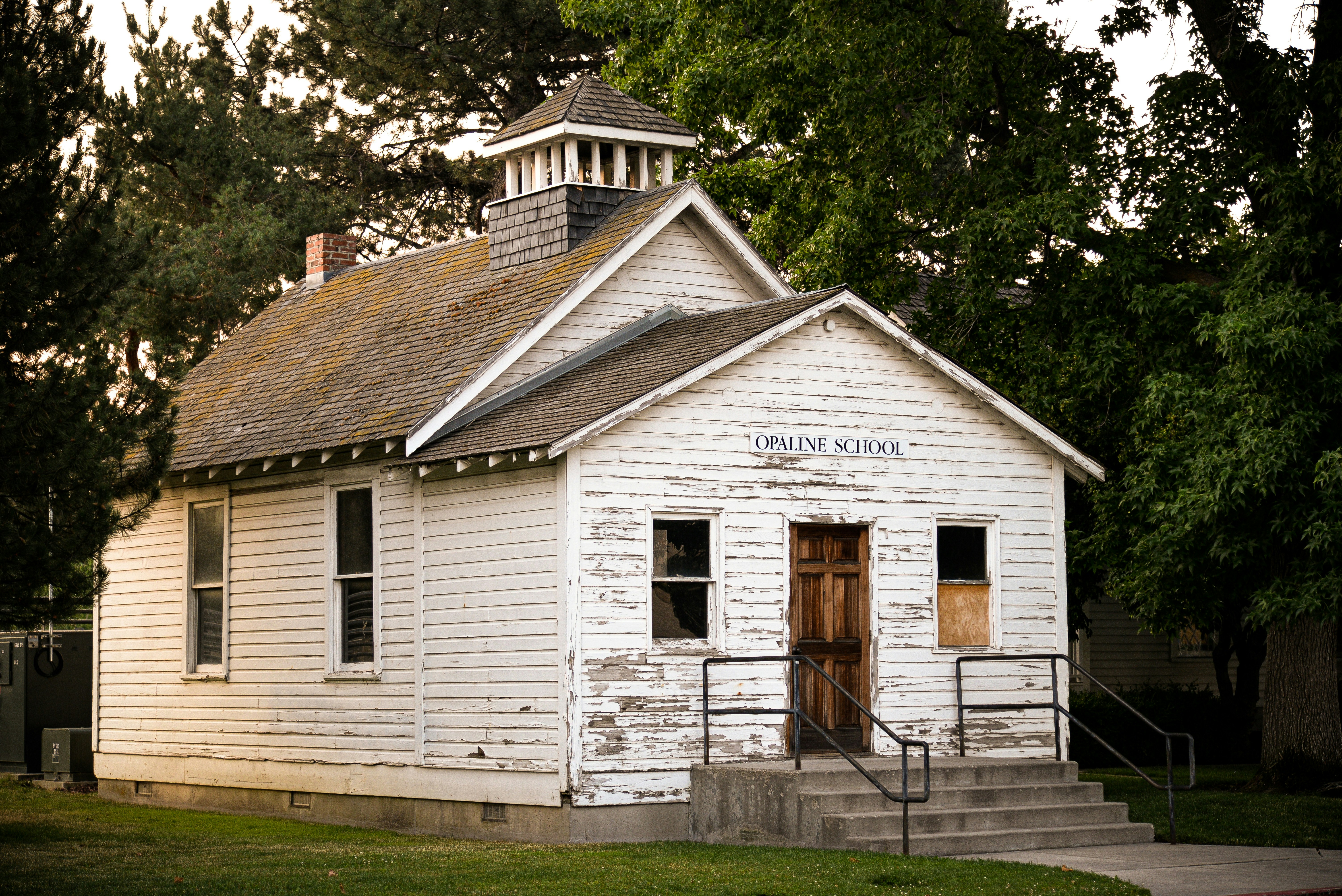
Recently I enjoyed the opportunity to visit another school while classes were in session. I visited various classrooms and was able to observe a slice of the daily life of a school somewhat like my own. This school moved into a new building only a few years ago, and the whole place is modern, efficient, and beautiful. Things appear to run like a well-oiled machine. I watched a friend of mine teach her class of fourteen in a spacious, sunlit room considerably larger than my own little basement room where twenty-two students are stuffed into a space that might be ideal for a dozen or so. You can probably imagine some of the thoughts that were running through my head.
Let me tell you about the place where I teach. During the heat of early fall each year, my first task when I arrive at school is to empty the dehumidifier that has been running overnight. I deal with the daily decision of whether to put up with the heat all day or to wear out my voice by trying to talk over the noise of the air conditioner. One day a few weeks ago when we flipped a breaker (for the umpteenth time) while running the microwave at lunchtime, the students wondered why it keeps flipping. I said, “This is an old building. It wasn’t wired to run a bunch of microwaves and air conditioners.”
“When was this school built?” asked one student incredulously. “1993?”
“Actually, 1952,” I replied.
“Well, I was close,” he said. I suppose 1993 and 1952 are equally ancient to him. I hid my amusement and noted the need to keep teaching math skills.
Old buildings have their quirks, and living creatures find ways to get in. One of the many unexpected skills I have acquired as a teacher is dead aim with a fly swatter. I’ve had a student get stung by a bee in the middle of class (Lesson learned: When there is a bee in the classroom, stop everything until that bee is dead or is chased out the window). And do you want to hear mouse stories? Ok, it may be best if I don’t get started on those.
I write all this because my guess is that most of you who read this blog do not teach in state-of-the-art buildings, nor do you teach under ideal circumstances. As we deal with inconveniences, we can choose complaining and frustration, or we can choose gratitude, creativity, and a sense of humor.
Gratitude lets us focus on what we have, not on what we wish we had. I am immensely grateful for a positive school culture, a strong staff team, and a supportive school community. All these things are much more important than having the perfect classroom with all the latest teaching tools. I would far rather deal with flies and flipped breakers than with bad attitudes or relational issues.
Creativity helps us realize that even the inconveniences can be part of our students’ education. Those ants that literally come up from under the edge of the carpet and start building a home there provide a free science lesson. Being a little uncomfortable from the heat or from the crowded room does not hurt my students in the long run, and it may in fact help them build resilience. Creativity lets me find joy in fixing the broken flushing mechanism in the toilet with a paper clip or in finding that I can make the clock work by stuffing a folded piece of paper beside the battery to make it fit more tightly. We teachers can be masters of creativity when the occasion calls for it, and it is our privilege to revel in this ability.
Keeping a sense of humor is a good way to keep our sanity. After all, sometimes the ridiculous inconveniences make the best stories afterward, and it can be delightful to laugh over them with fellow staff members. I can tell you that experiencing mouse escapades together is a quick way to create some great staff camaraderie.
Plans are underway for our school to construct a new building sometime in the next few years. Though I look forward to things like a larger classroom and central air, I will miss some things about our old school. I hope that we will not take the conveniences for granted. No matter the space in which we find ourselves as teachers, we can choose to make the best of what we have and to teach our students to do the same.
Photo by Khay Edwards on Unsplash

How Were You Thinking? Calling Students to Think Deeply
Facing discouragement about my students’ struggle to grasp math concepts, I added a small space on an assignment requiring them to briefly explain the thinking that led to their final response. By asking “Explain how you got your final answer in the space below,” I figured that students’ detailed descriptions would allow me to see where their thinking was going awry. I hoped to use this information to maximize my reteaching the next day.
With great anticipation, I sat down at my desk that afternoon to begin reading the insightful responses, but what I found left me speechless and a little annoyed. Rather than describing their thinking, the typical response to my question was Because I did math. Needless to say, that is not very helpful to a teacher! I wanted to scream, “Of course you did math! But what did you actually do?” In reflecting on that situation, I realized that a misunderstanding of the math concept was not the root problem. It was an inability to slow one’s thinking down so that it may be described, analyzed, and modified as needed.
If you spend enough time around school-age children, sooner or later you will be tempted to use these classic words: What were you thinking? In my mind, I can hear the exasperation in a teacher’s voice as he incredulously tries to interpret a student’s work. In moments like these, I have found it more productive to approach the conversation about thinking from a different angle. Encouraging students to become more mindful of their cognition will support content mastery while also cultivating habits of mind that will support lifelong, independent learning.
The human brain is one of God’s masterpieces. Neuroscience has advanced rapidly in the last few decades, yet there remains much mystery around the way that a rather large hunk of organic matter between our ears provides us with all we need for a lifetime of learning. By observing the thinking habits of people, we note that:
The brain is wired for efficiency. You may have heard the phrase ‘Use it or lose it’ in reference to abilities or knowledge. This reflects the process of synaptic pruning in which unused neural connections weaken while those used more frequently are strengthened. This allows messages to travel more quickly among the different regions of the brain. The efficiency, however, does not stop there. Much of our everyday thinking happens at a fast pace, so our brain must learn how to fill in the gaps by recognizing patterns based on prior experiences. This is ideal for completing tasks that are both predictable and routine. Daniel Kahneman, a well-known researcher in the field of decision-making and judgement, describes this as System 1 Thinking (2011).
Our brain also has the capacity for slower, more deliberate thinking. This kind of cognition naturally requires greater effort and activates a different set of neural pathways, primarily located in the region responsible for planning and reflection. This ‘lower gear’ thinking enables us to more effectively evaluate information, consider and make judgements about multiple options, and make decisions based on evidence. This stands in stark contrast to the pattern-based thinking described above! Kahneman (2011) speaks of this skillset as System 2 Thinking.
Our automatic, pattern-based thinking helps us move efficiently through familiar tasks, yet deeper learning generally happens when we intentionally shift gears into slower, more reflective thought patterns. Developing this skill requires that we grow in our awareness of our thinking and recognizing which speed our varied daily experiences require. Students who have the opportunity to intentionally practice these metacognitive skills will develop powerful habits that will support both academic success in daily class content but also grow into lifelong, independent learners. Becoming aware of our thinking is a learning process that is not necessarily tied to any specific curriculum or school content area. My experience has shown that it takes the awareness of a teacher to help students develop this skill throughout the school day.
Incorporating intentional thinking routines into classrooms is an effective way to accomplish these objectives. To do this, we need to transition in our practice from considering thinking as something that only happens inside students’ heads into a practice that can be visually demonstrated for the teacher to see. Building in opportunities throughout the school day for students to make their thinking visible invites everyone to slow down, evaluate their reasoning, and reflect (Ritchhart et al., 2011). This allows you, the teacher, to be in tune with how students are thinking so that the appropriate feedback can be given. Here are some ways that you can begin doing this in your own teaching:
Use Protocols as Guides. For students just beginning to think about their thinking, it can feel abstract and difficult to achieve. However, providing a simple protocol or template can remove that hurdle, allowing students to constructively engage in both System 1 and System 2 thinking. One of the simplest ways to begin is the See-Think-Wonder protocol: What do you see? (Use observation to focus on evidence) What do you think is going on? (Use evidence as the foundation for interpretation) and What does it make you wonder? (Generate questions that stir curiosity and inquiry). Ritchhart et al. (2011) describe many other helpful protocols in Making Thinking Visible. Resources may be found online and in their book on the topic.
Model! We likely all have heard of read-alouds, in which a teacher reads a book out loud to his class. I suggest that teachers also engage in think-alouds. These are planned moments of the day in which the teacher audibly thinks through a problem for students to see cognition modeled that would otherwise happen only inside someone’s head. This is most effectively paired with solving problems in mathematics, analyzing text in English language arts, and processing observations in science. This activity shows your students that thinking can be an extended process and not just a final answer. You can maximize the effectiveness of this practice by also inviting your students to participate as well!
Consider Thinking as the Final Product. I have seen this done effectively in mathematics by giving students just a few problems (such as one or two) and encouraging students to explicitly describe each step taken in words, sketches, and/or calculations. Yes, achieving the correct answer is important, but encouraging students to slow down and focus on their understanding is just as important. This allows the teacher to provide feedback on the process and not just the answer. A similar approach can be used in different subject areas other than math.
When my students explained their work to the math problems in my opening paragraph, my first assumption was that their answers reflected their misunderstanding, apathy, or laziness. However, I now see these responses as evidence of students needing to cultivate an awareness of their thinking, permitting their thoughts to be examined, discussed, and (when necessary) revised. Perhaps we as teachers should reconsider our propensity for asking students the question ‘What were you thinking?’ and going no further. Modifying our approach to include the question ‘How were you thinking?’ will encourage students to make their thinking visible or audible. Nurturing this practice in our schools will equip students to think deeply while also preparing them to use their God-given minds to faithfully serve others in ways that make a difference in the Kingdom.
References
Kahneman, D. (2011). Thinking, fast and slow. Doubleday Canada.
Ritchhart, R., Church, M., & Morrison, K. (2011). Making thinking visible: How to promote engagement, understanding, and independence for all learners. Jossey-Bass.
Photo by Fernando Santander on Unsplash
KJV Bible Memory Resources
Large flashcards with illustrations for each verse, coordinating coloring pages, and Bible Memory plans. Twelve passages available.

An open letter from the Education Committee
October 12, 2022
Christian greetings!
The Dock is owned by the Conservative Anabaptist Education Committee, and jointly operated between CAEC and the Resource Group at Faith Builders. Since its launch in 2017, The Dock has seen steady growth and increased demand. Its reach has expanded to include users in most of the world’s nations. The Dock is entirely funded by donations, and users like you can be an active part of its ongoing success. The Dock’s annual operating budget is $30,000, and your donations help not only to maintain The Dock, but also expand its offerings. You can use PayPal for single or recurring donations, or send checks to: CAEC c/o Mark Webb, 10555 Lew Jones Road, Rawlings, VA 23876.
Cordially,
The Conservative Anabaptist Education Committee
Gerald Miller
Mark Webb
Adin Stoltzfoos
Chet Stoltzfus
Matthew Peachey
Privacy Policy
How we handle your personal information
What personal information do we collect from the people that visit The Dock?
When you fill out a form on The Dock, or sign up for an account, you will be asked to enter your email address, information about your educational roles, and other details as appropriate to maintain consistent quality for all users of The Dock.
When visitors leave comments on the site we collect the data shown in the comments form, and also the visitor’s IP address and browser user agent string to help spam detection.
An anonymized string created from your email address (also called a hash) may be provided to the Gravatar service to see if you are using it. The Gravatar service privacy policy is available here. If you use Gravatar, your profile picture is visible to the public in the context of your comment.
If you upload images to the website, you should avoid uploading images with embedded location data (EXIF GPS) included. Visitors to the website can download and extract any location data from images on the website.
When do we collect information?
We collect information from you when you register on our site, fill out a form or enter information on our site.
How do we use your information?
To improve The Dock in order to better serve you.
T o ask for ratings and reviews of the content on The Dock.
To follow up with you by email or phone regarding a technical support or content question.
How do we protect your information?
Your personal information is contained behind secured networks and is only accessible by a limited number of persons who have special access rights to such systems, and are required to keep the information confidential. In addition, all sensitive information you supply is encrypted via Secure Socket Layer (SSL) technology. We implement a variety of security measures when a user enters, submits, or accesses their information to maintain the safety of your personal information. All donations are processed through PayPal and are not stored or processed on our servers.
Do we use ‘cookies’?
Yes. Cookies are small files that a site or its service provider transfers to your computer’s hard drive through your browser (if you allow) that enables the site’s or service provider’s systems to recognize your browser and capture and remember certain information.
We use cookies to
Understand and save user’s preferences for future visits.
Compile aggregate data about site traffic and site interactions in order to offer better site experiences and tools in the future. We use trusted third-party services that track this information on our behalf.
How we use cookies, and how you can manage them.
If you close a pop-up or message bar on The Dock, a cookie is set to help us avoid showing you that message again.
We also use Google Analytics cookies to help us compile aggregate data about site traffic and site interaction so that we can offer better site experiences and tools in the future. These cookies do not identify you personally, but they tell us your location and, in many cases, your device and your demographic information.
If you leave a comment on our site you may opt in to saving your name, email address and website in cookies. These are for your convenience so that you do not have to fill in your details again when you leave another comment. These cookies will last for one year.
If you have an account and you log in to this site, we will set a temporary cookie to determine if your browser accepts cookies. This cookie contains no personal data and is discarded when you close your browser.
When you log in, we will also set up several cookies to save your login information and your screen display choices. Login cookies last for two days, and screen options cookies last for a year. If you select “Remember Me,” your login will persist for two weeks. If you log out of your account, the login cookies will be removed.
You can choose to have your computer warn you each time a cookie is being sent, or you can choose to turn off all cookies. You do this through your browser settings. Since browser settings vary, look at your browser’s help menu to learn the correct way to modify your cookies.
If you turn cookies off, it won’t affect your experience except that your site preferences may not be saved and you may need to log in in order to use the Favorites feature.
Third-party disclosure
We do not sell, trade, or otherwise transfer to outside parties your personally identifiable information.
Third-party links
The Dock includes links to third-party products or services as well as content embedded from third-party sites such as Vimeo. These third-party sites have separate and independent privacy policies.
Embedded content from other websites behaves in the exact same way as if the visitor has visited the other website.
These websites may collect data about you, use cookies, embed additional third-party tracking, and monitor your interaction with that embedded content, including tracing your interaction with the embedded content if you have an account and are logged in to that website.
We seek to protect the integrity of The Dock and welcome any feedback about these links and content.
How long we retain your data
If you leave a comment, the comment and its metadata are retained indefinitely. This is so we can recognize and approve any follow-up comments automatically instead of holding them in a moderation queue.
For users that register on The Dock, we also store the personal information they provide in their user profile. All users can see, edit, or delete their personal information at any time (except that they cannot change their username). Website administrators can also see and edit that information.
What rights you have over your data
If you have an account on this site, or have left comments, you can request to receive an exported file of the personal data we hold about you, including any data you have provided to us. You can also request that we erase any personal data we hold about you. This does not include any data we are obliged to keep for administrative, legal, or security purposes.
General safeguards
You should know that
You can visit The Dock anonymously.
You will be notified of any Privacy Policy changes on this page.
You can change your personal information by emailing us or by logging in to your account on The Dock.
We honor Do Not Track signals and do not track, plant cookies, or use advertising when a Do Not Track (DNT) browser mechanism is in place.
We do not allow third-party behavioral tracking.
We do not specifically target children under the age of 13.
Email privacy
We collect email addresses in order to send updates and respond to inquiries
For regular email updates from The Dock, we agree to
Not use false or misleading subjects or email addresses.
Identify the message as an update from The Dock.
Include the physical address of The Dock.
Monitor third-party email marketing services for compliance, if one is used.
Honor opt-out/unsubscribe requests quickly.
Allow users to unsubscribe by using the link at the bottom of each email.
Summing it up:
We have a strong interest in maintaining privacy. We never sell advertising on The Dock, and we will make it our goal to treat your information with the same honor we want our own to be given.
Contacting Us
If you have questions or concerns regarding our use of your information, you may contact us on the contact page or use the information below.
The Dock
28527 Guys Mills Rd
Guys Mills, Pennsylvania 16327
United States of America
dock@thedockforlearning.org
6199 results found with an empty search
- Algebra 1 Class Work 4.1
Algebra 1 Class Work 4.1 Brian J Martin December 28, 2017 Algebra 1 Class Work 4.1 Document 00:00 / 01:04 Download Download This class work gives students practice working with equations and number lines. Download Brian J Martin
- Algebra 1 Class Work 6.2
Algebra 1 Class Work 6.2 Brian J Martin December 28, 2017 Algebra 1 Class Work 6.2 Document 00:00 / 01:04 Download Download This class work gives students practice working with number graphs and the slopes of lines. Download Brian J Martin
- The Giant Killer, or The Battle Which All Must Fight with Study Guide
The Giant Killer, or The Battle Which All Must Fight with Study Guide Edward Lake March 4, 2020 The Giant Killer, or The Battle Which All Must Fight with Study Guide Document 00:00 / 01:04 Download Download Download the book or preview it below. Download the study guide or preview it below. This 1868 novel by Charlotte Maria Tucker (ALOE) begins the Robyn family series. In this book, the Roby children struggle with sins that mirror the struggles of a knight named Fides in an allegorical book their parents reads to them and the Probyn twins. In that story, Fides has to battle and overcome giants that include Sloth, Selfishness, and Untruth. From this story the Roby children and the Probyns learn how to defeat their own giants. Download Edward Lake
- Pre-Algebra Class Work 8.1
Pre-Algebra Class Work 8.1 Brian J Martin July 20, 2018 Pre-Algebra Class Materials Pre-Algebra Class Work 8.1 Document 00:00 / 01:04 Download Download Class Worksheet to go with Lesson 8.1 Pre-Algebra Bob Jones Math. Practice in adding and subtracting numbers and variables, including some parenthesis. Download Brian J Martin
- Homemaking As A Ministry
Homemaking As A Ministry Cynthia Brubaker January 7, 2022 Western Fellowship Teachers' Institute 2021 Homemaking As A Ministry Audio 00:00 / 01:04 Download Download The home is a powerful platform for ministry, the ultimate place to nurture a love for God in children. Download Cynthia Brubaker
- In the World, But Not Of the World
In the World, But Not Of the World Mary Lois Shenk July 20, 2022 REACH 2019 In the World, But Not Of the World Audio 00:00 / 01:04 Download Download Mary Lois Shenk shares stories and principles from her experience of raising a family in an urban setting. How can we reach our neighbors and respond to their needs while keeping our children’s hearts? How can we direct their hearts toward God so that they develop a passion for advancing God’s Kingdom? Download Mary Lois Shenk
- Teachers and Secretary Needed at Shady Grove Christian School (Mifflinburg, PA)
Teachers and Secretary Needed at Shady Grove Christian School (Mifflinburg, PA) Unknown Contributor January 6, 2025 Teachers and Secretary Needed at Shady Grove Christian School (Mifflinburg, PA) Classified 00:00 / 01:04 Download Download Shady Grove Christian School is a small school with patrons from numerous conservative Mennonite and Beachy churches. We typically have between 65 and 85 students. For the 2025-2026 school year, we are currently in need of multiple staff. We need 2 elementary teachers and 1 high school teacher. First grade teacher (anticipating 4 students) Additional elementary teacher for 2nd, 3rd, or 4th grades (some flexibility in which grades you would teach based on your preferences) High School teacher: grades 9-12 are combined into one classroom with 10-12 students; curriculum is primarily self-paced and individualized; primary role is classroom management with a limited amount of active teaching or lecture Download
- CLE Social Studies Grade 3
CLE Social Studies Grade 3 Unknown Contributor June 4, 2019 CLE Social Studies Grade 3 Classified 00:00 / 01:04 Download Download I have 3 of the Living Together on God's Earth CLE Social Studies texts, as well as one teacher's guide, and one set of score keys. They are available for a donation of any amount plus shipping costs. Download
- Building On Our Heritage
Building On Our Heritage Sheldon Yoder April 10, 2020 CASBI 2020 Building On Our Heritage Audio 00:00 / 01:04 Download Download Having a clear-eyed understanding of our heritage on the one hand and a clear perspective of the times on the other, how do we build on our heritage in times like these? What exactly do we wish to build? What are some of the methods? Download Sheldon Yoder
- What Is That in Your Hand?
What Is That in Your Hand? Jonathan Hostetler May 30, 2025 CASBI 2025 Recordings What Is That in Your Hand? Audio 00:00 / 01:04 Download Download In this encouraging and inspiring session, Jonathan uses the story of Moses in Exodus 2-4 as a parallel to many aspects of being a teacher or a board member. When Moses experienced doubts, God assured him of His plan and equipped him with the tool already in His hand (a shepherd’s rod). Similarly, anyone working in a Christian school can be assured that their roles are not accidental but sovereignly appointed by God and blessed with His divine provision. Teachers and board members also have a “rod in their hand,” the vision and influence they wield to train the next generation to serve God’s kingdom. Those involved in Christian education should embrace their calling passionately, surrendering any burdens to Jesus, whose yoke is easy. “What Is That in Your Hand?” was presented by Jonathan Hostetler at CASBI 2025 held at United Christian School in Nappanee, Indiana. Download Jonathan Hostetler
- Algebra 1 Class Work 12.2
Algebra 1 Class Work 12.2 Brian J Martin July 20, 2018 Algebra 1 Class Work 12.2 Document 00:00 / 01:04 Download Download Class Worksheet to go with Lesson 12.2 Algebra 1 Bob Jones Math. Practice in finding the variable in an equation with an exponent. Includes addition, subtraction, and parenthesis. Download Brian J Martin
- Classroom Leadership: Establishing and Maintaining Order
Classroom Leadership: Establishing and Maintaining Order Elmer Glick July 23, 2025 Teachers Week 2015 Classroom Leadership: Establishing and Maintaining Order Audio 00:00 / 01:04 Download Download In this presentation, Elmer Glick focuses on effective classroom management and discipline strategies for teachers. It covers: Classroom Management Positive Expectations Procedures and Rules Relationships Preventive Discipline Remedial Discipline Listening to the other talks in this series for newer teachers: Setting the Tone Establishing and Maintaining Order Gaining Wisdom Through Knowledge Maximizing After-school Chat Time "Establishing and Maintaining Order" was presented by Elmer Glick at Teachers Week 2015, on August 4-7, 2015, held at Faith Builders Educational Programs in Guys Mills, Pennsylvania. Download Elmer Glick
- Essential Personal Qualities of Teachers (Jonas Sauder)
Essential Personal Qualities of Teachers (Jonas Sauder) Jonas Sauder November 2, 2018 Teachers' Week 2017 Essential Personal Qualities of Teachers (Jonas Sauder) Audio 00:00 / 01:04 Download Download No amount of skill or training can supplant the need for cultivating the inner qualities of the teachers heart. All teachers must carry authority, bring order, value learning, burn with compassion, have a vision, and exercise patience. This presentation considers how to stir up these qualities in our hearts in a way that will connect with students' hearts. Download Jonas Sauder
- Teacher needed for small Mission Outreach School
Teacher needed for small Mission Outreach School Unknown Contributor March 18, 2019 Teacher needed for small Mission Outreach School Classified 00:00 / 01:04 Download Download Our church's (Believers Mennonite Fellowship) school vision is to reach out and make available a Christian education for families in our community. Although we are from a small town in WV, the needs are great!! We are currently seeking a teacher for the 2019/2020 school term. We will have appx. 4 students with the possibility of more as families apply. We have mostly elementary students and at least one high school (10th grade) student at this point. In the coming year all students will be from the community so you will have opportunity to share the love of Jesus and God's Word with these students and their families. We primarily use the CLE curriculum along with a few others. If you feel this could be something God is calling you to do and would like more information or have any questions please contact our principal Robert Weaver at 304-668-2081 or board chairman David Robertson at 304-668-4901, or by sending an email to the address on the link below. You can also find information on our facebook page on the website link. Download
- Algebra 2 Class Work 4.3
Algebra 2 Class Work 4.3 Brian J Martin December 28, 2017 Algebra 2 Class Work 4.3 Document 00:00 / 01:04 Download Download This class work gives students further practice working with additive inverse numbers. Download Brian J Martin
- Prayer as Ministry
Prayer as Ministry John Coblentz July 19, 2022 REACH 2019 Prayer as Ministry Audio 00:00 / 01:04 Download Download Praying for others and with others is a ministry we easily neglect. But both Jesus and Paul—the two lives most visible to us in the New Testament—show us that prayer is essential to ministry, not an add-on. Download John Coblentz
- Nervous System Worksheet 1: Christian Light Biology
Nervous System Worksheet 1: Christian Light Biology John Mark Kuhns July 28, 2025 High School Biology Course Nervous System Worksheet 1: Christian Light Biology Document 00:00 / 01:04 Download Download This worksheet focuses on the cells (and parts of cells) in the nervous system. Download John Mark Kuhns
- 3 teachers needed for 2022/2023
3 teachers needed for 2022/2023 Unknown Contributor May 1, 2022 3 teachers needed for 2022/2023 Classified 00:00 / 01:04 Download Download We are currently looking for a teacher for grades 2&3 and a middle school teacher and a high school teacher for 2022/2023 year. Download
- Ordering Your Digital World
Ordering Your Digital World Kevin Shenk July 22, 2025 REACH 2022 Ordering Your Digital World Audio 00:00 / 01:04 Download Download As our work becomes increasingly computerized, so can our sense of digital clutter and frustration. This session explores both individual and organizational strategies for and getting things done in this brave new landscape while warding off digital messiness. We’ll explore tactical strategies for creating useful folder hierarchies, managing emails, going paperless, and even transferring thoughts to your computer. Ordering Your Digital World was presented by Kevin Shenk at REACH 2022, on March 24-25, 2022, at Calvary Church in Lancaster, Pennsylvania. Download Kevin Shenk
- How Can Parents Support Teachers? 12 Things You Can Do
How Can Parents Support Teachers? 12 Things You Can Do Shari Zook October 19, 2018 How Can Parents Support Teachers? 12 Things You Can Do Blogpost 00:00 / 01:04 Download Download One of the greatest gifts I have been given is the input of other adults into my children’s lives. Many adults give a little to them (extended family members, pastors, professionals, family friends), but their teachers give a lot. I essentially outsource my children’s training to them for six hours a day, five days a week, nine months a year. I want to be a loyal and appreciative school patron, but what am I doing in practical ways to support my children’s teachers? How am I setting them up for success? Writing from the perspective of a parent, I feel at a disadvantage on this question. So I took the liberty of asking the teachers at my children’s school to tell me about the support that means most to them. How can parents get on the school’s team and offer meaningful encouragement? This is what they said. 1. Ensure that your child’s assignments are returned completed—or communicated about, if not completed. You can be vocally supportive till the bus comes home, but why isn’t Betsy’s spelling paper making it into her backpack each morning? This is a small-but-ever-so-practical way to let teachers know you’re on their team. 2. Write a note of encouragement; speak life. Don’t wait to communicate until things are going badly. Let teachers know how you see them impacting your child’s life for good. They don’t know by telepathy that you’re supportive and grateful. Write it. Tell it to them in person, speak it out loud, say it behind their backs. Words of blessing mean even more when a class is going through rough waters—or when you’ve been present in the classroom, when you saw what was going on and can affirm your teacher specifically. 3. Be actively involved in your child’s education at home. In your questions and activities at home, reach into your child’s school interests and experiences. Build on what he’s already learning, and let the teacher know what you see. You are part of your child’s educational team. Teachers love to have you on board. 4. Communicate, communicate, communicate. Is your child having health issues? Or leaving for a trip? Maybe Dad and Mom will be out of town for a few days while Johnny stays at Grandma’s? Anything that may affect your child’s performance at school is important information to his teacher. A morning email or text is fine for many teachers – it saves steps in the early morning routine if they don’t have to make a run to the office to find out why a child is absent (or exhausted). 5. Cultivate friendship. Be open and eager to chat – about your child, about the latest book you read, about local events. Initiate relationship outside of school hours and roles. You may not believe it, but teachers are people too. They want to be more than distant professionals. Sometimes a school’s social events can feel lonely or awkward for a single teacher. She’s put much work into planning the evening, but when it arrives, she is alone in the audience. When both parents make a point of saying hi or initiating a short conversation, she feels seen and honored as a person. 6. Extend an invitation. There’s nothing like enjoying a meal they didn’t have to cook! Sharing it in your home and being drawn into your family circle is even better. Of course it will make their busy schedule even busier, but your hospitality is a beautiful gift. 7. Plan your family’s getaways and appointments during vacation, not during the school year. Parents who send their child to school every day possible conserve many hours of teacher time and much mental energy. Enough said! 8. Don’t be afraid to critique. In person. Most teachers want to hear when they are doing or teaching things you don’t agree with. When you come directly to your child’s teachers with your concern, it lets them know you’re paying attention, you want them to succeed, and you trust them to hear you and respond appropriately. Thoughtful engagement with a teacher is costlier than blind support, but it means immeasurably more. 9. Give a gift. Gifts are one of the loveliest ways to connect people with people. They are not something your children’s teachers will demand from you, or even expect--but that is the beauty of giving. It catches them off guard, when their heart is busy and careworn. It says I value you. I appreciate you. Gifts don’t have to cost a lot to communicate appreciation. A simple gift might be a chocolate bar, a stylish pair of socks, a certificate of service, or a good book. A larger gift might be a gas card or other gift card, a piece of local art, a subscription, or a lush basket of goodies. A special kind of gift is one that helps your teacher to equip her classroom – such as a gift certificate to Teachers Pay Teachers , Amazon, or your local education store. If you walk into a classroom and see attractive things that provide a learning environment where students want to be, most likely the teachers bought it out of pocket and on a limited personal budget. 10. Make food! When a mom takes time to concoct a delicious treat to send to school, teachers taste more than warm butter and sugar. They taste care: someone was thinking about me, and priority: someone deliberately carved time out of their busy day in order to make mine sweeter . Alternately, consider packing a lunch for your teacher, or bringing in a hot meal for a day! It’s one less thing for him/her to take care of. 11. Volunteer at school. Do you have a little extra time in your week? There may be something you could help with in the classroom! Teachers have a lot on their plates; your time can be a most valuable asset. You might listen to Bible memory recitations, grade papers, organize library books, scrub dirty corners, supervise recess, or drive for a field trip. Are you willing? 12. Pray. No one may ever see this aspect, but it is real. I remember one stressful year with my son, when each day as I dropped him off at the school doors and drove away, my heart groaned to God for his teacher, for his classroom, for his school. I prayed the Holy Spirit’s wisdom and presence into those walls. I cried aloud. Later, one of the teachers said to me, “I just felt there was something special about that school year, some extra measure of grace.” I am ashamed to say I have not kept up this habit through the years. Am I counting on others to do so? Does it make a difference? Would your school change if every day, the patron parents carried their staff and students to the Lord, and laid them in his hands? I suggest we give it a try. *I am intensely grateful to the quality men and women who invest in my children’s lives in the classroom. Special thanks to the staff of Faith Builders Christian School for their honesty in sharing what support looks like on the ground. Many of these words are theirs. Download Shari Zook