All Content

Psalm 119:17-24 GIMEL
The text of Psalm 119:17-24, sung acapella. The arrangement is by Michael Owens and Frederick Steinruck. The text: Deal bountifully with thy servant, that I may live, And keep thy word. Open thou mine eyes, That I may behold wondrous things out of thy law. I am a stranger in the earth: Hide not thy commandments from me. My soul breaketh for the longing That it hath unto thy judgments at all times. Thou hast rebuked the proud that are cursed, Which do err from thy commandments. Remove from me rep
Psalm 119:137-144 TZADDI
The text of Psalm 119:137-144, sung acapella. The arrangement is by Michael Owens and Frederick Steinruck. The text: Righteous art thou, O Lord, and upright are thy judgments. Thy testimonies that thou hast commanded are righteous And very faithful. My zeal hath consumed me, Because mine enemies have forgotten thy words. Thy word is very pure: Therefore thy servant loveth it. I am small and despised: Yet do not I forget thy precepts. Thy righteousness is an everlasting righteousness, And thy law
Psalm 119:145-152 KOPH
The text of Psalm 119:145-152, sung acapella. The arrangement is by Michael Owens and Frederick Steinruck. The text: I cried with my whole heart; Hear me, O Lord: I will keep thy statutes. I cried unto thee; save me, And I shall keep thy testimonies. I prevented the dawning of the morning, and cried: I hoped in thy word. Mine eyes prevent the night watches, That I might meditate in thy word. Hear my voice according unto thy lovingkindness: O Lord, quicken me according to thy judgment. They draw
Psalm 119:113-120 SAMECH
The text of Psalm 119:113-120, sung acapella. The arrangement is by Michael Owens and Frederick Steinruck. The text: I hate vain thoughts: But thy law do I love. Thou art my hiding place and my shield: I hope in thy word. Depart from me, ye evildoers: For I will keep the commandments of my God. Uphold me according unto thy word, that I may live: And let me not be ashamed of my hope. Hold thou me up, and I shall be safe: And I will have respect unto thy statutes continually. Thou hast trodden dow
Psalm 119:9-16 BETH
The text of Psalm 119:9-16, sung acapella. The arrangement is by Michael Owens and Frederick Steinruck. The text: Wherewithal shall a young man cleanse his way? By taking heed thereto according to thy word. With my whole heart have I sought thee: O let me not wander from thy commandments. Thy word have I hid in mine heart, That I might not sin against thee. Blessed art thou, O Lord: Teach me thy statutes. With my lips have I declared All the judgments of thy mouth. I have rejoiced in the way of
Psalm 119:129-136 PE
The text of Psalm 119:129-136, sung acapella. The arrangement is by Michael Owens and Frederick Steinruck. The text: Thy testimonies are wonderful: Therefore doth my soul keep them. The entrance of thy words giveth light; It giveth understanding unto the simple. I opened my mouth, and panted: For I longed for thy commandments. Look thou upon me, and be merciful unto me, As thou usest to do unto those that love thy name. Order my steps in thy word: And let not any iniquity have dominion over me.
Psalm 119:33-40 HE
The text of Psalm 119:33-40, sung acapella. The arrangement is by Michael Owens and Frederick Steinruck. The text: Teach me, O Lord, the way of thy statutes; And I shall keep it unto the end. Give me understanding, and I shall keep thy law; Yea, I shall observe it with my whole heart. Make me to go in the path of thy commandments; For therein do I delight. Incline my heart unto thy testimonies, And not to covetousness. Turn away mine eyes from beholding vanity; And quicken thou me in thy way. St
Psalm 119:65-72 TETH
The text of Psalm 119:65-72, sung acapella. The arrangement is by Michael Owens and Frederick Steinruck. The text: Thou hast dealt well with thy servant, O Lord, according unto thy word. Teach me good judgment and knowledge: For I have believed thy commandments. Before I was afflicted I went astray: But now have I kept thy word. Thou art good, and doest good; teach me thy statutes. The proud have forged a lie against me: But I will keep thy precepts with my whole heart. Their heart is as fat as
Psalm 119:25-32 DALETH
The text of Psalm 119:25-32, sung acapella. The arrangement is by Michael Owens and Frederick Steinruck. The text: My soul cleaveth unto the dust: Quicken thou me according to thy word. I have declared my ways, and thou heardest me: Teach me thy statutes. Make me to understand the way of thy precepts: So shall I talk of thy wondrous works. My soul melteth for heaviness: Strengthen thou me according unto thy word. Remove from me the way of lying: And grant me thy law graciously. I have chosen the

Old Fashioned Games for Dreary Days
In our neck of the woods, �November� is our shorthand for �bleak days with unremitting gray skies and lots of rain.� Sometimes we say �No� because that�s even shorter. But it doesn�t change anything.
What do you do with energetic children when the weather is too drippy to go out?
Here are some old-fashioned games we used to play when I was a kid. They�re good for corralling a herd of young�uns when you don�t have access to a gym or the great outdoors. I�m sure there are infinite variations; I�m explaining the simplest rules I know. Feel free to improvise and use what you have on hand.
Michael Finnegan
One person is chosen to be �It� and leaves the room. The rest agree on an action he must take upon his return � such as closing an open book, patting someone on the shoulder, or turning on a light switch. When he comes back into the room, they begin to sing Michael Finnegan or another nonsense song, on repeat. When he comes close to the thing he must do, they lower their voices. When he moves to the wrong part of the room, they sing louder. When he does the right thing, everyone stops singing and cheers. It seems impossible that he could guess, but who can decipher the secret coding of childhood? (all ages)
Swat
Need I say more? If you don�t know, ask your students how to play. In my childhood, we used a rolled up newspaper to hit the knees. In Europe, I found they used an empty plastic pop bottle on the head. Yikes. (all ages)
Jump Rope Games
Jump ropes are good for a lot of games besides individual skipping. Google it. Here are some ideas to get you started.� (age 6+)
Hide the Thimble
Like hide and seek, only hiding one thimble instead of many persons. Everyone tries to find it; the one who does hides it next time. (< age 8)
Winker
Everyone sits in a circle and receives a penny; the one whose penny says 1982 (or another chosen date) is the Winker. When the game begins, he tries to wink surreptitiously at anyone in the circle. If they see him wink at them, they must throw their penny into the middle of the circle. They have been eliminated. If they see him wink at someone else, or in general feel he is behaving suspiciously, they may say, �I suspect.� Someone else may say, �I agree.� The one who suspected then says his guess � �James Smith.� If the second person disagrees, the moment passes. If she agrees, James Smith is asked if he is the Winker. If they are correct, he is eliminated and everyone else wins. If they are wrong, the one who suspected him is eliminated, and the game goes on until a) the correct Winker is found and dispatched, or b) the Winker has eliminated all but one person. Multiple Winkers may be added for larger groups. If a Winker winks at them, they simply wink back and keep playing. (age 8+)
Farmer in the Dell
Everyone stands in a circle and holds hands to march around the farmer while singing The Farmer in the Dell, with a new person picked each time to be the farmer�s wife, the child, the dog, and so on. The circle narrows each time, as one more person moves to the middle with the farmer. (< age 10)
Animal Sound Match
Slips of paper are made ahead, with the name of an animal on each slip, but only two alike for each kind. (Pig, pig, horse, horse, sheep, sheep.) On the count of three, each person starts making the sound their animal makes, and trying to find the other person who is making the same noise. The game ends when everyone finds a match. (< age 10. I�ve known teenagers to play it, but only in the right mood.)
Congress
The group divides into smaller groups, with four or five people in each. In each round, one person from each group is sent out of the room. These �Congress members� collaborate in choosing an item to remember in their heads � as simple as a pumpkin, or as complex as George Washington�s thumbnail. They return to their groups, and answer rapid-fire questions to guess the item, answering only yes or no. The first group to guess the correct item wins, and new delegates are sent out of the room. (age 10+)
Nursery Rhyme Game
One person is chosen to be �It� and leaves the room. The rest pick a well-known nursery rhyme and are each assigned a word from it, possibly skipping nonspecific words like �the, it, and, or, etc.� So in order, children may have �Jack, Jill, up, hill, fetch, pail, water� and so on. When the It person returns, he asks any of them a question. �What did you have for lunch today?� Or, �Where did you buy your blue jeans?� They may answer truthfully or fancifully, but their answer must include the nursery rhyme word they were given. �I cooked up a bowl of soup.� Or, �I didn�t buy them, my friend Jack handed them down to me.� The It person tries to identify the nursery rhyme based on their answers. He may ask the same person a different question three times in row, if he wishes, and their word becomes more obvious. (age 10+)
People I Know
Each player receives three scraps of paper. On each, he writes the name of a person � historical, Biblical, literary, or personal acquaintance. All the scraps are gathered and shuffled in a basket. All players sit in a circle, and two teams are comprised, using every other person. The basket passes around the circle. Each player gets one minute to help his team guess as many names as he can, speaking quickly and using clues. He may say anything he wants, but use no hand motions or parts of the name. A name like Anne Frank might be recognizably easy, but even if the person knows nothing of the name, he breaks it into parts to describe it as best he can. �Who lives at Green Gables? Okay, that�s the first part, and the second is another name for hot dog.� He keeps the papers for any names they guess. When his time runs out, he throws any unguessed name back in the basket and passes it to the next person, who starts describing names for HIS team. The game ends when all the papers are used up, and the teams count their points, one score per paper. (age 10+)
Upset the Fruit Basket
I�m sure you remember this one from your own childhood. A circle of chairs is set, with one chair too few for the number of people. All players receive the name of a fruit � apple, plum, cherry, grape, apple, plum, cherry, grape, around the circle. The remaining person stands in the center, and calls out a fruit. �Apple!� All the apples stand and rush to find a different chair to sit in. No one may return to her own chair. The middleman tries to find a chair too, and whoever is left standing moves to the center and takes a turn to calls the fruit. �Upset the fruit basket!� means everyone finds a new chair. (< age 12)
Four on a Couch
This one is more complex. Each person writes their own first name on a slip of paper and places it in a basket. The names are shuffled and redrawn. You are the name you draw, but it�s a secret. Teams are boys versus girls, because teammates need to be identified at a glance, though some girls may have to join the boys� team to even out the numbers, etc. All players arrange themselves in a circle: boy, girl, boy, girl. One extra chair is added to the circle, so there is an empty spot. Four chairs in a row are chosen to be �the couch.� The goal of the game is to fill the couch with your own team members. The person to the right of the empty chair calls out a name, and whoever has that name on her slip of paper comes to sit in the chair. These two people trade names. The person to the right of the newly vacated chair calls a name, and the game goes on, with a name trade happening at each call. Names are first called at random, and then with increasing knowledge and strategy. You must remember enough of your own team members� names to call them up to the couch when you get a chance, and enough of your opponents� names to call them off the couch. Do you see? The team who fills the couch with their own players wins. (age 13+)
*
I hope you enjoy these games, perhaps for your next honor roll evening or indoor recess. Whatever the weather, we�ll make it together�right? Fingers crossed.

Myth Busting for the New Elementary Teacher
The first day of school approaches. Sharpened pencils, neatly stacked book, organized files, and alphabetically arranged encyclopedias grace your classroom. Everything is clean, shiny, and waiting.
I picture you standing at your classroom door on the first day. You are prepared to see your students; you are ready to begin living your dream as a teacher. This is good! I feel anticipation for you.
As you head into the warp and woof of the school year, you may encounter some �New Teacher Myths.� Those of us who have taught for a few years know that falling prey to these myths can happen quickly. Join me as we bust some common myths.
Myth 1: Never Smile till Thanksgiving
Perhaps we smile a little at this outdated adage. Isn't that how teachers functioned in the olden days? If all else fails, at least keep order? Perhaps.
We do, however, often underestimate the importance of a teacher's smiling face and cheerful presence. While it is not always possible to be at your classroom door when your students arrive in the morning, try to make it a priority. When you are there to greet and welcome your students, you communicate to them that they are loved by you; you are grateful for their presence in your classroom and you delight in them.
Our students need to know we are cheering for them and we want them to succeed. Hugs and high-fives are all appropriate for a little person. A hug and a bit of tender care may soothe the first grader who is missing Mommy. Smiles, hugs, affirmation, or cheerful encouraging words help to establish that positive classroom atmosphere. Smile a lot!
Myth 2: Every Lesson I Teach Must Be Amazing
May I bust this myth for you immediately? This is an unrealistic expectation, nor is it possible. Your lessons will not all be grand. Some of them will flop miserably. But take heart! Tomorrow you will teach Reading and you get to try again!
Playing the comparison game may come naturally when you peek into the veteran teacher's classroom. It appears as if she has props, visuals, and kinesthetic aids for every lesson.
First, remember that comparison is unfair. The twenty-year veteran has had two decades to grow her large, extensive collection of resources and to establish her root system. If you attempt to parrot her, you will find yourself on the path leading to serious burn-out.
Instead, ponder your day and your schedule carefully. Is there one lesson you can prepare that involves some pizazz? Preparing an extensive lesson plan for one lesson a day or several lessons a week gives you a much more sustainable goal than expecting that for every lesson.
Myth 3: I Am In This Alone
Young teacher, you may feel alone but you are never alone. Yes, that bump in the journey, that reality check may come a few weeks or months into the school term. Feelings of incompetence, panic, uncertainty, fear, or anger may surface. How are you to navigate this teaching journey well?
It is easy to cast a glance around at your co-teachers. Their classrooms are running smoothly, they know how to navigate challenging students successfully, and they have tips and tricks for teaching Math. You feel alone because you are still trying to find good classroom routines and it feels like your efforts flop when it comes to that challenging student.
Times of loneliness will come. You may find yourself alone in the school building still preparing for your History class, while the other staff members have departed. Acknowledge and embrace the loneliness. Talk to Jesus. Find a mentor or veteran teacher who can help you gain perspective during moments of reality checks. Be humble enough to ask advice; view the seasoned teacher as a resource, not a threat.
Myth 4: I Must Be Jesus for My Needy Students
Not all teachers encounter this myth. However, if you are blessed with a sensitive, compassionate heart, you will likely find this struggle is real. Perhaps your heart hurts because of a student experiencing neglect, hunger, filth, or abuse.* Some children are deep feelers but have no words to express the turmoil in their inner world. They usually go about asking for your love and attention in undesirable ways.
I know. We have all heard the stories. James comes into Miss Miller's classroom, destined for failure. His parents are divorced, his step-dad beats him up, he's failing in every subject, and he is sullen and depressed. Enter Miss Miller. She loves on and believes in James. In the shadow of her tender love, James begins to thrive, and soars to the top of his class. By the end of that school year, he's even studying a second language! In high school, he still sends Miss Miller notes about how she was his favorite teacher and turned his life around. Last time she heard from him, he was attending the university with plans of receiving a doctorate in Clinical Psychology.
In the honeymoon stage of our teaching career, stories like these can stir our hearts, despite the fact that they are not very realistic. We dream about how wonderful it would be�to be used in such a dramatic way in the life of one student.
Dear teacher, may I remind you that you are not the Savior? You have not been called to redeem the lives of your needy students; you are not that powerful. Yes, ask Jesus for ways to love on the dear little person desperately needing nurture and care. Times of pondering are appropriate. However, when you leave your classroom in the evening, try not to carry your troubled students home with you. (Those of us gifted with mercy are more vulnerable to this.) Place them in Jesus' hands and then go home. Spending your entire evening mulling over student needs takes significant energy and draws from your resources. Your job is teaching academics, not being a savior.
If God chooses to use you in a dramatic way in the life of a student, He may do that. But you should not seek that dramatic moment. Be faithful in showing love, kindness, and patience, and then focus your energies on preparing lessons and teaching well.
*If you know for certain that a student is experiencing sexual abuse, you are a mandated reporter because you are a teacher. Talk to your principal about the system your school has in place for handling situations involving sexual abuse.
Myth 5: Your Students Should Not See You CryIt makes them feel uncomfortable, doesn't it? After all, you are their teacher and you need to remain in control and in charge, right?
I recall an experience I had when in grade school. During one morning singing period, our teacher burst into tears! Initially, I thought this was funny, seeing the teacher cry, but that feeling was soon replaced with discomfort, as she continued sobbing in front of us. Nothing I could do would make her stop crying, and I came away from that situation with a vow that �I will not let my students see me cry because I don't want to make them uncomfortable.�
I have, however, been surprised by some of the conversations we had as a class during moments when I felt emotionally weak. One morning, shortly before the school day began, I received some disturbing news. With school was beginning in 10 minutes, I needed to get in front of my students, tears or no tears. Rather tearfully I greeted my class that morning and attempted to continue with my plans for the day. As I was herding students and chairs out of the building for our outside class, one of my boys paused beside me at the door.
�Miss Kuhns,� he said, �What are you going to sit on?� I paused, realizing that I had forgotten to bring my stool with me, which is what I perch on for outside classes. �I will go get it for you,� he offered, heading back to our classroom.
Perhaps my tears called forth a bit of manliness from my second grader that morning. I have discovered that times of emotional vulnerability can turn into times of sweet classroom bonding when I am willing to be real with my students. If the tears come, embrace them and let your students love on you. They need to know that you are a real person too.
As you encounter these myths or others on your teaching journey, I pray that you will be strengthened for the journey. May the Master Teacher bless you with wisdom and confidence!
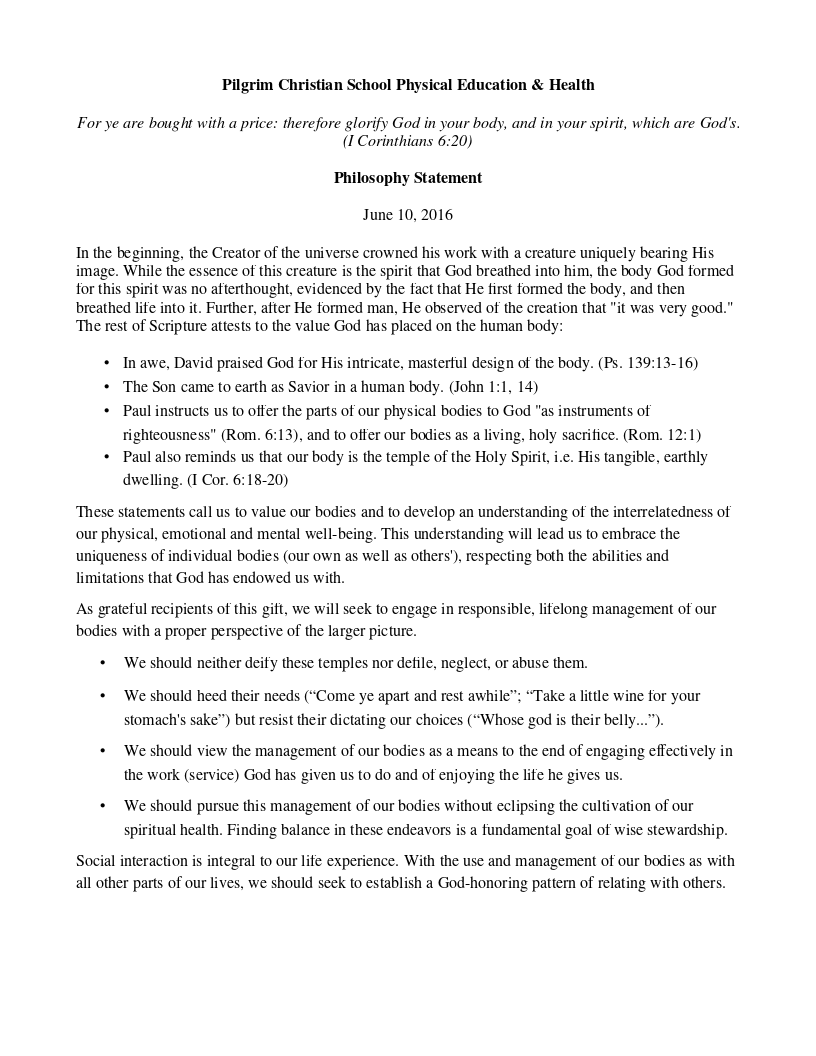
Physical Education & Health: Statement of Philosophy and Purpose
This document from Pilgrim Christian School grounds the school's physical education and health programs in a thoughtful understanding of divine creation and human embodiment. We take care of our bodies because they are good gifts from God.
I Have a Question!
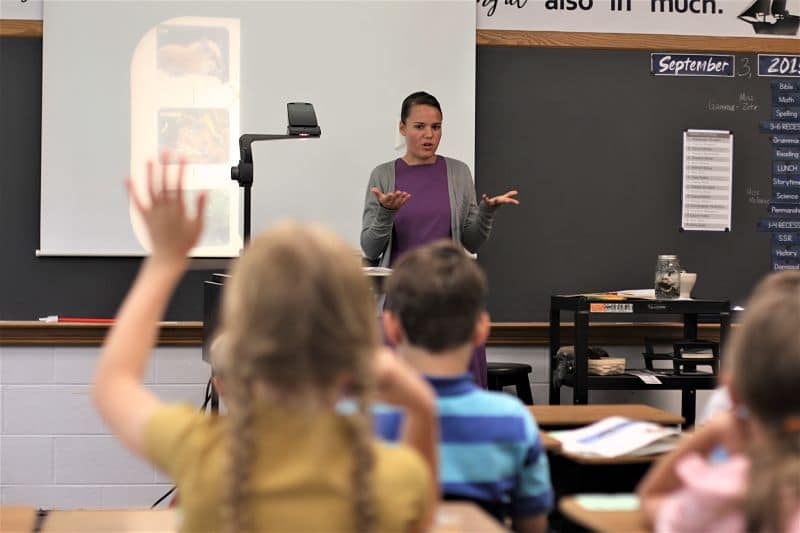
“Mrs. Birt, I have a question!” Nelson called out. Nelson has many questions.
When is God’s birthday? What does God look like? What is your name? (It is not Mrs. Birt!)I appreciate when children ask questions as they are learning and show that they are curious and wondering about their world. Children sometimes ask questions when I am reading aloud. “What is a coyote?” “What does ascend mean?” They ask questions related to our lessons. “Why does ‘know’ have a ‘k’?” Asking questions helps them learn, aids in clarifying information, and gives information.
How do teachers handle questions from children? Sometimes I will ask them to find the answer. Renee asks, “Where do I put this paper?” I tell her to read the morning list: “You will find the answer.” I may direct students to reread a page or story to find the answer to a question. I may say the answer. Maybe I don’t know the answer, so I tell them I will look it up. (I need to make a note of the question, so I remember to do that!) We can then have a brief lesson on what I find. Currently I have it on my list to find out how large zebra’s eyes are!
Questions are also a good teaching tool. Teachers ask high-quality questions of their students to spur thinking, begin discussions, direct understanding, and engage students. Questions are a great method of assessing knowledge retention.
We are studying “Questions and Questioning” in our staff professional development sessions and thinking about the kinds of questions we ask and how we can use questions to grow in our teaching. Some questions are used for classroom management, while other questions ask for information recall, and we need these types of questions. However, for learning purposes, we want to have higher-level questions to develop deeper thinking.
Looking at Bloom’s Taxonomy (table below) can help in developing higher-level questions. The words in the taxonomy can be used to plan quality questions and aid in higher level thinking. On the Evaluation level, use the “trigger words” to create questions of assessing, evaluating, or defending. You can ask students to support their answers with evidence from the text, as on the Analysis level.
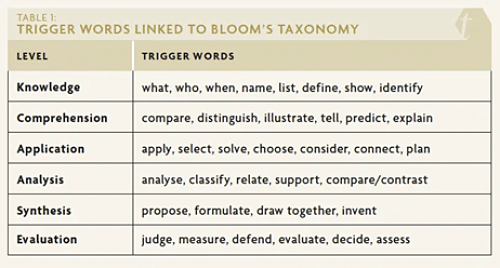 Table from Doherty, J. (2017). Skilful questioning: the beating heart of good pedagogy. Impact Journal of the Chartered College of Teaching.
One of our PD activities was reading a text and coming up with good questions. We then asked a colleague to evaluate our questions. I realized that I need to plan ahead on questions. I need to write the questions ahead of class and not try to come up with good questions while I’m teaching.
Teachers may write questions on the board and have students discuss them with a partner for a few minutes before writing or sharing their answers. The students may be required to give evidence to defend their answers. Questions may be used to drive a class discussion, or be included as part of a test or used for morning work. Students may be directed to write the questions.
Here are some strategies for using questions (adapted from Doherty, 2017):
- On the Hot Seat: Students take turns sitting in the ‘hot seat’ and answering questions.
- Ask the Expert: The teacher asks questions of a student on a given topic, and encourages other students to also ask questions.
- Ask the Classroom: Display questions to encourage thinking about pictures or objects in the classroom.
- Phone a Friend: A student calls on a fellow-student to answer the teacher’s question. The first student also gives an answer.
- Eavesdropping: The teacher circulates in the classroom, listening in on groups, and asking questions based on their discussions.
- Question Box: The teacher has a box containing a series of questions. At the end of the day, or end of the week, take some time to choose a few questions for class discussion.
- What is the question? Provide the answer, and encourage students to determine the question.
High-quality questions are powerful teaching tools. Let’s learn how to use them well!

Celebrating the Seasons in the Elementary Classroom: Autumn Ideas
It wasn’t until I started teaching first grade that I began to see the seasonal changes in our world through the eyes of a child. Their awe at the trees changing colors, the plentiful bouquets of colorful leaves they delivered with eager hands and sparkling eyes, and their appreciation of the colorful changes made to the classroom environment made each the transition into each new season an enjoyable one. There are plenty of fall crafts and art projects you can do with young students and most elementary teachers are familiar with those. However, are there other ways besides pasting, cutting, and coloring that will help heighten awareness to the sights, smells, and sounds of a new season? Can we touch on math, literacy, science, and history while learning in the moment?
Plan a leaf raking party
Each year, a parent from the classroom would offer their yard for our yearly leaf raking party. Armed with rakes, the children attempted to rake the leaves into large enough areas to jump into. The children greatly enjoyed the crisp air, working together to complete a task, and the crunch of the leaves as they jumped in the piles over and over again. An added bonus was always the drink and treats provided by the family hosting the party.
 Literacy connection: In reflection of the event, have each child share their highlight for the event or write a sentence for each of the five senses. “At our leaf raking party, I tasted… I heard… I smelled… I touched… I saw…” Discuss with your class the items the students wrote that pertain to autumn and usually are not experienced in the other seasons.
Make applesauce
Aunt Ada’s American Applesauce
Ingredients:
approximately 10 apples (teacher should prepare by coring but not peeling)
3 T. brown sugar
sprinkle cinnamon
3 ½ c. water
Additional items needed:
paper bowls, table knives, plastic spoons, napkins
Students receive an apple or half of an apple (depending on the class size) and cut apples into small pieces using table knives. Dump apples into an electric skillet with a lid. Allow students to help complete the rest of the recipe by adding water, cinnamon, and brown sugar. Cook until apples are very tender. Dish out and serve.
Math connection: Discuss the measuring cup set and teaspoon/tablespoon set measurements. Have the students arrange them in order from smallest to largest.Literacy connection: Read the book How to Make an Apple Pie and See the World by Marjorie Priceman. Using similar format, write a book as a class entitled How to Make Applesauce and See Berks County (substitute with the county that the school is located).Display the leaves they gather for you
Encourage their exploration of the world outside your classroom by delighting over the nature items they bring into your classroom that they collected while at home or at play. Decorate your shelves, window frames, and desk with the pumpkins, corn shocks, and leaves they bring in. Staple up their handfuls of leaves around your bulletin board. Have the students write things that they are grateful for on the leaves with permanent markers and then dip into beeswax and hang as garlands or make a “We are grateful for…” tree.
Observe the change of a tree seen from your classroom window
If possible, choose a tree that changes vividly with the seasons and that you can easily see from a classroom window. Have the students draw the tree as it changes with each season – now, an autumn tree. Wait several months and direct their attention to it again when it stands bare with no leaves in the winter. Wait several more months and have them note the spring changes. At the end of the school year, draw it a final time in its summer glory.
Literacy and science: Read Tree, Seasons Come, Seasons Go by Britta Treekentrup or A Tree For All Seasons by Robin Bernard and discuss the changes that the students anticipate to see happening to the “classroom tree.”Take local seasonal field trips
Is there an orchard you could visit? A pumpkin farm? A fruit festival? An outdoor cleanup project for elderly neighbors? A colonial village or demonstration that shows how food preservation happened in the olden days? Check Macaroni Kid for events that your students may be able to participate in. Click on the “Change Your Town” tab in the upper right to check for events specific to your local area.
As you experience this autumn season with your students, direct their five senses toward the changes. As they see you notice and delight in the changes, hopefully they too will become active and enthusiastic learners and observers of the world around them.
Granted, I am writing this article from the perspective of autumn in the northern hemisphere. Here in Pennsylvania, we have a distinct and vibrant change from summer to fall. If you are in an area where autumn is not so scenic, you may have to make some changes or adaptations to these ideas to fit your area.

Twenty-Seven Traits of Teachers
Teachers are called to balance accepting the abilities God has given us and pushing ourselves to grow. How did Jesus work with the twelve men that were His disciples? In this presentation, Mr. Lichty explores foundational themes, focusting on traits of teachers and how these affects their classrooms.View the PowerPoint.

Motivated Students: Tips for Active Learning in the Individualized Classroom
I just find myself in the middle of that. They give extrinsic motivation to get them— to bribe them—to do their work. They should be grown up enough to do it because it's the right thing to do. But then I find that I'm sometimes not that either. So what do you expect out of a 10 year old? And it seems like at some point down there, extrinsic motivation is necessary. They should grow out of it. And at what point should you expect them to do that? And I'm never quite sure. So we try different things, but it does seem that by the time they get into high school that are very self-motivated, and most of them are really, really on top of the work and taking it seriously.
What types of extrinsic motivation do you use?
We do a few different things to keep students motivated. One is that, if they get their goals done today, they get an extra 15 minutes of recess tomorrow. If they don't have homework at least four days this week, then they get an extra 45 minute recess next Friday. There's honor roll, a field trip for that. A few different things that it's not been a real big problem. There's always a student or two that you scratching your head trying to figure out how to keep them motivated. And what I suppose you have the same, same deal as a conventional type setting. It's probably different students. Different ones cooperate better with different settings.
What about incomplete homework?
In a setting like this, the homework's not really part of the grade, and so if you don't do your homework, if you just mess around all day at school and don't get your work done, and then you don't do your homework, then what do you do with that? How do you how do you get them to catch that back up and not get farther and farther behind? What do you use for punishment or whatever? And the best thing that I've done is in the last few years, I decided to attach it to the to the test grades. And if they don't have their homework done, it's two percent off of the final test grades in that subject. Whatever subjects that they don't do their homework. That has helped a lot. I give them two free times a quarter. Incomplete homework: no questions asked. No penalty. I know stuff comes up.
How do you answer students' questions?
Yeah. Try not to just give them the answer. There's probably occasions when I'm really in a hurry, and you have the answer, but, you know, usually I just start back at the point where I think they don't understand and ask them questions and try to guide their thinking. Or if they've got the work of all worked out, some of them have this habit of coming up with the wrong things. So they erase all that work, and then they put their flag up.
I say, "No. Leave all your work there. I can see what you're doing wrong, and I know what to explain. I don't have to explain everything about this. You probably understand most of it."
Usually got a sign turned around, or they added when they should have multiplied, or it's just something simple. And I'll tell them what row to look and see if they can find it, find the problem. Or if they just don't understand it, step back at the beginning, wherever I think they don't understand and ask them questions, help them to think through it on their own, and then hopefully that helps. Sometimes just having them read the question out loud is all it takes because they didn't read it properly, or maybe they didn't even read it.
What about the student who is too dependent on the teacher?
I think the best thing to do for them usually is just make them look a little look a little harder. Especially, usually it's more like social studies, that type of thing. They're supposed to read the text, and they're supposed to find the answers. And now they read a reading story, and here's a reading question, and they're supposed to answer it.
Well you answer their flag and say, "OK, where did they talk about— where's this in the story?"
The story is 10 pages long. I'm not gonna stand there and read it.
"Where do they talk about it?"
"I have no idea."
"Well, then you did read the story good enough. You have no idea where they even talked about this. Read the story again. And if you still didn't find it, put your flag up. But at least you got to give me the page where they're talking about it."
Or if I think they... I may, I may narrow it down: social studies textbook or something. I may say it's on this page or this column, but try to try to help them understand they're not going to give free answers. They need to put forth effort. But I try to guide them to at least the right place to look.

First-Grade Journals
At the moment the first-grade journal period is filled with stories of train “drivers,” swinging with friends, playing doll, fishing, and kayaking. Today one student was putting out a fire. Another one was playing with his dog while his younger brother sold apples and apple cider at a stand and his sister made apple jam to sell. Many of their stories are fiction while some are autobiographic. Some of these beginning writers have struggled to come up with a subject. Some of them have so many stories that they don’t know which one to journal about. These young authors have only had five weeks of school but most of them are already enthusiastic journal writers. (I’m using the term “journal” loosely. It encompasses any material that is composed during our journal class.)
Since we aren’t very far into the school year, you may be wondering if first graders are capable of journal keeping. While they may not yet be able to write the words on paper themselves, yes, they can keep a journal. Most young children love to tell stories. Our journal class is a means for putting their stories on paper and sharing them with others. For the first several months of first grade, the students draw their story and dictate a sentence for me to write on their paper. We then have a sharing time when they stand up and tell about the picture they drew. As first graders learn to read and write they can start writing labels on their pictures. Eventually I require them to write something about their picture. We end the year with a storybook that they have written and illustrated as an accomplished author and illustrator.
There are several benefits to starting this writing process early in a child’s academic journey.
- Creating a positive and non-threatening writing experience early in a child’s learning career cultivates an appreciation and enthusiasm for writing in later years. When a school creates a writing culture, it produces writers. Not every child will embrace the writing experience whole-heartedly but there are fewer groans and complaints of “I don’t know what to write about.”
- Starting to write early in the school years aids the child’s ability to develop clear communication skills. The more a child practices a skill the better he becomes at it. Introduce writing early enough that they become good communicators before they are graded on how well they communicate a thought.
- Children are creative. It has been stated that children are creative until they go to school and then school takes the creativity out of them. It doesn’t have to be so. Allow them to use the writing period to express their creativity.
- A main benefit that I see coming from early writing classes is the development of language and thought process. Children need to learn to tell stories in proper sequence. They need to learn to use complete sentences in oral and written communication. With the proper guidance and prompting, first-grade journal classes can help students organize their thoughts into coherent ideas. When a child has had practice dictating sentences to someone, it becomes easier for them to put their ideas on paper when that time comes.
We journal twice a week on set days. When it is part of the weekly schedule, students are less inclined to view it negatively. Most often I allow students to journal about whatever they would like. Once they become familiar with the routine, many of them start to think about what would make a good story in advance. In the week of Youth Hunting Day, several of my students came to school with hunting tales. They are primed and ready to put their stories on paper. I find that most first graders will journal about real happenings in their lives. A few will use their imaginations to concoct fictional tales. There are usually a few children who have difficulty coming up with something to journal. Then it is helpful when the teacher knows something about their life outside of school and can help give suggestions. It can also be helpful to have a list of ideas to write about. Some years I give out a story prompt that the student should use if they have not already chosen a topic. And sometimes I tell them that we will all be writing about the same thing. I usually need to warn them in advance if I require a topic. If I spring it on them at the last minute some of them will be disappointed that they can’t write what is on their minds. Some children have difficulty deciding what to journal about because they can’t draw the subject, or they can’t spell the words. I stress doing the best that they can because my dogs look pretty funny, too.
As we go further into the year and the spelling skills grow, I start requiring students to write their own words. At first they can simply label the picture. Then I require a sentence. As the ability progresses, I start urging students to produce more words and sentences as we slowly transfer from pictures to text. By the end of the year, my goal is to have the written words more prominent than the pictures.
Spelling is always an issue. Students are quite capable of wanting to write words that they can’t spell. I deal with this in two ways. First of all, I allow invented spelling. I also keep an index card for each child on which I write down the words they ask me to spell, unless it is a word they can sound. Many students will need the same words over and over so if you keep a card that they can reference, it saves you time.
I am not looking for perfect spelling, perfect structure, or perfect grammar. The main requirements for the end of first grade are that the piece begins with a capital letter, ends with a period, and names are capitalized. If I have time, I like to look over the written journal piece with the child. We look to see if there are other places to put periods. We may weed out some ands and thens. I may help them correct the grammar. I guide them into using complete sentences. I may have them fix some spelling errors. Usually this does not happen for every child, every time though I try to get around to each child every couple of sessions.
There are two components of a journaling class that help create enthusiasm and purpose for the writer. First, we start the class with a short story that I usually read to the students. Or, I may tell them a story. I choose well-written and classic stories. I also use this time to introduce them to the various story genres: the folk tale, a tall tale, fairy tales, tales from other countries, true tales, Bible tales, and story poetry. When possible, I use a book that is well-illustrated. Just as important to the young child is the sharing time. When we are finished with our journals, each child gets to stand up in front, show his picture, and share his story. Most children learn to enjoy sharing their stories. There are usually a few shyer students who need to be coaxed into telling their story by questions from the teacher to draw out the details, but after a while they are comfortable sharing also.
In the presentation part of journaling class, we talk about how to share the story and we also talk about what the listener does. A good listener pays attention to the speaker. He also does not laugh (unless the speaker means for them to laugh) or make uncomplimentary comments about the ability of the one sharing. This part of the class needs to be a safe time for all the students.
Our journal stories are kept in a personal ring binder that grows through out the year. Students enjoy seeing their progress and parents enjoy paging through the binders when they visit school. For many of the students, these pages have become a first-grade keepsake that they bring out and chuckle over in later years. And, some students have discovered an enjoyment of writing that goes with them through their school years and into life.