
All Content
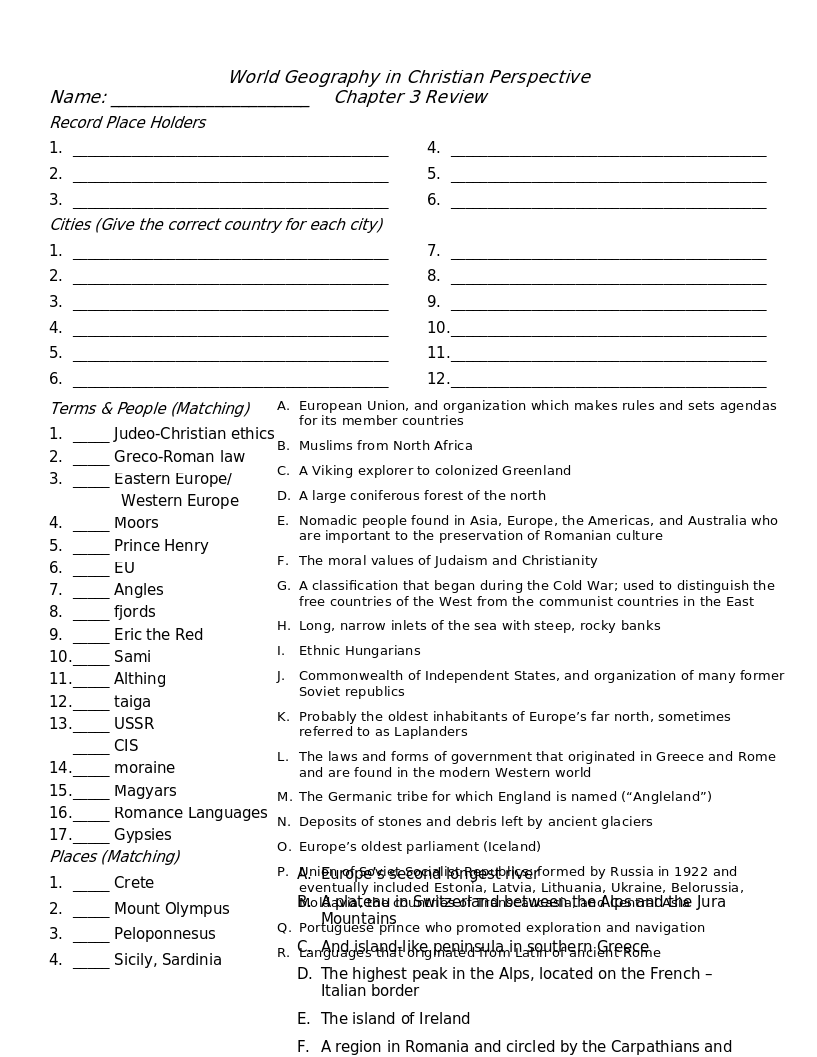
World Geography Chapter 3 Review
This is a review worksheet for Chapter 3 of Abeka World Geography in Christian Perspective.
Related: World Geography Chapter 2 Review
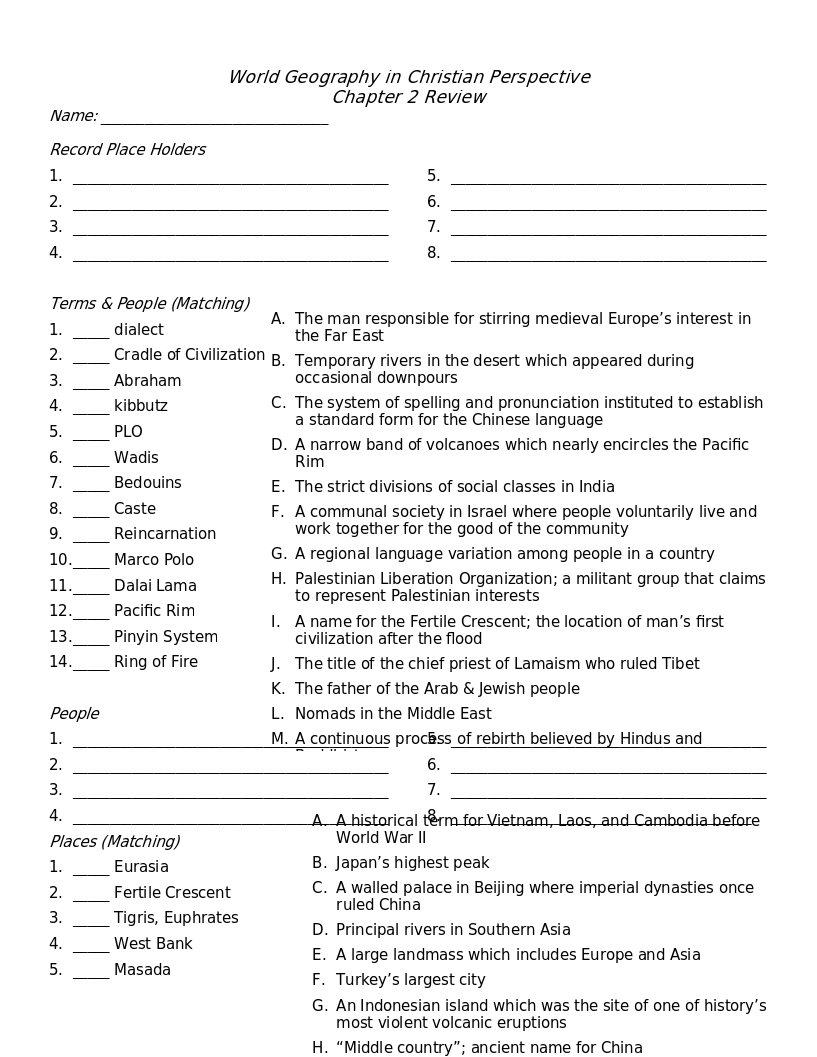
World Geography Chapter 2 Review
This is a review worksheet for Chapter 2 of Abeka World Geography in Christian Perspective.
Related: World Geography Chapter 3 Review

This Eternal Kingdom or That Mini Kingdom?
You want to be the leader of a new civilization on a beautiful island in the South Pacific, so you apply and get accepted to this position. You hire a personal tutor to educate and train you in everything you need to know for your new life and your future responsibilities. This guy is really, really good at everything from science to politics to personal relationships. He is supremely talented and incredibly wise. He has a knack for reading everything right.
So you give him control over every aspect of your training and agree to learn and do everything he tells you. He has daily teaching and training sessions with you that address every single facet of your life—your character, your personality, your knowledge of the world, your physical fitness—everything.
At the beginning of your training, he tells you, “I want you to keep going to school and to keep taking all the classes that you are already taking. Even though your teachers there don’t know nearly as much as I do and not all of the learning is really on track with mine, I want you to be as good a student as possible and learn everything you can. You will hear things there that won’t line up with what we are learning in our private session; just ignore this and keep going. The school also has some expectations of their students that would jeopardize your qualifications for the South Pacific Mission (like learning how to spin the truth for your own advantage); you need to refuse to participate in those activities. The goals and attitudes of your fellow students won’t be the same as yours, but just keep your eyes on the mission that you are about and stay focused.”
Looking at this student from the outside, he will look similar to all the other students. He is enrolled in the school and learning the same things and playing the same games. He completes all his assignments but often goes well beyond the requirements of his school and completes them with an eye toward satisfying his private tutor. He listens to the teachers, follows their instructions, and abides by the policies of the school (most of the time). Once in a while he deviates and seems to do his own thing. But through careful observation, one can see that he has a bit of a far-off look in his eye and seems to be listening to something outside of the school as he goes about his day. It looks like he is operating under the authority of the school, but his real authority is that man out there with whom he is going to meet after he gets home from school.
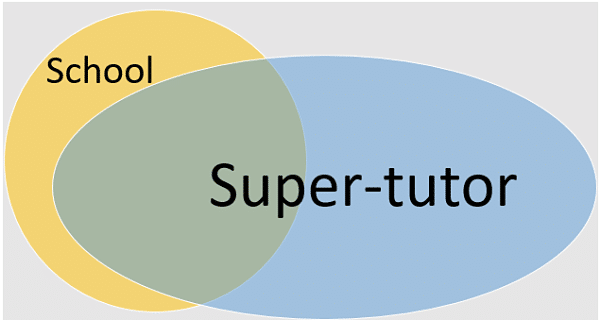
In our high school history class, we used this imaginary scenario to discuss a Christian’s position in civil society. He operates as a citizen of a nation-state and in its socio-economic structures but is being actively directed by an outside source of authority and with a core identity that is different from his peers. This diagram illustrates the rank and over-lap of this citizen’s authorities. Just as our imaginary student lives wholly within the sphere of his guide, a Christian lives wholly within the blue oval, the Kingdom of Jesus. That sphere extends into yellow territory, but the way that he participates in that arena is dictated by the purposes and norms of Jesus, the super-tutor.
In history class, we look at the timeline of world history, the rise and fall of kingdoms, and the Kingdom Jesus talked about when He entered history’s timeline. Studying this raises questions of how His Kingdom compares with other kingdoms.
History began with God creating the world. It belongs to Him. But the world—nature and humans--have been twisted and cursed because of sin.
The majority of the world’s inhabitants have given free rein to their twistedness, creating an existence that opposes the rule and will of their Creator. They have used their God-given abilities to develop systems—rebellious mini kingdoms—to insulate themselves from God. These rebellious systems include political structures, educational institutions, philosophical propositions, ethical systems, cultural norms, and economic structures. Over time, these systems become more sophisticated and more corrupt.
However, God has never ceased to be the Ruler of His creation. It has always been God’s desire that His creation—the earth and humans—be restored to a place of submission, love, and shalom, under His caring lordship.
Jesus inaugurated the Kingdom of God on earth with His life, death, and resurrection. The first message of His public ministry was, “Repent, for the Kingdom of God is at hand.” With this message, He announced God would turn the current rebellious mini kingdoms on their head. “God is coming to reclaim what is rightfully His. Acknowledge Him and submit to His rule voluntarily.” Jesus made it clear that anyone was welcome to join His Kingdom: “Fear not, little flock, for it is the Father’s good pleasure to give you the Kingdom.”
Christians are those who respond to Christ’s call to repent with faith and humility. They renounce their former allegiances in order to become a liege of the King of Kings . They recognize that the self-serving systems that they were a part of oppose God’s will. In doing this, they are “translated from the kingdom of darkness to the Kingdom of His dear son.” Local congregations of believers are the outposts of this God’s Kingdom, seeking to bring His will and rule to bear on everything within their sphere of responsibility and influence.
God’s Kingdom provides a stark alternative to the rebellious systems and mini kingdoms of the world. Like the experience of our imaginary student in the introduction, submission to God’s rule puts Kingdom citizens into an entirely different orientation toward life. Instead of seeking to avoid their Creator, they seek to know Him and love Him. Instead of putting themselves at the center of the universe, they acknowledge Christ at the center. The Kingdom provides them with a new identity, a new society, a new culture, a new agenda, and new methods.
As Christians live in submission and obedience to Christ, the Kingdom of God is their home, both in its current form and in its promised future form of perfection. As they live on the earth and see their place in history’s timeline, Christians do not find identity or meaning in race, class, political party, nationality, economic status, geographical setting, historical era, IQ, level of education, appearance, or competence—the things that history usually values. They find their place as they kneel before the throne of their Creator in love and worship. In coming under Christ’s rule, the rebels have come home, and “nothing can separate them from Him.”
Earthly activity as God originally designed is good and worthwhile. “Be fruitful, multiply, have dominion.” But now Christ has given a new and more urgent mandate for His Kingdom in this enemy-occupied era—the mandate to make and teach disciples. Christians prioritize their resources according to God’s priorities. Creating a rose garden, for example, aligns with God’s original intent for man and can be a good activity. However, in light of the world’s current needs, God calls Christians to put the majority of their resources into growing the church.
Christians look forward to the ultimate triumph of King Jesus over sin and death—the devastating aspects of a broken, twisted world. Jesus, our eternal King, accomplishes this triumph through the resurrection of human beings and the re-creation of the new heaven and the new earth where He reigns forever. Christian will enjoy life with Christ eternally in the new heavens and the new earth. This Kingdom is far superior to any temporary mini-kingdom that we study in history!
Questions for reflection or discussion:
- What kind of Kingdom is Jesus’ Kingdom?
- Where does this Kingdom exist?
- When does it exist?
- Who is a part of it?
- Can we tell who is a part of the Kingdom?
- Is “the Kingdom” synonymous with “the church”? What is their relationship with each other?
- What are the implications of being a part of Christ’s Kingdom? What difference does it make for those who are a part of it? How would people act if they became fully convinced that the Kingdom is established already and Jesus is reigning over it right now?
- What are the agenda, the laws, the style of governance of this Kingdom?
- What is its relationship with all of the other kingdoms of the world?
- What is the future of Christ’s Kingdom?

Introduction to Diverse Learners: Part 1 of 5
Classrooms as Greenhouses
I found it helpful to think about our classrooms like a greenhouse. If you imagine a greenhouse full of plants and full of all different types of growing things, each of them needs different things to help them to thrive. So some plants need much more water than others. Some need more sunshine than others. And some plants—their beauty is shown with greenery, and other plants are quick to flower and show their beauty in that way. And so each of our students, I feel like, it's helpful to think about them as being plants, kind of. So they're the plants. Our classroom is the green house, and as the teacher, we are the gardener.
And our task, our job as a teacher, is to help them or to create a classroom environment where each of the students is able to thrive in spite of their differences. Our job is the teacher: some of us will need to water here and prune here. We'll need to encourage here and challenge them forward—to call them to something higher. So each student is needing different things.
Embrace Differences
Our classrooms are diverse places, full of diverse people in them, and our students have a wide ranging interest, and ability levels, and backgrounds, and cultures, and we need to―I really believe that we need to―embrace them, embrace their differences and what we can learn from each of them. The concepts of community and empathy and caring for each other in spite of our differences is something that I feel we should be cultivating in the context of our classrooms.
Student of our Students
I believe as a teacher, we need to be student of our students and be studying, how do they learn? How does this student... how can I best help them to grow and to thrive? How do we begin studying our students and figuring out how to best teach them? Starts with having a foundational understanding of the learning differences or learning disabilities that students can be facing. And so that's the goal of this video series, is to give you some foundational understanding of the various differences that students can be experiencing or people that we come in contact with in life as well.
Types of Diverse Learners
I have here a chart or a graph, and this is a graph that's showing the percentage of students that are receiving services in 2017 and 2018 in the public school system. And if you look at this graph, you will see that this Specific Learning Disabilities category is the largest with 4.6% percent of students in public schools receiving services with these kinds of needs. Then there's Speech and Language Impairment, Other Health Impairment, Autism, and the list goes on. In the other category are things like a visual impairment or deafness or an orthopedic impairment like cerebral palsy.
In this series, we're going to take a look at three specific categories of disabilities that we might experience more often in our Anabaptist schools. The first one is dyslexia, which would fall under the Specific Learning Disabilities category. Then we will look at autism, which falls under its own category there in the yellow. And the third one would be ADHD, which falls under the other health impairment category.
Of course, in addition to these disabilities, there's many other causes or factors, things that can be impacting a child's success or performance at school. And some of those things could include like trauma, or attachment disorders, or different behavioral or emotional... the different level of emotional or mental health, or things like having a limited English language proficiency. All of these things can be playing into a student's... how they're doing in school.
Teachers as Problem Solvers
And so as teachers, we really have to be problem solvers and think about, well, what are all the factors here? What are all the different things that could be going on? And sometimes our first take or our first impression is not correct. And so we need to dig into that and look into and see what could be going on, and how could I be a help to them?
Things to Understand
In general I think there are some things that we should understand about disabilities. First, they can really range from... Like so say that someone has dyslexia. It could range from mild to moderate to severe to profound. You could have a mild case of dyslexia or a severe case that is very difficult to overcome or to work with. And so there is that range there.
Also, I think it's important to understand that, in order for an individual to be diagnosed with one of these disabilities, to be significantly impacting their functioning in life or their performance in the classroom. That's always compared with typical development. So a child... a first grader is going to be more moving more readily, and that's expected of them when we think about something like ADHD. It's always compared with what's typical for the child or the individual at their current age. Sometimes we joke about having disabilities like we're feeling restless. After we stop for a while, we kind of joke around like I have ADHD or something. And I, I really caution us against that. I think that that discredits the fact that these disabilities are real. These disabilities are very impactful for many individuals. And so we... Yeah. Let's be careful about how we talk about them.
Also, I encourage us to think about our role as educators in that we are professionals, and we want to be doing our job and talking about these kinds of needs in a professional manner.
People First Language
And one way that I think is important to keep in mind when talking about disabilities is using something called “person first terminology.” And that just means that, say that someone has Down syndrome, we wouldn't say "the Down syndrome child." We would say "the child with Down syndrome.” Or the same way we wouldn't have an "ADHD child" or a "dyslexic child." We would have "a child with dyslexia" or "a child with ADHD." It's just a small thing, but I think it can show respect. It can show that they're a child first, and the problem that they're encountering is not defining who they are.
Labels as a Tool
Also, I hear a lot... there's a lot of talk about labels, and how do we think about those? And there's a lot of pushback on labels. We don't want to label this person with this, with this problem. And we have to be careful with labels. We really do. They don't limit an individual or capture the whole person. That doesn't define who they are. And labels also, we don't want to use them as an excuse, as something that now I don't have to be putting forth my best effort, or I don't need to... like this behavior is OK because I have this problem. Like it's not an excuse.
And so I do want us, though, to think about labels as being a tool. When someone has been diagnosed with a specific disability, it opens up the door for resources. And as educators, it helps us all to have a sense like... It helps us to define what's going on, to know maybe where to look for resources, where to... It gives us direction for how to help our students whenever we kind of have a better understanding of what specifically is going on for them.
Labels also, I feel like, can be a relief for some when it kind of can explain why school has been so hard for me. It's not that there's something that I'm doing wrong. Yeah, it can be an incredible explanation of the challenges, and it can also give a way forward.
Conclusion
So as an educator, you won't need to be teaching long to encounter many of these disabilities in your classroom. And so I just encourage us to lead with empathy, to continue growing and learning and as educators. Do your research, look into things, and let's be advocates for our students, and help them, so that they can thrive, just like the plants that we've talked about earlier.
Tasting the Seasons
Imagine with me a walk in the woods or along a path in a state park, carrying a foraging basket. You bend to pick a purple violet, marvel at its velvety petals, sniff its sweet scent, and then you chew it slowly, sensing the delicate essence of the season. There are so many violets blooming, it is easy to pick a cupful for garnishes on salad or to make a small batch of lavender jelly.
Around a bend in the path, you see a hemlock tree (not the hemlock plant that killed Socrates) with elegant fresh growth, and you pinch off some tips to make a refreshing tea. You keep your eyes peeled for wild mint with its strong scent. If you are not a tea person, you can pull a few fat dandelion roots to roast and grind for ersatz coffee. Many state parks trails have shiny, low-growing wintergreen at the edges, with their bright red berries that taste a little like Grandma’s candy if you chew them slowly. The wintergreen leaves themselves are not very tasty until they have been made into an infusion or soaked in water for a few days, so they do not yield the instant gratification of the berries.
Unlike the pioneers who spoke with affection about finding the first dandelion leaves and chickweed to relieve the boredom of their winter diet, we are privileged to have plenty of fresh greens available year-round. There is, however, a deep satisfaction in picking sprigs packed with vitamin C in the wild. Purslane is another abundant and easily recognized “weed” with a juicy, tart flavor that enlivens sandwiches and salads. If you fancy a tangy bite to your salad, look for the prolific garlic mustard with its feathery white flowers that bloom early.
Maybe you are wondering about the vegetable course in your foraging. Wild asparagus is easily identified once you see it, but it can be hard to find in tall grasses unless you have memorized where it bolted to seed the previous year. Fresh hosta shoots, tightly furled, taste similar to asparagus and are so abundant in landscaping that they are easy to forage, with permission, of course. There is always wild garlic shooting up in the lawn, or you may find pungent ramps in shady, low-lying areas of the woods. You may even enjoy fern fiddleheads, sauteed lightly.
As you finish your stroll in nature, you look into your basket with pleasure. All of this variety was just growing out there, with the amazing flavors that God created in each plant.
Tasting Safely
As a teacher, your thoughts naturally turn to how you can teach this interesting skill of foraging to your students. Many children only hear one mantra, “Don’t eat the berries!” when they are on a nature walk. People tend to be held back by the fear of eating something that will kill them on the spot. In fact, there are very few things that are that lethal. Many toxic plants either taste nasty or cause a stomachache or warning rash. In the case of children, who like to taste everything, it is good for them to learn exactly what it is that they may eat. That means that the adults in their lives need to educate themselves, and then go on those nature walks and introduce the children to the joys of tasting nature.
Mushrooms are one aspect of foraging that can be potentially lethal if you misidentify them, so I do not recommend trying them unless you have an experienced forager to show you the characteristics of the edible species. Probably the most familiar mushroom in our region is the morel of early spring, and the thrill of the hunt is likely as great as the taste of the fried mushrooms.
Resources for Learning to Identify Edible Wild Plants
Foraging is not only an enjoyable experience, but also a valuable survival skill. As a young adult, my one provision for the looming threat of Y2K was to buy a Peterson’s Field Guide to Edible Wild Plants. My logic was that it would be easier to find some cattail roots for dinner than to store buckets of lentils. Thankfully, the need never arose, but the field guide remains a great resource on our bookshelf. It is so comprehensive, however, that it can be a little confusing. You do not want to search for a plant that grows in the Pacific Northwest if you don’t live there. We have been happier with regional field guides such as Northeast Foraging. And there are many regional guides available. Our top favorite guide is one that would likely work for most areas of the United States, because it is simply Backyard Foraging, a guide to sixty-five edible plants that people have in their landscaping.
Even better than field guides are people who can show you where to find plants, and who can explain how to prepare them. These people guides are also valuable when it comes to berries and fruits. There are roadside median strips, (usually public property, but you should make sure) dripping with ripe blackberries in August. There are acres of huckleberries in boggy places, or overgrown apple trees on abandoned homesteads. There are saskatoons and mulberry trees in state parks, with their luscious fruit falling to the ground. You will want to check the laws in your state for foraging, but in Pennsylvania state parks, it is legal to harvest nuts, fruits, and berries in reasonable amounts to feed your family.
If you are interested in learning the art of foraging, start slowly with the most obvious plants. Download an app that helps you identify plants, and then start tasting! You will be pleasantly surprised at how much fun it is to pop a rose hip into your mouth and have a vitamin boost as you stroll along, or daintily nibble on a daylily petal. If you have children with you, they will be following right along on the adventure, broadening their food horizons one dandelion at a time!

Lord Willing
�Tomorrow we don�t have school, because the teachers come to work. Monday when we come back, we have music and library.� This was my end-of-day announcement on March 12, 2020. Little did I know that was the last end-of-day announcement I would make to that class! We had a teacher in-service day the following day, and at the end of our in-service we listened to President Trump talk about this new coronavirus, and we found out we would not have school for two weeks because of this virus. We all know that the two weeks stretched into months, and school was cancelled for the rest of the year.
This year I have been very aware of how I announce things to my class � we will plan to do this tomorrow. It is Tuesday, so our schedule has PE. We will try to do _______________. Lord willing, we will _____________.
Lord willing� We are not assured of tomorrow�we know this from March 13, 2020. We never have been assured of tomorrow or tomorrow�s plans, but this has made me especially aware of it.
I have tried to be very careful with promises anyway � after a student accused, �You promised!� on something I was unable to fulfill. I try to say, �We�ll plan this�� �Hopefully we can ��
Children do need structure and a schedule, so I�m thinking how I can help my students learn to deal with unexpected events. We need to hold things loosely, as our administrator encouraged us last year. We�ve talked about promises and how God always keeps His promises, but sometimes people can�t or don�t. We discussed the meaning of �Lord willing.� We pray and notice answers to prayer and thank God. I try to make my classroom be a secure place, listening to the children�s concerns, praying with them and for them, reading and sharing scripture, discussing special verses, telling stories of God�s faithfulness, showing love and kindness for all. I don�t want to share my worries�they don�t need that burden. I try to keep current events discussions out of the classroom�yes, we can pray for these events, and might talk briefly about them, but we don�t need big discussions of them in first grade. I share reassurances from God�s Word and from my experiences.
One year we were scheduled to go to a greenhouse on our field trip and the manager had told me ahead of time that I would probably need to take the children around in the greenhouse as spring is so busy for him and he probably wouldn�t have time to give us a tour. That was okay�I love greenhouses and I went ahead of time and found many interesting things to share with the class. The day of the field trip was a very rainy day. When we got to the greenhouse, we found that they were not busy because of the rain, so the manager could give us a tour and he had time to let the children each pot a petunia for their moms for Mother�s Day. That was an unexpected treat on our rainy field trip, and we later talked about how the rain was disappointing because we couldn�t go to the park, but God worked out good from that and they got to have flowers for Mom! Sharing stories like this can help the students learn trust in God�s goodness.
One of my students commented last fall, �We don�t need to worry about covid, because God is in control!�
Now I see this topic again! Little did I know on February 17 when I left school, anticipating a snow day, that I would not be returning any more in February! Thanks to two snow days and a quarantine after a positive covid test, I have been home for a long time. Lord willing, I can return to school March 1. Again, I needed to hold things loosely.
I used to think, �Oh, I could �crawl in� if I did get sick, and get things ready for a substitute if I needed to!� This time I could not do that�I didn�t feel like going in, and I was not allowed to go in. I learned some lessons from this experience.
- I should have had a day�s worth of already prepared sub plans. I could have a reading, math, and phonics lesson of a general nature that a substitute could use.
- I need to plan ahead and be prepared, preparing the classroom and lessons before I leave in the evening, and not thinking, �I can quickly pull this together in the morning.� I might not be there in the morning!
- I was thankful that I already had classroom procedures and behavior plans in place so my students could continue in their routines somewhat and I didn�t have to explain everything. This also enabled the children to help the substitute teachers. (One day they had four different teachers!)
- I need to accept help from others. Some teachers offered to do things for me and I did appreciate that. I also needed to ask some people to get materials out for me, or to get something ready for the next day.
- I need to give grace to myself, to my students, and to the substitute teachers. Maybe something doesn�t get done just how I would have done it but that�s okay.
- I may need to let some things go. Maybe some of the work pages accomplished their purpose in being completed, but I don�t need to grade them.
- I did have copies made ahead and that helped.
- I tried to plan some special things for the children to help them in the uncertainty of their teacher being sick and having several different substitutes.

How to Make a Book
“I can’t wait ‘til journaling time. We get to start our books!” The class they’ve been anticipating for the past few weeks has now arrived. First grade students will embark on their big writing project of the year as we explore what it means to be an author and an illustrator. They will write their own stories, illustrate their work, and find success in being a “published” author. This project is always a favorite of mine and (most of) the students.
Some years back I sat in a workshop at a teacher institute and listened to Pat Roy share about her career of working with underprivileged students in her Washington, D. C. public school classroom. Having them write and illustrate their own books was one of the ways she connected with her students. As she detailed her method of book-making, I realized that this was a project I could get excited about. I’ve adapted and streamlined her methods—she didn’t have the computer programs we have that make it easier. It still takes some work and effort but I’ve found the project rewarding to students and teachers alike.
I do this project with first graders. However, it can be done with any grade level and can be adapted to suit any manner of needs. My ideas are just a spring-board to launch your own authorship project.
The project has several simple steps.
- Build enthusiasm and structure for the project.
- Students write their stories and edit them.
- The teacher puts the stories into book form.
- Students turn into illustrators and illustrate their works.
- Students share their books with others.
Those are the simple steps but let’s flesh each one out a little more.
- Build enthusiasm for the project. We start talking about the project several weeks in advance. I read some of the books that previous students have written. I also try to keep my ears open for stories they may be sharing with others. If I hear a story that sounds like book material I may comment to the student, “That could be a good idea for your book.” It is important that they already have an idea about what to write before the actual writing time, otherwise they may panic. We also explore picture books and discuss what an author and illustrator do.
- Build structure for the project. Talk about characters and the setting. Have students name their characters and identify their story setting. Invite them to think about the problem or main idea of the story. They could also think about what they might put in the beginning, the middle, and the end of the story. (These are all concepts that we’ve worked with in reading and writing so they are familiar with the ideas before this class.) Having students think about their project and detail some of their thoughts will help them know better how they want their story to proceed. However, first grade stories seldom follow the initial plot line and that’s okay. Their creative juices have been primed and the ideas can start flowing.
- Students write their story on regular paper. It’s not a book yet, it’s just the first draft. They will need at least four to five sentences. More is better but for some first graders this is all they can accomplish. I help with spelling as they need. Sometimes I need to help with ideas. And sometimes a child is off and writing for several pages. Some students finish their stories quickly. Some need several journaling periods.
- Teacher and student edit the story. I recommend light editing during a second journaling period. First the student is to read their story to themselves. I will often send them out of the classroom to read it aloud and catch any words they have missed or sentences that don’t make sense. Sometimes they may want to add more to the story or realize that some changes would make it better. After they think they have the story like they want it I will go over it with them. We make sure that periods are where they belong and the capital letters are in the correct places. I may suggest a few changes such as rearranging the sentences into better chronological order. I’m not too critical of spelling mistakes. This is not a highly polished project. The book is to be the student’s work, not the teacher’s. However, if I know a student is capable of fixing their mistakes, I will point them out and let them make the changes.
- The teacher puts the story into book form. To do this, I first start by dividing and numbering the story into seven parts. Each part is a page in the book. I have created a Power Point template that I use when I type up the stories. (See the attached file.) You can set up your own form using text boxes. Divide an 8 ½ x 11 sheet in half (landscape view). Each half of the sheet is one page in your book. The first sheet is the cover so the title and author are on the right half. The second sheet will have the last story part on the left half and the title page on the right half. On the third sheet, part one will go on the left half and part six goes on the right half. The fourth sheet has part five on the left and part two on the right. Sheet number five has part three on the left and part four on the right. I type up and print out each book, printing on both sides of a paper except for the cover which is printed on one side of a piece of cardstock Then I fold and center staple the book.
- Students turn into illustrators and illustrate their books. We spend the next journaling sessions illustrating the books. We look at library books with good illustrations, including various styles of illustrations. We discuss the covers and the title pages and then the students are allowed to let their creativity flow. Provide encouragement to the child who thinks they can’t draw. Recognize any commendable effort.
- Students share their stories with others. When the books are finished allow a share time. Read the books to the class. Encourage them to read the story to their grandparents or other interested listeners. Celebrate being an author!
I do not typically give first grade writing projects a grade and neither do I score their book. It’s my opinion that allowing creativity fairly free rein at this grade level is better than polishing their work to a high degree. At the same time, I do encourage growth in the writing process as a child is capable of accomplishing more. However, if you needed a grade for the project, you could create a simple rubric to check their progress. A rubric allows for growth without stifling the child’s own creativity in the project.
Doing this project in the fourth quarter with first graders always shows me how far they have come since the beginning of the year. I am always encouraged by the progress they’ve made and the students enjoy the satisfaction of accomplishment. They have written their first book!
Download the book template now or view it below.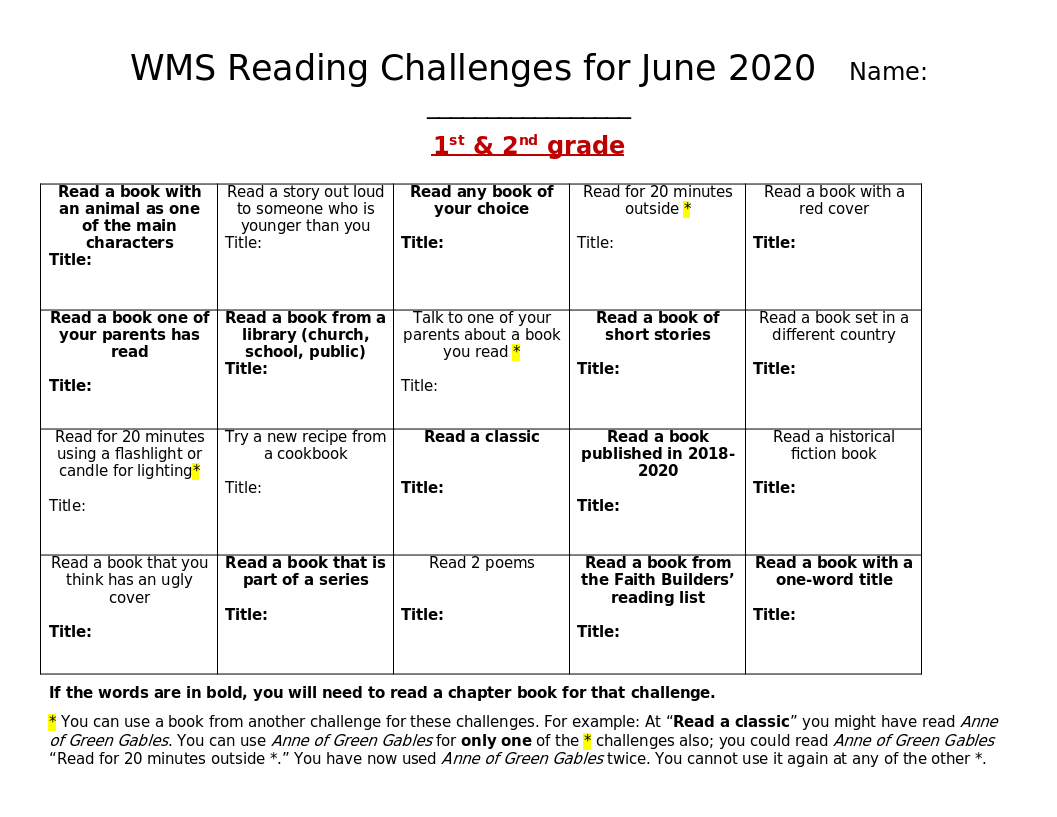
Summer Reading Challenge
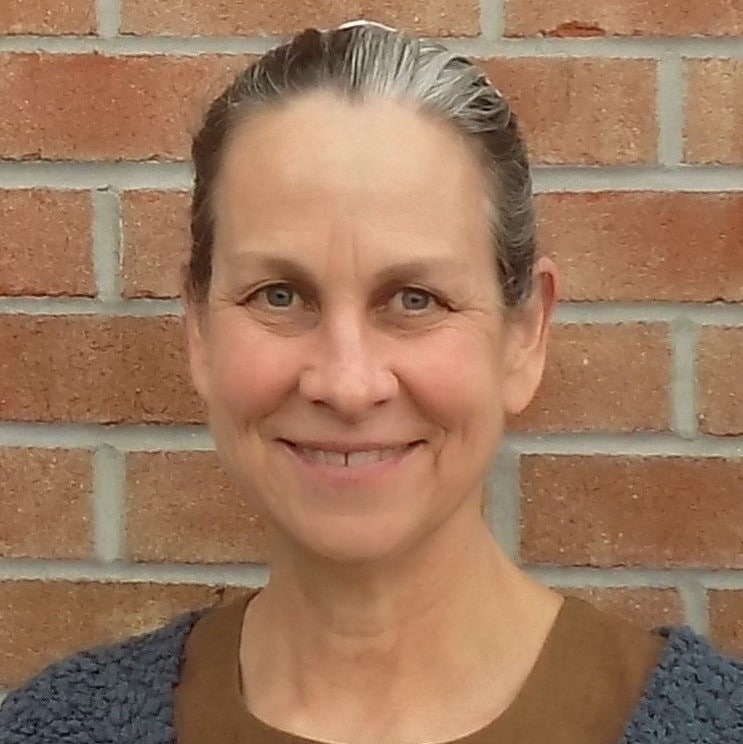
Summer offers a welcome break from school, for student and teacher alike. But the extended time off can also work against hard-won academic gains, especially for younger students still learning to read. Encourage your students to keep their minds active and engaged over the summer with these fun reading challenges. Although the challenges are written for Grades 1 and 2, they could be easily adapted for more advanced classes.
Learning by Doing: Developing Activities that Inspire and Inform
Introduction
So I made half of the class the immigrants, and I said, "All right! All of you have a job, and your boss isn't paying you very well and you have to work 16 hours a day. And so you get tired of it.
And so you go on strike, and you say, 'We don't want to work.'"
And they all laugh because they probably don't want to work.
And then I say, "Oh, well, here's the other half of the class. They just got off the boat from Ireland because the potato famine is going on. And guess what? They want your jobs. And guess what? The boss hires them. So now they have a job. And now you went on strike. But too bad nobody cares. You don't have a job."
And all of a sudden, they're not laughing anymore.
Tips for Collecting Ideas and Resources
How do you get ideas? So how do you plan to use these in the classroom?
Tip One � Gather Over the Summer
The first thing, and I've only done this one year, but it worked really well�I took the book home over the summer. I think it was the science book that year, and I researched whatever it was. We're going to do this science experiment and this science experiment. And most of the experiments were already in the book.
So I made a list:
- I can get these things from home.
- I need this from a hardware store.
- I need to get this at Hobby Lobby or whatever.
And I actually had all summer long, and I just gathered the stuff, put it in a box, had it in my classroom. And that way, as soon as that science experiment came up, I had it. I don't usually function like that, but if you've got the time, it's a wonderful way to do it.
Tip Two � Look One or Two Days Ahead
The second way is kind of what I'm doing now. I try to look a day or two ahead, and then a lot of times... For instance, tomorrow we're going to make these little like a handmade book. Before the printing press was out, if somebody wanted to make their own books, sort of like a Lewis and Clark Journal kind of thing. And I researched it. All I needed was some construction paper (which I went up in the office and got it). And then we used yarn to sew the binding. Well, I had that already in my closet from all of the industrial age stuff. I just keep my basket of yarn in there. And then we needed awls, and I figured out you can just use your pen. So for that, I really didn't need to gather much stuff at all.
Tip Three � Find Future Ideas in Present Subject Matter
Another way�and this is usually what happens with me�is when I'm teaching, I'll think of something. We'll be reading it or discussing it, and I'll think, hey, we could do that. We could make that, or we could do that.
For instance, we were reading about the South and the plantations and the cotton (which we'd already done this) and indigo dye and rice. Well, I can't grow rice, but hey, what about indigo dye? And so I went a mile up the road and I got a little bottle of purple dye, blue dye, whatever it was. And I told each�I went home and got a bucket�and I told the students they could bring in anything that was white and that I would�again I would bring them because they always forget.
(And I think if we tell them to bring stuff in, it's not going to happen as well as if I go to the thrift store and for a dollar, I find a whole yard of muslin. So I just cut the muslin up into little squares and they each got a square. So if they wanted to bring something, they could. But that way nobody's left out. Everybody can participate, and the parents don't have to, "Oh, dear. What does Mrs. Swanson want them to bring now?" I can just go. I've already got it myself, and nobody's troubled. If they want to, they can.)
And so we dyed the fabric. So that's an example of I'll just be teaching, and I'll read about something and I'll think, oh, we could do that. And I always have sticky notes nearby. I've got them on my desk, I've got them at my podium and I'll grab my sticky note, and usually I write it legibly enough. I'm writing quickly that I can read whatever I wrote down, and I'll run to the store that night, or
I'll get something from home, or I'll go up to the office and get the supplies. And so that's just kind of how I function.
Tip Four � Accept Students� Ideas
Number four would be my students give me ideas, and I tell them, "Y'all are starting to get the hang of this now. Why don't you, when you have an idea, just raise your hand and say, "Hey, Mrs. Swanson, could we do that?"
Maybe we could. A lot of times some of my best ideas I've gotten from students. It was their idea. And I've said, "Sure we can do that." And tell them that, you know, "Let's all work together. You give me your ideas too."
Tip Five - Research
Number five. If I'm desperate, I'll research� like those domes. I had no clue what to do for the Renaissance. And so I just looked up. I think I just typed in domes or whatever, and I just research, "How could we make a dome like out of bricks or something?"
Newspapers were much easier, and it doesn't take me that long. I've got one forty five minute period a day, so I try to do as much of it as I can at school.
Other Tips
And another helpful hint is just to think arts and crafts. Like a lot of times the art that they did in a certain country or during a time period, obviously it's very hands on. Usually we have a lot of the supplies here at school. And so that is kind of one of my first go tos is what was the art? What would they have made during that time period?
And another question was, how do we how do we make it sustainable? How can we keep doing this?
And I think the most important thing is just to set a goal and to purpose to do it. And my goal is, at the end of every chapter after the test, (usually we can take the test pretty quickly, have it graded, and either that day or the next day) have a twenty to thirty minute period where we work on something hands on from that time period to help them understand it better.
And so if I want my students to enjoy learning, I want class to be fun and hands on and interactive and involved for them. And then it's my goal to try to come up with something. And I have found that even my most feeble attempts (and some things that just didn't work that well) the student still appreciated it.They weren't sitting in their seats getting a lecture, and they were appreciative.
And even the guys�I teach these big boys that are bigger than I am�and they'll sit there and make their little yarn dolls or whatever. It's fun. They're doing something rather than just taking notes. They enjoy it.
I keep a notebook. This is my history notebook. I've got like money and just different pictures of things in here. And I keep pictures: Rosy, whatever, when the women all left home and went to the workforce. I have just different pictures and different things. I've done articles. I've got the plans for the domes in here, and I just keep these as my personal resource, and I'll put sticky notes in the book. I'll put sticky notes actually in my teacher's book, make Lewis and Clark journals for this or make Geodesic Domes for this. And I'll stick the sticky note in my book, and that way I won't forget from year to year.
And that's why you need to keep teaching, because every year that you teach, you have all these ideas and it gets easier and easier, and you've already put that hard work into it, so you might as well benefit from your years of teaching. Also, something that's very important is to make it yourself first, do it yourself, so that you not only have an example to show them, but you know exactly what you're doing, and you know where the where the pitfalls are.
Prayer of the Teacher
Not a Good Day
�The directions say I am supposed to find fourteen adverbs in this story,� she said. �I only found three of them, two not�s and one very.�
I was tired of this day and of this conversation, and inwardly I rolled my eyes. Of course, she would recall the words that always are adverbs and forget the rest of the lesson. And of course, she would try to get me to do the work of remembering for her.
�What question do adverbs answer? Look for the verb, then you just have to ask yourself�� I prompted.
��Which one?� my daughter asked in the hesitant tone of voice reserved for pure guesses. We had gone around and around parts of speech, particularly adverbs, and I couldn�t think of any fresh ways to make it stick. They seemed pretty straight-forward to me. I took a deep breath and repeated my admonition a little louder in the special tone of voice reserved for martyrdom during language class. �Look for the verb first,� I emphasized, but I wanted to say, �Come on. I must have told you this a hundred times. Just pull out the information and use it!�
It had not been a brilliant day in the school department. I knew it, and the children knew it. They were scatterbrained during spelling and positively plodding during flash cards. They lost papers and broke pencils and had to go to the bathroom and get more drinks in a predictable cycle. They forgot rules and broke them. Now we faced an uncomprehending blank in the parts of speech, and I was just plain weary of all the work, the repeated instruction, the endless day that couldn�t seem to get done.
I knew we could pick up the unfinished work again on the next day. The feeling of having lost ground went deeper than neglected assignments.
I had to be honest: the issues that had seemed to snowball, complete with personality clashes and a slightly shrill tone of voice coming from the teacher, were largely my problem. Although I was the grown-up in charge of the school day, I found myself facing off with things I couldn�t stand about these little people that I loved. I knew I had trampled impatiently on feelings and been unkind in my words. The first step back into fellowship was obvious: I gathered the children, apologized for the way I had spoken to them, and dismissed them to play. They lit up happily, and tore outside, gleefully abandoning adverbs and teacher both.
Teacher Time-out
It was sweet of them to be so forgiving, but I needed to get a better perspective, be taught by someone much wiser than me. As I was praying and thinking about the day just past, I turned to the prayer of Moses in Deuteronomy 32. Verses two and three had become categorized in my head as �The Prayer of the Teacher.�
"May my teaching drop as the rain,my speech distill as the dew,
like gentle rain upon the tender grass,
and like showers upon the herb.
For I will proclaim the name of the Lord;
ascribe greatness to our God!"
This was the introduction to Moses' last song just before God instructed him to go up to Mount Nebo to look at the Promised Land before he died. If you read the entire song, you hear Moses telling the people that he was well aware of their rebellious tendencies. He knew they were going to walk away from God after he died. He also remembered the provocation of their complaining that day he lost it and hit the rock.
If any teacher/leader ever had a reason to be aggravated beyond all endurance, Moses did. Yet here he was, praying that his words would fall �like gentle rain upon tender grass� in his very last address to these exasperating people.
Moses and Me
As a parent and a teacher, I find myself talking a lot. There are daily opportunities to respond with forbearance or to drop sarcasm like icy pellets of sleet. I find the strongest trigger to impatience when I am trying to convey an idea that I really love, and I am met with indifference or even resistance.
I can�t imagine the amazing things Moses knew after his lengthy meetings with God, but it didn�t seem to make a lot of difference to the recalcitrant people under his care. I am guessing there were times when Moses wished he could bellow out some pithy truths before finding a solitary place with a nice flock of sheep to mind.
Someone once said that every word and action is a statement of faith. The question that needs to be answered is this: do I believe that the power of Jesus within me is sufficient to exercise kindness in the face of the most irksome circumstances? Why, yes, I do! My children know when they have messed up. Sometimes I catch that expression in their eyes, "Oh, no, now I have really done it. I wonder what she is going to say." It stops me in my tracks as I think of the tender grass, and I take care with my words. I am making Moses' prayer my own, and it is helping me to speak graciously.
May my words be the supernatural kind that �ascribe greatness to our God.�
A Sweet Spring Treat
One of the best things about seasons is the excitement as a spent season rolls over into a brand-new one. While we all have favorites, spring is especially exciting with new life popping up everywhere. Who doesn’t feel their sprits rise with the return of the songbirds and the benevolence of the sunshine? It’s a great time to celebrate! We like to do edible bird’s nests, either as party centerpieces or just for fun springtime décor. They don’t usually last very long, but that is why we make them after all!
There are a lot of options for nest materials. Considering that we use melted chocolate to hold the nest together, it is good to use something salty. Very thin pretzels would work, but we prefer chow mien noodles because they look just like little bent twigs. For a gluten-free option, there are potato sticks.
Our glue is melted chocolate, preferably almond bark because it is formulated to melt very easily and set up again quickly. When working with melted chocolate and children, I find that the sooner it returns to a solid state, the better!
Of course, the nests need eggs. There are many candy eggs available. You can find large speckled jellybeans or Whoppers malted milk robin eggs.
Here is a list of what is needed to make ten sweet bird’s nest treats:
- Small styrofoam bowls and plastic spoons
- 12 oz. bag of chow mein noodles or other nesting material
- 24 oz. package of chocolate almond bark
- Candy eggs
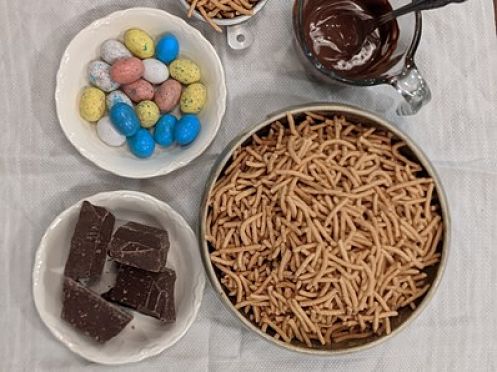
You will also need plenty of paper towels or wet wipes for the inevitable sticky fingers.
The first step is to melt the chocolate. Almond bark does not seize up quickly like some melting chocolates do, but it is wise to stir it often so that you can tell when it is melted and remove it from the heat. If you have a microwave, give it 30 second bursts in a glass bowl, stirring it well until it is pourable and smooth.
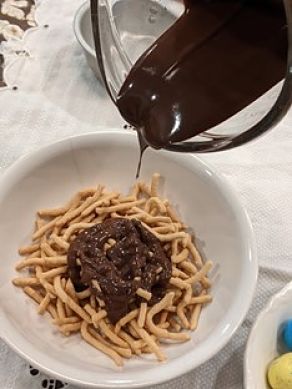
Give each child a small Styrofoam bowl and put at least ½ cup of nesting material into the bowl. When the chocolate is ready, pour about 1 ½ tablespoons on top of the chow mien noodles. It doesn’t take much, just enough to hold everything together. Each child can stir their own nests until the chocolate is evenly distributed, then form a dip in the middle for the eggs. At this point, the only thing required is about fifteen minutes of patience until the chocolate is set up and then the eggs can be placed into their hollow.
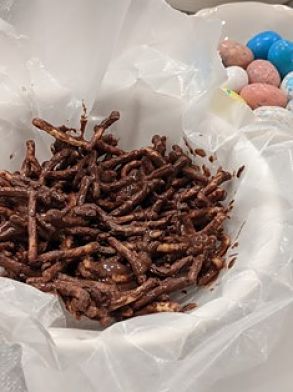
Styrofoam bowls work really well because it is easy to unmold the nests, although if the nests will be transported home, it is better to leave them in the bowls. And there you have it—a craft you can eat to celebrate the season!

Grammar Songs: Practical Grammar Songs for Grades 3-6
A SONG ABOUT ADVERBS
An adverb is a part of speech. It modifies a verb or another adverb.
It can also modify an adjective.
It answers three questions: how, when or where? It answers three questions: how, when or where?
SINGING FOR REVIEW
One of the things I do at the beginning of language arts is I have grammar songs that we sing together, grades three through six. And we sing— we learn—all the songs together. And as we learn the songs, I review questions and comprehension questions across the grade levels. And so I might start with reviewing with my oldest student, and eventually I can work on that concept in my youngest students even before they need to know it.
SINGING FOR MEMORIZATION
And the other good thing about singing is it's very helpful in memorization. And I find sometimes with grammar the reason students can struggle is simply because they can't remember all the terms. And I've found that students can begin to dislike grammar because it's so many terms to memorize, and why do I have to memorize them? Whereas if you learn fun, playful songs, they learn the terms without even trying it, especially the youngest students.
SINGING DEVELOPS EXCITEMENT
And I also try to include in my classes (or with those singing sessions) is, "Wow, you're in third grade, and you're already learning a sixth grade term, and you sort of understand it!" And I do as much as I can to build on that excitement and challenge and moving forward. And I find that over time, students can really become alive and excited with what they're learning.
A SONG ABOUT VERBS
Spencer: A verb is a part of speech.
Students: A verb is a part of speech.
Spencer: A verb shows action or a state of being.
Students: A verb shows action or a state of being.
Spencer: A verb is a part of speech.
Students: A verb is a part of speech.
Spencer: A verb shows action or a state of being.
Students: A verb shows action or a state of being. [together]
All: A helping verb helps another verb to express its meaning. A helping verb stands near the verb.
It is called an auxiliary.
Am, is, are, was, were, be, being, been.
Has, have, had, do, does, did, may, might, must, should, could would
Spencer: (could, should, could, would)All: Shall, will, and can. A helping verb stands near the verb,
and it is called an auxiliary.
A helping verb stands near the verb. It is called an auxiliary.
EMPHASIZING THE MEANING OF SONGS
Students can very easily memorize words strung together and not access the meaning of them. And so that is something I do try to do, is include an understanding of what we're saying.
A SONG ABOUT ADJECTIVES
An adjective is a part of speech, used to describe or define
the meaning of a noun or pronoun.
It answers the question, Spencer: How many?
Students: How many?
Spencer: Whose? Students: Whose?
Spencer: Which one? Students: Which one?
Spencer: Or what kind? Students: What kind?
All: It modifies a noun or a pronoun. It modifies a noun or a pronoun.
A SONG ABOUT DIRECT OBJECTS
D.O., D.O.
A direct object
is an objective element that tells what the subject is acting on.
D.O., D.O.. It's a noun or a pronoun after a transitive verb.
D.O., D.O. It answers the
question what? or whom? after the verb.
D.O. And its label, D.O..
Getting Along
“These girls are just not getting along. I think at one point each one has felt left-out or bullied. I don’t know how to help them!” worried a new first-grade teacher.
“Teacher, they won’t let me play with them.”
“They ran away when I came to play.”
“I don’t have anyone to play with.” These are comments heard after recess.
On a little different note, Tara told me, “I feel like a hot dog in a bun!” because there were two other girls who were always grabbing onto her and both wanted to be with Tara all the time. Competition, jealousy, and girl drama entered in this scenario.
We recently had a meeting of teachers to discuss how we can help these children to get along and be friends. I will share some of our ideas.
- Do role-play to show how we should play at recess. How can we include others? What can we do when someone is left out? How can we be a good friend? What do good friends do? What can I do if I want to play with someone?I would start the role-play with the teacher and another adult or older student performing. Do some scenarios the wrong way and have students identify the problems and discuss how we should act. Have students show the right ways to act. Example: One time I brought a doll and used that for my “friend” in a role-play. I did not talk to the doll, I just walked past her, and I left her out. We discussed how to be a friend, and then some students acted out a situation to show us how to walk up to someone, say “Hello,” introduce ourselves, ask “Would you like to play with me?” or whatever ideas they come up with.
- I suggest the teacher eat lunch with the “offenders” and talk about including others, not leaving out people, and being friendly. I do not like to see cliques at school (or anywhere!) and have addressed this in a lunch meeting. I asked specific people to join me for lunch and we chatted about being friends with everyone, not always playing with the same people, and making sure we are including others.
- Have a class meeting and address concerns with the whole class. Ask them to share their ideas for getting along. Decide which ideas we can implement right away. Check back on troubled situation.
- Enlist the help of a secure student. Talk with Jenna and tell her that Diane is feeling sad at recess and wants someone to play with. Ask Jenna if she would be a good friend to Diane and play with her. When I’ve done this, Jenna is usually pleased to be asked this and glad to be friendly to Diane.
Sometimes we might need to forbid children from being together. My two boys who are conspiring and always together to the exclusion of other children, are not allowed to sit together or be in line beside each other.
One time I had two students who had each told me that they didn’t have any friends. I hooked them up by seating them together, encouraging each to talk with the other, and finding commonalities for them, and soon they were friends.
Pray for wisdom for yourself and ask God to give ideas and ways to work with the children. Be a model of caring and compassion and including all children.Pray for and with the children. One year when there was a lot of girl drama we had prayed about it, and then after recess some of the girls told me that they had a prayer meeting at recess and prayed that everyone would get along!
Teach the children about love and friendship and being kind. This morning I am presenting a devotions lesson to two classes. We will discuss being kind, including others, and using our words to build up and encourage others. I will begin with “Sticks and stones may break my bones but words will never hurt me” and display some sticks and stones. We’ll talk about how sticks and stones really can hurt us, but is it true that words will never hurt us? Words may not hurt us physically, but they can hurt our hearts. Verses to use: Eph. 4:32, Psalms 19:14. I also use a lesson on “wrinkled hearts” (See my “Bursts of Teaching Ideas” post).
The Curious Ones
Albert Einstein said, �Education is what remains after one has forgotten what one has learned in school.� Clearly, Einstein had a good education; he was considered to be the most influential physicist of the 20th century. Yet as a child he was told by a teacher that he would never amount to anything. This unfortunate remark was made to a child who was too original and creative for the educational style of the day. It seems he kept being distracted by ideas about light waves and magnetic fields. I can imagine how frustrating this was for a teacher trying to show him how to identify a French verb. After all, not many people were curious about space/time in the 1800�s.
It is easy for educators to classify successful students as those who diligently lean over their books, finish assignments, and care about their grades. They are the ones we expect to do well in life, the easy ones, and we send them out into the world feeling like they are well prepared for its challenges. It only takes a little while to see whether a person continues to learn or whether they stopped learning back at school where they think it belongs.
Our goal should be to inspire a lifelong love of learning in our students. May I suggest that the curious ones will do better at this than the ones who check off all the high-school credits and stuff their brains into a frame along with their diplomas?
There are some students who thrive on following meandering trails off the beaten path of the course outline. These wanderers are curious about the cute kangaroo in the illustration on the page of prepositions. �Do you think it could also jump over a wall? Over a car? What about over a house?� At which point the teacher says, �Okay, let�s get back to the word over.�
They make unsolicited observations about the habits of the cardinals at the bird feeder and forecast precipitation because the clouds are stratus. This would be great if they didn�t do it during math class. They have burning questions about history, �Why is it called the Mason-Dixon line?� and have an uncanny way of catching their teacher off guard. Teachers learn not to seat them close to the window or in the back of the classroom, murmuring platitudes like, �Stay at your work,� and, �Focus,� as they walk past their desks.
It has been helpful for me to recognize the inherent intelligence that underlies curiosity. These are the children who love to learn, and random questions are a good indication that they have a thirst for knowledge, as well as enough imagination to wonder. Distraction is a problem, and it amplifies if a child learns to derail the whole class as a stall technique. At those times the teacher is tempted to tamp down any questions and rigidly stay the course. It takes wisdom to encourage learning about interesting things while at the same time assigning �boring things� such as verbs and nouns. Hats off to those who turn boring things into interesting ones!
In our home we call the distracting questions �squirrels�, because they are exactly like the squirrels that tempt our dog to break away from the leash and dash willy-nilly into the woods. We do chase squirrels a lot, because they are so exciting! Children do not easily forget research that they do when they really want to know. In fact, the genius of this sort of research is that it doesn�t feel like school or even like learning. It feels like fun. One year my son took a great interest in watching the skies. I bought a small cloud tracker with illustrations to help him identify each one. All of us learned a lot about clouds, and he took great satisfaction in marking the ones he saw. It didn�t occur to him that he was doing science in his spare time. Of course, there are times to be on the discipline of the leash. This is the teacher�s challenge: encouraging the curiosity while simultaneously teaching students to push through hard things.
In our quest to inspire love of learning, there are some valuable resources to help. A collection of field guides is very useful when Jonny wants to know what kind of trees are planted alongside the school yard and what kind of birds are eating the berries in the trees. He can look it up after class and tell everybody about it at lunchtime. Encyclopedia sets are a treasure trove for lovers of trivia, and dictionaries are great for the word nerds. Even if you know the answers to their questions, let them look it up and then tell what they learned. Obviously, for very young students, it takes a lot of the teacher�s time to help them find answers. The intersection of wonder and industry is often where curiosity gets shut down and learning becomes a grim business in textbooks.
Teachers are very busy people and squirrels do not seem so wonderful when the goal is to hike three miles at all costs. We, the educated ones in their eyes, model to our students what we believe about learning. It takes humility to say that we don�t know the answer to their question but we will try to find out. This reinforces in a student�s mind that we never stop learning, even when we are old enough to be the teacher.
Recently my fifth grader taped a simple motivational poster onto the wall above her desk. It came from a dollar store multi-pack and said one word, �Focus.� I applauded her for her insight into what tended to be an ongoing struggle, especially when it was time to do homework assignments. �Yes,� she agreed, �but there is also one that says, �Not all who wander are lost.��
I couldn�t argue with that.
A Review for Creative Writing Curriculum
Andrew and Jennifer Yoder’s curriculum is called Creative Writing: Sparkling Bits of Writing, and comes in two books. The first is recommended for grades 5-6 and the second for grades 7-8.
How the Curriculum Developed
The curriculum grew from Jen’s own creative writing classes at the school where Andrew still teaches. When Jen became a mother to their first child, she didn’t feel able to continue teaching. Andrew wanted to keep on with the creative writing classes but didn’t have time to prepare all the lessons. Jen stepped in to help by compiling her class notes into book form. The books have been under development for six years now, two years under the current student-and-teacher-tested edition.
The Layout of the Curriculum
The curriculum is designed for grades 5-8 and is intended to be a fun approach to creative writing rather than a grammar heavy one. According to Andrew, “Our goal is to stimulate the thinking process in a fun way rather than teach all the mechanics. That makes this a supplement to a grammar course, not a replacement. We feel examples are key to learning; therefore, we have student examples in the lessons.”
Browsing through the books, I found the assignments to be fun and engaging. A few of my favorites, rephrased here for brevity:
- Use the letters of your name to create an acrostic describing yourself.
- What happens on a terrible, horrible, no-good, very bad day?
- Create a dialogue between two non-living objects, such as a hamburger and hot dog.
- Answer this question: Would you rather live inside a glass house or a twig house?
- Paraphrase a parable as if it happened in today’s world.
- List 25 uses for a shoestring.
- Tell what happened after the “happily ever after” in a common children’s story.
The assignments are short, most easily doable in 30 minutes. Lessons are flexible, easy to pick up and do whenever it fits into your school schedule, with little forethought needed. Jen and Andrew encourage writing that stimulates enjoyment and imagination, with teachers providing critique rather than a grade.
The books hold three types of lessons:
Mini Writing Lessons: These short writing assignments encompass a nice variety, from writing simple poems to writing a letter to an endangered species. All are imaginative and engaging. Although Jen and Andrew deemphasize grades, every so often, a star appears at the top of a lesson, indicating a “gold piece lesson,” which teachers may choose to grade. Students are encouraged to spend extra time revising and polishing these pieces of writing, and a rubric is provided in the back by which to measure a grade. Lessons with a “friends” icon at the top are intended to be done with a friend, providing another fun piece of variety.Free Writing: Coming every five lessons, free writing lessons require students to respond to a writing prompt by writing non-stop for 8-10 minutes, “brain dumping” whatever comes to their minds. As a teacher, I used this technique on my elementary students, and they loved it. Free writing takes away all the pressure students associate with writing. Because there are no expectations besides writing continuously, students relax and enjoy seeing what comes out. Both teacher and students are almost always pleasantly surprised by the results. In fact, free writing became my most successful method of teaching creative writing, and the CLP team also plans to include it in the curriculum we are developing. I was thrilled to see it included here.Reading Response: Also coming every five lessons, reading response lessons provide a story for students to read, along with several questions to answer about what they’ve read. According to Andrew, reading response lessons are intended to “stimulate thinking and to learn techniques from published examples.” Excerpts come from a variety of classic literature: Oliver Twist, The Secret Garden, Not Regina, Daddy Longlegs.Each book holds 75 lessons, about the right amount to get you through a school year by completing several a week. Although Jen and Andrew recommend Book I for grades 5-6 and Book II for grades 7-8, I can easily imagine my former teacher self using one book to teach my entire class because at one time, I had five students in grades 1-8. Assignments could be modified slightly for younger or older students. The curriculum is flexible that way.
Strengths of the Curriculum
- Fun. I see this as really fun curriculum that will capture and engage students’ imagination and enjoyment. As a teacher who loves writing but has struggled to pass that enthusiasm on to my students, I believe this is the most important attribute of any elementary creative writing. If students learn in the early years how much fun it is to express themselves, they will put far more effort and creativity into writing when they reach high school years.
- Flexible. The curriculum is easy to fit into your schedule in the way that works best for you. Assignments are easy to modify, to pick and choose from, or to teach to several grade levels at once.
- Includes important writing concepts. Although this is a supplement rather than a complete curriculum, it does teach simple writing tools that provide an important base for young writers. The tools include:
- Show don’t tell.
- Active versus passive verbs.
- Concrete nouns
- Figurative writing such as simile, metaphor, hyperbole, and onomatopoeia
- How to structure paragraphs and essays
- How to vary sentence structure
- Story setting
Weaknesses of the Curriculum
- Not a complete curriculum. As mentioned, this is intended as an introduction to writing, rather than a comprehensive curriculum. Though the assignments are given in simple language that most students will be able to follow with ease, don’t expect review and repetition of concepts learned. Occasionally, for students who don’t have a strong base in a grammar curriculum, you may need to provide some extra explanation for certain assignments.
- Intended for beginning writers. While not necessarily a weakness, note that the curriculum is intended for beginning writers. Christian Light Publications does sell these books as a curriculum supplement and lists them in their catalogue as appropriate for grades 7-12. However, Andrew emphasized that field testing has confirmed the curriculum is appropriate for grades 5-8, not high school grades. As a multi-level teacher in need of ideas, I could easily imagine myself picking and choosing and perhaps modifying assignments for grades younger than 5th or including a high school student in a whole-room lesson. However, the difficulty level of the assignments is most appropriate for 5th through 8th grades.