
All Content

Introduction to Diverse Learners: Dyslexia
In the previous video, we took a look at 14 of the different categories of disabilities, and today we're going to talk about one of those specific categories, which is a Specific Learning Disability or SLD for short. And one of those specific learning disabilities is dyslexia.
Definitions
Dyslexia is a common learning disability, one that we know a lot about. In the Greek, "dys" means difficulty with, and "lexia" means language or words. And so dyslexia is difficulty with words. When a child has dyslexia, he has an average or above average IQ, and he's very intelligent. But when it comes to learning how to read and write and spell, that task can look insurmountable.
And I think that is important for us to understand; when a psychologist is evaluating a child for dyslexia, they're going to first test their IQ, or figure out their intelligence quotient, and then they compare that with their academic performance. A child is not diagnosed with dyslexia unless there's a very large discrepancy between their IQ and their performance or their reading and their spelling skills.
Dyslexia is something that's inherited, so it's often passed down from one generation to the next. And there are quite a few signs or symptoms, things to look out for. If you're wondering if this child might have a dyslexia, linked in the description below we'll include a signs and symptoms sheet that was written by Susan Barton.
Teaching Phonological Awareness
I really think that if we as teachers understand this skill or understand what is going into reading, that's going to help us when we think about "I have a child that's struggling with reading. How do I help them? What can I be doing in the classroom to be assisting them?"
Phonological Awareness
I think it's important for us to understand that dyslexia is not a vision problem. It is something called a phonemic awareness problem to understand this person, to talk about something called phonological awareness. And you can think about phonological awareness as being the umbrella term, the overarching term. It has a lot of different pieces or components to it. Phonological awareness is the ability to hear and manipulate sounds in spoken language. And so we use our ears, not our eyes, for phonological awareness.
Phonemic awareness is one piece underneath this umbrella, and there's a progression of skills as someone grows in their phonemic awareness. So when a child is very young, they may just hear�like when you speak a sentence�it's just like one long blur of language or a sound. And at some point a child is able to identify each of the individual words in a sentence. So, for example, if we have a sentence, "The cow plodded down the streets," a child will first need to be able to identify that there are 1) The, 2) Cow, 3) Plodded, 4) Down, 5) The, 6) Street. Six words in that sentence.
The next step in the progression is understanding compound words. So if we have "cow boy," we put that together and it becomes "cowboy," and "air plane" becomes "airplane."
The next step would be to identify syllables in a word. So let's say you have "table." A child should be able to identify that there are two syllables in that word, [clapping on each syllable "ta ble," or "banana" would have [clapping on each syllable] "ba na na."
You could also have the child make those motions on their on their legs and they could say [slapping one�s own thigh on each syllable] �ba na na," or say that we do "dictionary" [slapping one�s own thigh on each syllable] "dic tion ar y."
Phonemic Awareness
Then as they get better at this skill of phonological awareness, we get to the place where it's called phonemic awareness and that's taking the word and breaking it down to each of the individual sounds.
So let's say we have the word "go." A student would be able to identify, "g-oh," makes the word "go." Or sometimes it's helpful to use this motion. We can say "g-oh" and then teach the child to slide. And you blend it together, and you have "go." Also that would work with like "past" "p-as-t." And these are the types of skills that a child with dyslexia is struggling with. They're having difficulty breaking down a word into its parts, and that happens when they need to read a word.
Also, when they need to spell. It's the same skill. It's just, you know, encoding and decoding. Then we can even make this even trickier, and I can say, if I ask you to say the word "hop," you can say "hop," and then I can say change "h" to "st," and the word is "stop." And then I can just say change "p" to "k," and the word is "stock." And then I could change "o" to "i," and now the word is "stick." And so you have the ability to manipulate all of those sounds and change those words around just by changing one phoneme or one piece of the word.
Spotting Dyslexia
And so when a child has dyslexia, as you grow more experience with this, you'll be able to spot it in your classroom.
Spelling
One of the most common things with dyslexia is the difficulty with spelling. And that that is because, when a child goes to write a word, they're just trying to remember how it looked. They're not thinking about how it sounds and all of the different parts that are part of it. And so they might just wildly guess the spelling or, if they have a spelling list, they might be trying to memorize the words when instead they should be sounding the word out in their head.
A child with dyslexia will do things like, when they're reading along and the word should be �horse,� and they might say an entirely different word because of the picture. So let's say there's a dog, they might read puppy because they are basing what they're reading off of the pictures.
Nonsense Words
One of the true tests of phonemic awareness is being able to read nonsense words. So a word like "mip"�they should be able to read that because they can sound out the individual parts. A child with dyslexia is going to struggle with that because it doesn't ring a bell to them as far as having remembered it from somewhere else.
Relationship of Testing and Content Knowledge
In older grades, as students are learning to be more independent with their work, sometimes it's� it can be really common that a child does really... like they know all of the information. They understand all of the content. And when you ask them questions in class, they can give you back the answers. They remember what they're being taught. But then when it comes down to having a test and needing to read the test and write the words out, that can be extremely difficult. And so there's like the question of, "is my test testing their knowledge, what they know, or is it testing their ability to read and write?"
Those are some of the things that I often see in students when they're having dyslexia.
And as we mentioned in the previous video, there is a wide range. So it could be just a mild case where this shows up a little bit, but with help in the classroom, some accommodation or some extra teaching here and there, they will be just fine. And then dyslexia can also be a really severe problem. There's a range there.
Tips for Responding to Dyslexia in the Classroom
Clear on Phonics
What should we do about this? And we've kind of touched on this already, but I think first as teachers we can think about preventing this problem or being intentional about our teaching, especially in the kindergarten through the lower elementary grades. If we can teach phonics very explicitly.
Motions
If we can incorporate motions like I was showing you and some phonemic awareness practice right� kind of incorporated�in with our reading and spelling, teaching that can be... we can maybe avoid some problems, especially when there's just a mild or a little bit of a struggle for a student.
Adapting Tests
Also in the classroom, we're going to need to be accommodating and doing things like reading the test out loud for them when they need us to. And I always think about, so I teach third grade and students, for the first time that they're really having some of these... a lot of testing that they need to read on their own, like a bigger test, that they need to be independent as they do it.
Building up Stamina in Reading
And so I think about building up a child's stamina in their reading ability. So maybe, maybe I'll start by reading it for them, but then we'll take turns and I'll have them read it to me. And we kind of, or like they read a sentence, I read a sentence, and gradually we can build up, and until they're at the place where they're confident enough that they could push through and read on their own.
And often when I've when I worked with children with dyslexia, sometimes their reading is not very strong. But because they kind of know what it's supposed to be saying, they're able to use their comprehension and their other strategies to be able to be successful on the test.
One on One Help
Sometimes or often when a child has dyslexia, they're going to need one on one help, one on one tutoring, to teach them how to read. A child with dyslexia can learn to read. They're just going to need a different way to go about it, or they're going to need some different strategies to help them to do that.
Resources
Resources
And perhaps you have heard about the Barton Reading & Spelling [System] that many different schools have begun using to help a child when they're struggling to learn to read. And the foundation of Barton of that curriculum is teaching phonemic awareness, is teaching students each of the pieces, each of the components in words. And this is called Orton-Gillingham based instruction, and basically that means it's a curriculum. It's multisensory. It's structured. You hear each individual sound. There's progression with mastery.
All About Reading
And another curriculum that is Orton-Gillingham based that our school has begun using is something called "All About Reading." And I feel like this is a little bit more child friendly than the Barton curriculum. But it's taking the same techniques, the same procedures to teach a child to read. And there are many books out there that are resources that we can look at to help us to understand this a little bit more.
Overcoming Dyslexia by Sally Shaywitz
One of the�this is kind of the staple of books about dyslexia�"Overcoming Dyslexia" by Sally Shaywitz would be a really good book to read.
The Alphabet War by Diane Burton Robb
Also, I came across this children's book recently. It's called "The Alphabet War." And this book is just a story about dyslexia, helping children, even helping adults understand the challenges that are the struggle that a student can feel when they understand, but they just these words are so hard to understand them or to be able to read them. And so this book also points out that children with dyslexia often have significant strengths in other areas, and so kind of like we already mentioned, these children usually are auditory. They can just listen and soak in the information, but they struggle then with putting it on paper.
Seeing the Strengths in Students
I think that we need to also look for those strengths, look for the ways to encourage these students and build on what they're good at and the ways that they that they shine.
Conclusion
And so, if you're a parent or an educator of a child with dyslexia, I encourage you to keep learning, keep pressing into resources, and let's be well-informed so that we are understanding so that we can be prepared and be able to support and accommodate these children as best we can.
Resources
All About Reading. All About Learning Press. https://www.allaboutlearningpress.com/all-about-reading/
Barton, S. (2002). Warning Signs of Dyslexia. Barton Reading & Spelling System. https://bartonreading.com/pdf/Dys-warning-signs1.pdf
Robb, D. B. (2004). The Alphabet War: A Story about Dyslexia. Albert Whitman & Company. https://www.amazon.com/Alphabet-War-Story-about-Dyslexia/dp/0807503029
Shaywitz, S. (2020). Overcoming Dyslexia (Second). Vintage. https://www.amazon.com/Overcoming-Dyslexia-Complete-Science-Based-Problems/dp/0679781595/

Do All Students Have the Same Advantage in Your Classroom?
Can we predict if students will succeed or struggle before they begin their school journey?
Over the past several years, I have had the privilege of screening students before they come into kindergarten or first grade at two local Mennonite schools. I have then followed-up with the teachers as to how the students continue to progress through their school years. It is typically the same students who tested lower on the Gesell screening conducted before school began who are still struggling in second, fourth, and sixth grade. This opportunity of testing students coming into school always causes me to analyze and re-analyze the way we are starting our students off on their school journey: where is our education system failing these students?
An Extra Year of Brain Development before their School Journey Begins
In Outliers: The Story of Success, Gladwell begins by showing how the majority of top hockey players in Canada have birthdays in January, February, and March. He goes on to conclude that this is because the eligibility cut-off date for the hockey teams is January 1. A six-year-old child whose birthday is January 2 would be playing alongside a child who also does not turn six until December 31. When you are an adult, the difference may not be great. But when you are a child, the difference is much larger. The brain development, gross motor skill development, fine motor skill development, and language processing development of a child who is six for almost an entire year before another child turns six has a significant advantage over the younger child. And when groups are made choosing the best hockey players in the team to be in varsity or junior varsity versus second string, those who appear bigger, more coordinated, and stronger on the ice are put into the top groups. Varsity gets extra practice, better coaching, more play time and before long, players from those top groups grow up and become chosen for the big leagues. And, Gladwell concludes, that is why you see the majority of top hockey players having birthdays within the first three months of the year.
Are we doing the same thing in our schools? The students whose birthdays fall in September-November are in the same grade level as those whose birthdays fall nearly a year later in June-August. Again, they have nearly an entire year of advantage in brain development, gross motor skill development, fine motor skill development, and language processing.
If you are not doing some type of developmental screening test on your students before they are entering kindergarten or first grade, I encourage you to implement one as standard practice for entering your school. Those born in June-August will have to work harder than their counter parts in those first several years, especially if they are already displaying a weakness in one or more of those areas of development. For parents who feel that there may be a negative stigma attached to holding a child back a year before starting school, remind them of these two factors: 1) If you send your child, he will be competing against students that are nearly a year older than him for 8-12 years of his life. 2) By waiting, your child will have a year of additional brain development, gross motor skill development, fine motor skill development and language processing before he starts school.
Focused Instruction for an Elite Group
More importantly, are we separating our top students in math, reading, or sports and giving them better instruction than our lower-performing students? Is that ability grouping and specific instruction increasing the performance gap between our students or decreasing it? When teaching first grade, I had approximately twenty students in one grade. It was very difficult to give effective reading practice to that many students unless they were split up into smaller groups.
There is certainly a time and place for grouping students. However, it is important to keep the groupings fluid so students can move in and out of the groups easily. And, if possible, give your “slower reading group” double the amount of practice time and instruction than your “top reading group.” Our groupings should seek to lessen the gap between students rather than increase it.
Conclusion
Is it possible for an August child to compete with students born nearly a year earlier and still be successful as a student? Absolutely. My birthday is August 28, and my parents chose to send me to first grade even though I had barely turned six. I have no memories of struggling in school, and I thrived in the competitive, academic environment. As a teacher, I have seen several other students who tested well on the Gesell development test and were admitted to kindergarten or first grade at nearly a year younger than some of their fellow classmates, and they too tasted success within the classroom. But it is not typical.
There are far more “May-August” students who show delays in one or more areas of development when tested against their counterparts who are nearly a year ahead of them. First, let’s allow those students another year of development before asking them to start their school journey. And secondly, if they have already begun their school journey and are struggling, let’s give them more focused instruction in order to lessen the learning gap between them and their counterparts in your classroom.
Will we ever completely solve the age-old question of why some students thrive and others struggle? No, not on this side of heaven, but we can continue to analyze, make adjustments to our teaching, and always strive to help students to thrive.
Source
Gladwell, M. (2008). Outliers : the story of success. Back Bay Books, Cop.

Relational Challenges Facing Men in School Settings
In this talk given at Faith Builders Teacher's Week 2010, Howard Lichty talks about the advantages and disadvantages of being a male in the classroom. Along with the need for humility and authority, Howard spends significant time discussing the importance of male teachers comporting themselves with wise, friendly reserve in their interactions with older girl students and women colleagues.
Relating to Parent Families and the Local Church
In this talk given at Faith Builders Teacher's Week 2010, Glendon Strickler goes over some practical advice for keeping good relationships between teachers and parents, and for healing poor relationships. Things like good communications, common courtesy, positivity, humility, humor, and keeping the student's well being in focus goes a long way.
Principals Helping Teachers Succeed
In this talk given at Faith Builders Teacher's Week 2010, Jason Croutch discusses ways principals can do well at supporting teachers, such as helping with teacher-parent relationships, supporting new teachers, joining in with student life, and being a servant in small ways.
Modeling and Teaching the Anabaptist Christian Faith in a Practical Way through Informal Interactions with the Group and Individuals
In this talk given at Faith Builders Teacher's Week 2010, Glendon Strickler identifies numerous ways for teachers to shape the character of their students, such as establishing rapport, modeling character, developing relationships with students, listening well, mentoring, teaching with excellence, participating in student's interests, and using humor.
Modeling and Teaching the Anabaptist Christian Faith in a Practical Way Through Formal Classroom Teaching
In this talk given at Faith Builders Teacher's Week 2010, Glendon Strickler begins by sharing his burden for the importance of retaining a distinctive Anabaptist Christianity in opposition to continual secular pressures of doubt and corruption. Strickler reminds teachers to create an environment where they can be relatable models of true spirituality, to teach principles along with facts, to teach the Bible with charisma and color, and to look for God's wisdom in unlikely places.
Modeling and Teaching the Anabaptist Christian Faith in a Practical Way Through Discipline
In this talk given at Faith Builders Teachers Week 2010, Glendon Strickler shares many specific and creative tips for effective discipline. He discusses the purpose of discipline, examples of matching the seriousness of a punishment to the need, when to escalate, and a few things to always avoid.
Involving Parents in Classroom Instruction
In this talk given at Faith Builders Teacher's Week 2010, Howard Bean shares his own stories and ideas and also taps his audience for ideas on getting parents involved in children's education. Many of the ways to do this involve extracurricular, less academic projects such as shop class and other practical skills, but sometimes curricular classes like art can also be made to draw from parents' skills and expertise.
Helping Students Think as Anabaptists through Teaching Math Logic and Science
In this talk given at Faith Builders Teacher's Week 2010, Pete Peters speaks about the importance of respecting the 'hard sciences' as reflecting God's truthfulness and consistency. There is perhaps less in a proper teaching of these subjects that is particular to Anabaptism, but they can certainly be a reflection of general Christian commitments to the reality of objective truth.
Helping Students Think as Anabaptists Through Teaching History, Geography, and Civics
In this talk given at Faith Builders Teacher's Week 2010, Pete Peters reflects on the distinctiveness of Anabaptist education when studying cultures. The two kingdom concept, reminding us of our citizenship of a heavenly kingdom, will run somewhat counter to the nationalistic tendencies of popular curriculum. Peters has some practical pointers on how to inspire students to study their own unique history, as well as the cultures and histories of people around the world.
Helping Students Think as Anabaptists Through Teaching Bible and Guidance in Informal Activities
In this talk given at Faith Builders Teacher's Week 2010, Pete Peters shares stories from his thirty years of teaching relating his burden for students to grow up as true disciples of Christ. The ways we think of competition vs teamwork can support the Anabaptist focus on brotherhood. The importance we give Bible study and spiritual discussion in the classroom can have a lasting impact.
Facilitating Open Communication with Parents
In this session at Faith Builders Teacher's Week 2010, Jason Croutch discusses reasons and ways to stay in touch with students' parents, sharing numerous stories and addressing some audience questions. Healthy communication fosters parent support for the learning project and helps avoid problems.
Developing Public Speaking Skills Across the Curriculum

Boys Will Become Men
In this talk given at Faith Builders Teacher's Week 2010, Luke Bennetch shares stories and gives insights on relating with care and understanding to boys who are being boys. Having a vision of what boys can become helps inspire a deeper appreciation for them and a wiser approach to their training.
Staff Development: Empowering the Educator to Engage the Learner
When I first started doing some staff development sessions probably 10, 12 years ago, we, as my typical fashion is, I probably went into it too gung-ho and scheduled way too many and didn't do a very good job with them, and staff probably ended up being fairly—maybe disillusioned is too strong of a word— but we're real enthused with staff development. That being said, probably the best way to judge the effectiveness of our meetings would be to talk to the staff here rather than my own personal opinions.
Schedule
I think we've settled into a rhythm where we try to have between four to six sessions a year (a school year). Here at Countryside we have a staff meetings at 7:30 in the morning. On this year it's a Wednesday morning. We have them weekly for about an hour. So when I make up the staff meeting schedule, we will schedule these into that schedule for the year, trying to front load them to the beginning of the year, in the middle of the year, rather than the last two or three months.
Administrators Are Not the Source of All Knowledge
If I think of hints to someone starting doing some staff development or if you've been thinking about it, a couple of things that I've maybe personally struggled with in doing staff development is just recognize that you don't have to be the sole source of knowledge. I think that's the biggest trip-up that we can maybe get... The biggest trip-up we can have as administrators is to think that we have to be the source of all the knowledge. And that's just not true. And when you think of trying to build your staff team, you want to pull from the strengths from your staff as well, not just making them dependent on yourself. And so I think I erred at the beginning of thinking I had to be the source of all the ideas and all the knowledge, and that's just not--that's not healthy. And it tends to, you know, I get fatigued with it and staff get fatigued with listening to me talk as well. Whereas as your teachers will be able to contribute a lot of things.
Delegation
The thing that if you do pull other people in is you can delegate it, and that gives them the responsibility. So a couple... maybe an idea is if you have six sessions a year, if you plan on bringing one or two guest speakers in for two of them, and you plan on doing two sessions and then delegate one or two to one of your staff members—maybe an individual. And then all of a sudden staff development becomes much less onerous on you as the administrator, and you're drawing from a wide group of people, which tends to keep it—you'll be able to focus well on what you're presenting.
Schedule Early
I also would suggest planning it out at the beginning of the year, get it on the schedule. Get it in your calendars. Have it on a scheduled day, not something that's flexible, that can be... you're just going to try and fit it in sometime throughout the year. Because we all know that that's just not going to happen, and it won't get done. So beginning of the school year, sit down and plan out the schedule. Delegate the people. Contact who you want to have come in. And have it all squared away before the school year starts.
First Aid Training
When it comes ideas, we've done a lot of different things. And like I said before, some successfully, some not successfully. But some ideas, we haven't actually done this one as a whole staff, but I know schools that do. And that is to take first aid training. Have everybody do a first aid course of some sort. I think that's an excellent thing.
Child and Family Services
In Canada here, Child and Family Services is a resource that we sometimes need to touch base with or we need to be up to date on some of the policies and things. And so maybe having a representative from them that you trust come out and just speak to your staff about issues and things that they need to be aware of.
Software
Something that we've done, if we introduce a new piece of software into the school or maybe a new piece of hardware, is we'll take a staff development time to train on that software, on that piece of hardware, to learn how to use it. We had a dad come in and give us a teaching on how to use Microsoft Outlook. Some of the staff are very proficient already. So was this a boring, staff development class for them? Yeah, probably others were newbies at it, and so this was a training environment that we could either be benefited or we could benefit others by helping them along.
Staff Strengths
Pull from your staff strengths. Maybe you have someone on your staff team who is just a really good art teacher or things, and they can share with other teachers little techniques that can be useful in the classroom for teaching art or giving some art ideas. A number of our staff here at Countryside have presented at Faith Builders throughout the years. And one thing that we like doing for staff development is we'll have them redo that presentation here for the staff team and then we benefit because not everybody from here goes to Faith Builders for the Teachers Week or similar. And so we've had them redo that. So we've had sessions on writing rubrics or visualizing math and working with math. I did a session on understanding yourself as a teacher, which we also did here as a staff team as well.
Resource Room Teachers
I've also had over the years our resource room teachers talk through some of the different resources they're using and explaining how the resource that they're using maybe emphasizes or works with an area, whether it's in phonics or in spelling. That is not necessarily where it's approaching the curriculum from a different perspective and helping with students who struggle. And what we've been able to do with that is being able to take some of those ideas that are used in the resource room. And if it's a great idea, we'll incorporate it into the classroom as well. And just to make more effective learning as a whole.
Teach Like a Champion
I think probably the most successful staff development sessions we've had here at Countryside revolve around the work and the book called Teach Like a Champion. And the way we've utilized this is initially we brought it in as a as a staff book that we read through the summer and then came back at the beginning of the year. And we worked our way through a number of the techniques in the book. That was OK. But it has become more effective over the last couple years to just cycle back through those—through that book. And this is where I've pulled in our staff team and I'll just say I'll tap someone on the shoulder. I'd like you to pick one or two techniques and study it and be prepared to present that technique to the rest of the staff. And then we'll have a little bit of time of discussion together. But if we have two techniques in a morning that covers an hour, and we have a lot of good discussion. We talk about what this looks like in the classroom, and it varies from grade one through grade 12. But there's a common theme that that works. And the feedback that I get from the staff is that these are just very practical sessions and that they always come away with one takeaway that they'll probably go right to the classroom and start utilizing it that day. And so it's just an excellent source of tidbits and ideas for classroom management or effectively communicating with your students. And we just need to hear this over and over again. And so I can see Teach Like a Champion being a part of our staff development on an ongoing basis year by year that probably will have two or three days that throughout the year that we'll just have those as topics. And so that has been a very effective one for us here as a staff.
Let�s Pray
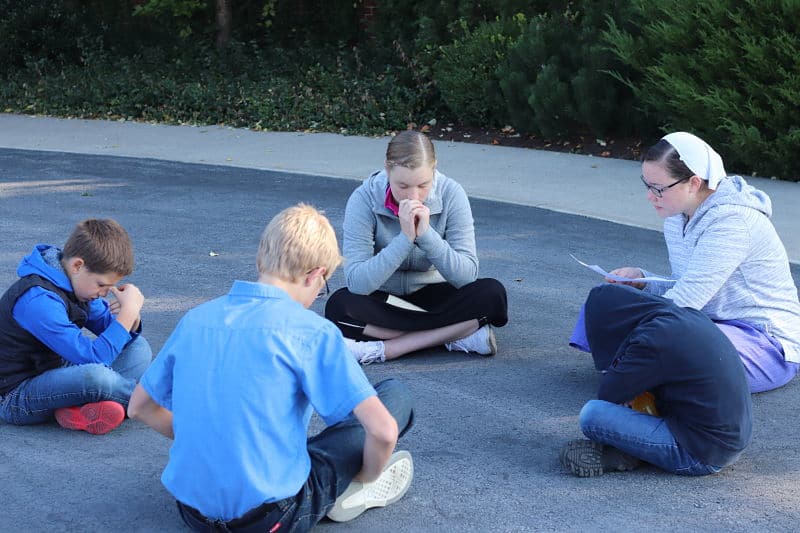
�Don�t forget to pray for Monster!� This request was called out just as I was preparing to pray at the end of the school day. I had to think quickly��Who is Monster?� Then I remembered: Monster is a cow that has a hurt leg. So we prayed for Monster.
Prayer is a vital part of our school day. We pray to start and end the day, we pray before eating lunch, and we may stop throughout the day to pray. Whoever is the �math person� in our class is asked if they want to pray for lunch. Most of the children want to pray and pray their own prayers. I am often touched by the things they say to God. Some years I give them the option of praying or not for the first round, and after that I ask each one to pray when it�s their day. I want them to learn to pray, and I will help them know what to say if they can�t think of anything.
One day I prayed for a cat with a hurt leg, a dog (that her puppies would be healthy), and a cow (Monster), and some grandparents and a little brother. Praying for these animals amuses me, but I am blessed by the faith of my students as they freely share their prayer requests and believe that God cares and will answer. I appreciate their faith.
Once when we heard sirens and the children were concerned, I commented that we could pray for the situation. We paused math class and prayed for whatever was happening. After that, every time we heard sirens, someone would say, �Let�s pray!� A few times I wondered if it was just a fun way to stop having class for a few minutes, but I realized the concern of the children was genuine and appreciated this call to prayer.
I teach a unit on prayer in devotions/Bible class and will share ideas here for teaching prayer in the classroom.
- Take prayer requests from the students. At first, I explain what a prayer request is, and give some guidance, so the children know what this means.
- Write the requests on the board and pray for them throughout the day.
- Encourage the children to pray for the requests.
- Write their requests on a poster board, post it, and note answers to prayer.
- Write prayer requests on slips of paper and put the slips in a jar. Students can write their prayer requests and put them in the jar, too. Select a few to pray for each time you pray.
- Remember to share answers to prayer!
- Thank God for listening and answering (even when the answers aren�t as we would like).
Many of our students learn to pray at home. I can tell some of their phrases come from their parents, and we can reinforce that learning at school and continue that dependence on prayer. Some of our students do not have that background and we can teach them to pray, as the disciples said to Jesus, �Lord, teach us to pray.� I have learned about prayer from my students, too!
One day I was hiking with my brother�s family when a storm hit and trees were crashing all around us. My brother and nephew, Jordan, were trapped under several trees, and I was stuck under another fallen tree. I heard three-year-old Jordan crying, �Let�s pray!� as trees continued to fall and the wind roared. There was not time for his daddy to teach him to pray but Jordan had already learned to pray and take his needs to God.