
All Content

Rote Learning and Critical Thinking
In this session, Robert Heatwole explores the balance between rote learning and critical thinking in education. Using biblical examples and practical illustrations, he emphasizes that both methods are essential, with rote learning providing foundational knowledge and critical thinking enabling problem-solving. He discusses their applications, limitations, and the importance of integrating them effectively in teaching.
Memory Strategies
Robert Heatwole explores memory strategies, debunking common myths about memory and offering practical techniques to enhance retention. Drawing from the book Your Memory: How It Works and How to Improve It, he discusses the stages of memory (recording, retaining, retrieving), the difference between short-term and long-term memory, and methods like chunking, mnemonics, and visualization to improve memory for both personal use and teaching.
Wolves Waiting at the Door: Bullying
This lecture is part of a series titled ‘Wolves at the Door. The seminars vary from about 4 to 10 minutes each and address different problems that can plague our schools if we aren’t proactive.
Wolves Waiting at the Door: Incompletion
This lecture is part of a series titled ‘Wolves at the Door. The seminars vary from about 4 to 10 minutes each and address different problems that can plague our schools if we aren’t proactive.
Wolves Waiting at the Door: Mockery
This lecture is part of a series titled ‘Wolves at the Door. The seminars vary from about 4 to 10 minutes each and address different problems that can plague our schools if we aren’t proactive.
Wolves Waiting at the Door: Disrespect
This lecture is part of a series titled ‘Wolves at the Door. The seminars vary from about 4 to 10 minutes each and address different problems that can plague our schools if we aren’t proactive.
Wolves Waiting at the Door: Tardiness
This lecture is part of a series titled ‘Wolves at the Door. The seminars vary from about 4 to 10 minutes each and address different problems that can plague our schools if we aren’t proactive.

"Called to Serve: The Role of the Christian School Board": Additional Resources
Documents for School Boards
- “Boards, Principals, and Administrators: Who Does What?” by Jonas Sauder Who Does What? (thedockforlearning.org)
- “Board Job Descriptions” by Gerald Miller Board Job Descriptions (thedockforlearning.org)
- Sample Parent and Student Handbook SMS Handbook 2016–17 (thedockforlearning.org)
- Sample Faculty Handbook Faculty Handbook (thedockforlearning.org)
- Classroom Observation Checklists by Jonas Sauder Classroom Observation Checklists (thedockforlearning.org)
Talks for School Board Members
Policy Ideas
The exact policy needs can vary from school to school, but here are a list of areas for which policy guidance would be helpful in most schools.
- Attendance regulation – sick days, doctor visits, vacation, etc; teachers and students
- First grade entrance requirements
- Pass/fail policy
- Homework
- Recording grades – daily? weight of quizzes and tests
- Discipline procedures
- Property damage
- Teacher/student conduct ( maybe this is falls under guidelines, not policy )
- Admission (non-member patrons )
- Technology use for staff and students ( computers, video for instruction, etc. )
- Graduation requirements
- Child Safety policy
Recommended Books for School Boards
- Doing Good Better by Edgar Stoesz and Chester Raber
- Called to Serve by Max De Pree
- Best Practices for Effective Boards by Fairbanks, Gunter, and Couchenour

Keeping Students Organized
Being organized is often an indicator of a student’s success in school, and it certainly does help a student function better. When everything is in its right place, all assignments written down, and student activities directed in an organized way (especially in the younger grades), students are much better organized and function better as they progress through school. Students also experience less stress when everything is arranged and done in an orderly fashion. Following are a few main aspects of student organization, along with suggestions on how to encourage your students to achieve them.
- Keep desks and/or lockers organized. I had a kindergartener come to school for the first time today. After welcoming him at the front door, I showed him where to put his lunch and where to hang his coat. I then walked him to his desk and helped him organize it: large items on the left, smaller items on the right. After using his colored pencils, I helped him make sure that the colored pencils went in the correct zipper pouch while the regular pencils and erasers were on the other side. If a student is taught to be organized from the start, it will often stay with him. Good habits have been established from the beginning, and the expectation of orderliness is set.
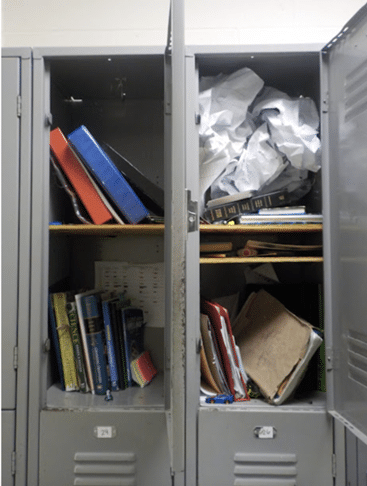
If students have not been taught to do this or for some reason do not organize their spaces, teachers can do much to instill the concept in them. Teach them how to do it, talk about it often, model how to do it, encourage it, then expect it. Give them time to do it quickly and quietly. I have often done a slow countdown (10, 9, 8, 7, . . . . ) expressly for the purpose of cleaning and organizing desks and picking up trash on the floor once the desks are organized. (I give students one “free” trip to the trash can.) Also having unannounced desk or locker checks fairly often does wonders to encourage this. Leave a small reward on the desks of the students who had a clean and organized desk, or let them go to recess first while the other students stay and organize theirs.
- Assign a “desk buddy.” Ask an older student to spend a few minutes each day with a younger student, helping him organize his desk. The accountability and assistance will often help a disorganized student to become more organized.
- Provide younger students with a student notebook organizer; expect older ones to have their own. When giving an assignment and due date, tell younger students and encourage older students to write down the due dates on their calendars. I often have a corner of the whiteboard reserved also for this purpose.
- Give accountability. Especially with large assignments, hold students accountable. It will help them develop good habits and make it almost impossible for them to procrastinate. With junior high students, I require students to turn in every step of their research papers, and I let them see me recording the grades. They stay much more organized, are much less fearful and stressed about it, and get higher grades every time this is required of them.
- Hold an end-of-day meeting. Spend one or two minutes asking students what they could do to be better prepared for the next day. Do they need to take a book home to study for a test? Is anything due the next day? Should they work on one step of an upcoming project tonight? Encourage them to check their calendar/organizers and to put a book in their backpacks if they need to. This practice should progress from being teacher-led to student-led, and finally to just a verbal reminder and time provided by the teacher to do it, depending on the students’ ages and abilities.
Most students are not naturally organized, and many have not been taught how to be organized. With gentle encouragement and the teaching of a few simple skills, students can learn to be organized themselves.

Read-Aloud? But My Students Are Too Old For That!
This scene is familiar in the lower elementary classroom: students gather around their teacher or the librarian on a carpet, looking at the pictures, and listening to the story. Or maybe they are sitting at their desks after lunch, relaxed and listening to the teacher reading a book before starting the afternoon lessons. But for most older elementary students, and especially middle school and high school students, read-alouds have been replaced with reading assignments for the students to complete on their own, all too often focused on standardized testing objectives.
Why Read Aloud To Older Students?
- A major reason for read-alouds is to demonstrate to students of any age a love for good literature. Reading interesting stories can help reluctant readers to fall in love with reading, instead of just seeing it as a boring assignment.
- Reading aloud allows the teacher to expose children to different books and genres, including the classics, that the students might not pick up on their own. Some of the teacher’s favorite books might have sections that are inappropriate for students of a certain age, so the teacher can modify language, skip small parts in the story, or summarize certain sections when reading aloud.
- Reading aloud helps the students connect with their teacher, by seeing his or her commitment to reading. The reader and listener form an attachment, enhanced when the teacher stops reading to discuss certain points. This can bring strong life lessons to the students listening and allow them to form perspectives on issues the book characters are experiencing that the students have not gone through personally.
- Read-alouds help students to learn about other cultures and life experiences, to feel empathy and compassion for others, and to teach the students how to act in certain circumstances.
- In a practical sense, reading aloud allows the teacher to model reading strategies, such as reading with emotion and figuring out the meanings of unfamiliar words from the context. Listeners also increase their vocabulary, writing skills, language skills, and imagination. English language learners can also pick up vocabulary and grammar patterns from listening to stories being read.
- By older grades, most students do not have many recesses or breaks built into the school day. A read-aloud time gives a chance for students to relax.
- Finally, and perhaps most importantly, research shows that students who are read to are more likely to keep reading on their own.
How Do I Read Aloud To Older Students?
- One important factor in reading aloud to older students is to choose a book that they will like. The book should be on or slightly above their grade level and reading ability. It needs to be about a topic in which they are interested. Two helpful sources in finding books to share are the books Honey for a Child’s Heart by Gladys Hunt and Best Books for Kindergarten through High School from BJU Press.
- The teacher must read dynamically. Nothing bores a listener—child or adult—more than a monotone. The teacher should always read ahead to know what is coming and to prepare how to read each section.
- Rather than pushing rapidly through the book, the reader can stop periodically and discuss both content and writing style. This teaches the listener to engage with the story and also gives opportunity to point out literary and writing terms.
- “And after that, Mrs. Ludmiller tripped, falling into the – .” Falling into the what? A good read-aloud pauses each time at a cliffhanger, leaving the listeners wondering what will happen next and keeping them engaged with the text.
- It works for a good book to stand on its own as a read-aloud. But occasionally, the teacher may want to add extra activities or rewards to accompany the book, such as book clubs, projects, puppet shows, or foods that fit with what is being read.
If done with appropriate methodology, reading aloud can be just as profitable for older students as younger.
Resource
Campbell, Linda, and Christie George. “How Read-Alouds Can Benefit Older Students,” Accessed 1 February 2023.

In a Winter Slump? Try Themed Days
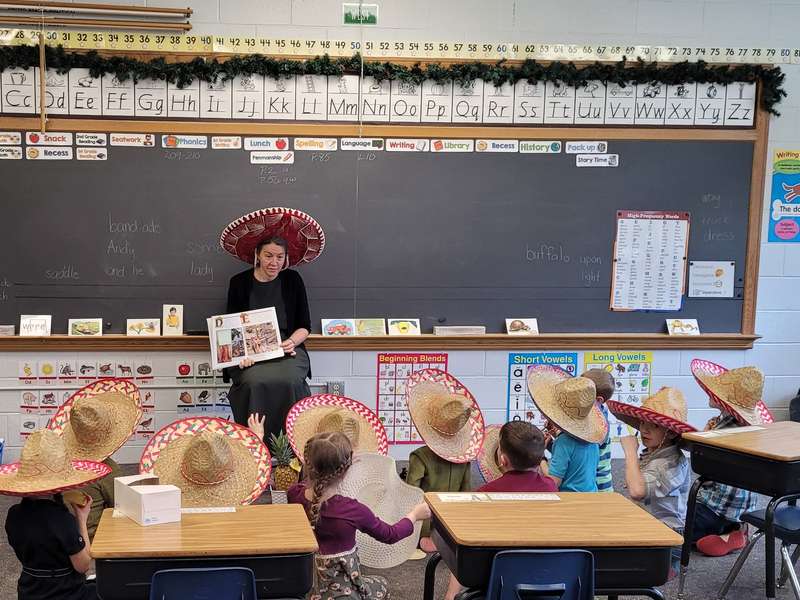
Over the years, teachers have become very creative with helping students get through the winter slump–those months between Christmas and Easter when the only hint of vacation or respite is a huge blizzard or ice storm that leaves the roads treacherous.
At the Mennonite school where I taught, each teacher planned February Fun days for their own classroom. Within that month, we had five days that the teachers collaborated on and designed for the entire school. In our local Mennonite high schools, there are “Spirit Days” These were five days usually in February and March. In the local public school where I taught, the entire school district participated in “Spirit Week.” Whether you are planning for the individual classroom, an entire school, for a week, or for a month, I am here today to give you an assortment of ideas to make a dull winter a bit more enjoyable.
Themed Days for the Classroom
I sent home a calendar with each child with the plan of what we were doing each day. This was the accompanying explanation of the upcoming days. I attempted to have a balance between days that I was doing the extra work for theme days and days the parents needed to do extra work. Beware that while parents enjoy seeing the enthusiasm of their child, it can get to be overwhelming for the parent if they need to send something along or dress their child in an unusual way multiple times a week.
100th Day It’s the 100th day of our school year! We go back to page 100 in our books to see what we were learning way back there. Bring a small bag with 100 small items to share with the class (100 cheerios, stickers, m-n-m’s, blueberries, etc).Trade-around day A day to trade desks and lunches. Pack a lunch for a classmate and we'll pick names to see who eats it!Teacher's favorite color day If you do not know what it is, you'll have to ask your children. We will wear it, eat it, write with it, and soon you might be feeling it!Twin day day Find someone with clothes similar to yours and match with them!Dress-up day A day of ordinary folks in extraordinary clothes. If they don’t wish to dress up as an occupation or famous person, they should at least dress in wacky colors or sunday best. Anything—just so it’s different.Chowdown day Bring a healthy finger food snack or two to share, such as crackers and cheese, finger jello, veggies and dip, frui, etc. We'll spread it out on a table to munch from throughout the day. You will not want to pack much in your child’s lunchbox today.D.e.a.r. day Drop everything and read! You may bring your pillow or favorite blanket to curl up with. Keep a book handy for when that bell announces an all-school reading blurp.Valentine’s day Wear red, pink, or white. Use red pens instead of pencils today. For a special lunch, we’ll decorate cupcakes in valentine's colors. Valentine’s cards and treats are optional.Game day Bring your favorite board/card game to play with a group. It's best if the games can be brought in a few days early so i can get things arranged for group sizes. During the day we'll play learning games to go with the subject we are in.Stuffed animal day Bring your furry friends to share the day. Bring as many as you like, as long as they're stuffed!Hat & pin day Wear hats and pins galore. The more, the merrier!Socks & slipper day Spend the day in comfy footwear! Shoes will still be required outside, of course.Popcorn day Have a popcorn party to celebrate the completion of achievement tests!Sweet treat day Indulge your sweet tooth for a day (at a superior's discretion) Give them gum or candy.Hot drink day Bring on the mugs and hot chocolate! We’ll provide one cup each of tea and hot chocolate mix.Balloon day Pop a balloon and have the class it says to have! We may end up having story first and reading class last! I also like to tie balloons to the desks in student appreciation and then release them later that day with the school address tied to the string.Just-in-case day Is in place for a theme day that's been cancelled and needed to be bumped, or if we get a new idea for something else.Licorice day A day with a random schedule. We will be picking pieces of licorice out of the basket to see what class we will be having next. It could be math in the morning and bible in the afternoon.Music day Bring your favorite tapes and CDs to listen to throughout the day. Story tapes are fine too; we will listen to a few of those.Backwards day Wear your clothes backwards, comb your hair backwards, or wear your backpack backwards. We will be facing the back of the classroom, doing our papers backwards, and have a backwards schedule beginning with singing “our day of school is over” and finally ending with “good morning, class.”Different name day Choose a name other than your own and be someone different for a day. We write the names on name tags so we do not forget who is who. Have your name chosen before you come to school!Formal day Come dressed in your Sunday best with your best manners. “Yes, ma’m” and “No, sir” will be required throughout the day. If there would be a mother or several mothers that would like to prepare a formal meal and set up in the basement, it would be greatly appreciated. Please, thank-you, and passing dishes to the left will be expected.Team work day We practice working together with a group. We participate in several team activities throughout the day and eat lunch with our hands tied to a friend’s hand.Hobo day Come in your best hobo gear with bib overalls, handkerchiefs, and dirty faces. Don’t forget to pack your lunch in a knapsack and include a raw hotdog and marshmallow or two to roast. We will tramp up to the orchard for a hillbilly roast. Hotdog rolls, ketchup, and mustard will be provided.Fishy day Bring books about fish, pictures of fish, and stuffed fish for us to enjoy. We will be trying to catch as many goldfish as we can throughout the day by doing good work and having good behavior. Who will be the best at eating a worm from the fishing line?Themed Days for the Entire School
These are days designed to encourage whole-school collaboration and involvement. A healthy school culture can be taken for granted or difficult to cultivate. It’s one of those intangible things that have a huge influence on your school. Many teachers and administrators and school boards grapple with how to grow a good school culture. Themed days will not be an instant fix, but maybe they can come one step closer to a the school spirit that you would like to build.
Kick-Off Day A relay is sent out to inform the students of a one hour delay. A special relay is sent to the students that are not on the bus route informing them that the bus will pick them up today. The teachers will ride the buses to pick the children up. As each child is picked up, the teachers greet them with a “It’s February Fun” song and a donut.Early Bird School will begin early and dismiss early. The hot lunch group for the month will be asked to make breakfast for the school. Or a cereal party could be held in the basement for the entire school. Families would be assigned to either bring a gallon of milk or a favorite cereal.Drama Day A week prior to this day, the student body will be split into groups and given a script to act out and perform on Drama Day. A group leader will be assigned and from 2:30-2:50 each day of that week when the groups will meet to assign parts, discuss, and practice their skit. The students will arrive on Drama Day in appropriate costume and will remain in costume throughout day. Parents will be invited to attend to watch the skits/plays in the afternoon. A group of three or four judges will give out first, second, and third place prizes to best skit/play group.Upset the Fruit Basket Each teacher will choose a different subject than normal to teach and then teach the subject for each grade. Perhaps each teacher can also choose a fruit to represent their class and give the snack out as the students enter the classroom. Recess would be held as a whole school on the soccer field playing jug-a-lug or other game. The last period of the day would allow each class to go back to their respective rooms for study hall.Wear Your Color Day One day prior to this day, the students are separated into 8-10 teams. Each team is given a color name and the team arrives at school the next day wearing its color. The teams interact together throughout the day such as sitting in chapel together, eating lunch together, and competing in competitions such as a tug a war and “making a snowman family” (using toilet paper to “dress” members of the team).Spaghetti Day Another mixed-up schedule day and another hot lunch. They won’t even know who their teacher will be next because even the teachers will be switched! Spaghetti is served for lunch.We are nearing the end of February. Use these ideas to prepare February Fun with your school. And if February isn’t a good time, no worries. The ideas can all be redefined as “March Madness.” Or, feel free to print these ideas and file them away to revisit when planning Winter Fun next year!

Three Writing Games
Looking for a fun activity to stretch your students’ imaginations? In search of an easy substitute for your regular lesson on a day you aren’t feeling well or are just stretched too thin to prepare everything in time? Interested in a random new game that your students will love?
If so, these writing games may be just what you’re looking for. Not only is writing an essential skill and learning tool, it can also be a wonderful way to tickle your students’ imaginations while providing a fun learning activity. These three writing games have been favorites for my students over the years.
Popcorn Writing
Materials needed:
- Piece of paper for each student
- Timer
- A way to randomly select each student one by one (for example, writing their names on slips of paper and picking them out of a dish)
- Sentence starter (optional—see below)
In this game, each student will write a story. Students may start writing about anything; I have found it often works best to give them a sentence starter to get them going. A few sentence starter ideas are as follows:
- It was a perfect day for a soccer game, so no one expected anything to go wrong.
- I gasped as I peered through my binoculars.
- It all started when I poured orange juice on my breakfast cereal.
- Paul couldn’t believe what was standing in front of him.
- I was doing my homework when I heard a loud crash coming from downstairs.
- The day I got my pet cat was also the day the trouble began.
- It sounded like a trumpet, and it was coming from outside.
As the students are writing, the teacher should start a timer for a set increment of time (45 seconds works well). When the timer rings, the teacher will randomly select a student. That student should say the word they just wrote on their paper. Every other student then needs to use that particular word in their own story within the next 45 seconds when the timer will ring again.
So, for example, if Student A is selected and they just wrote the word “fountain,” then every other student must somehow include the word fountain as they keep writing their own story. After another 45 seconds passes and the timer beeps again, repeat the process with another student. Perhaps student B has just written the word “rhinoceros.” Now every other student needs to find a way to make a rhinoceros show up in their story. Encourage students to be creative in this; perhaps they will simply describe something as being “as big as a rhinoceros.”
If a student has just written a boring word, like “the,” “an,” “and,” “when,” etc., I will let them say the second-last word they wrote. This makes the game more interesting and fun.
You may continue this activity for as long as time allows or until every student has been chosen at least once. Whenever you decide to wrap things up, give the students a minute or two to complete their story and make it feel finished in some way.
Don’t forget to give students a chance to share their stories with each other! Students absolutely love getting to hear how their peers used the same words in a totally different way, and they enjoy the random, somewhat crazy nature of the stories they end up with. This activity is a great way to promote flexible, creative thinking.
Picture Book Cover-Up
Materials needed:
- A picture book for each student (must be a story that is unfamiliar to the student)
- Small pieces of opaque paper (construction paper works well)
- Adhesive putty (or some other non-permanent, non-damaging adhesive)
Disclaimer: This game involves some preparation beforehand, and that can be somewhat time-consuming. However, teachers of older students could have their fast finishers help them with this part of the process in the day(s) leading up to doing the activity.
Prepare the picture books by covering all of the words with slips of paper. Paper can be cut to the appropriate size and attached to the book page using a non-permanent adhesive. Each book should have all of the words concealed, with the pictures still visible.
Each student will then receive a picture book. They should look at the pictures and come up with a story that would make sense with the images they see. Students can write their stories on top of the paper that is covering the original words.
It is great fun to have these books available for students to read and enjoy each other’s writing! When finished, you can have each student pull off the papers in the book they “wrote,” and have them take a few minutes to read what the original story was about. This activity is a fun way to exercise story-writing skills in a low-pressure way.
Sandwich Story
Materials needed:
- Sandwich story handout for each student
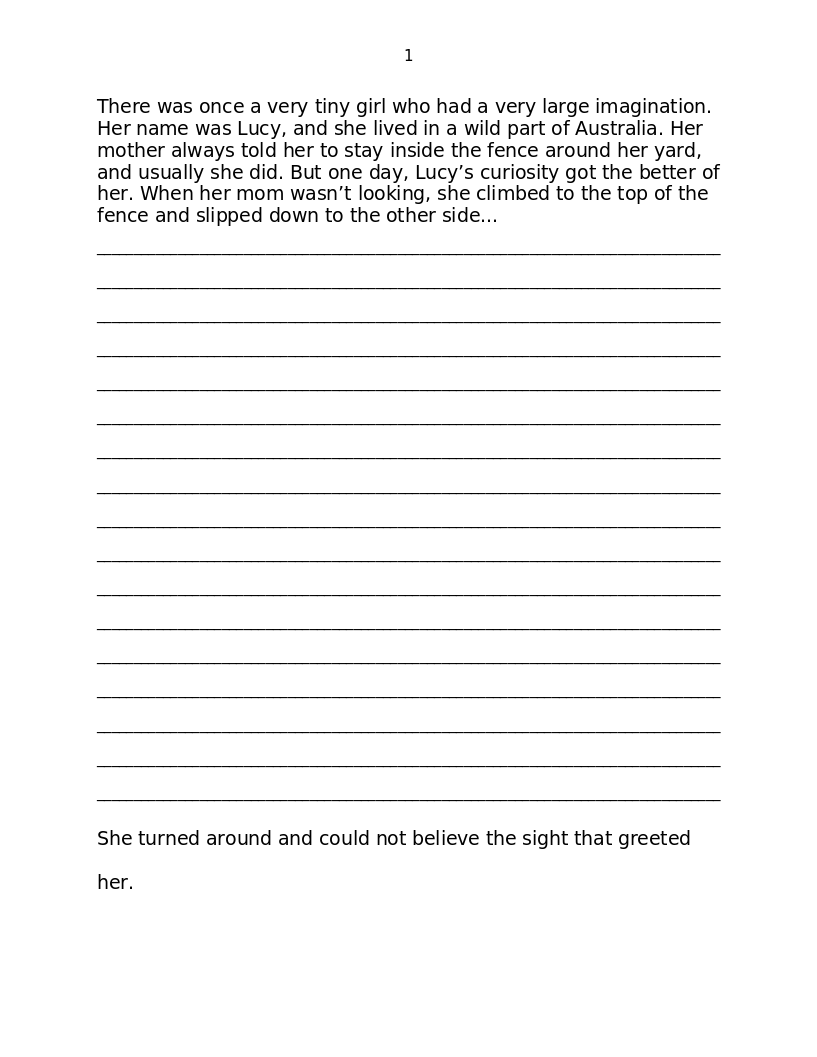
To understand this activity, picture a story written out on a piece of paper. Now, imagine that a giant eraser has completely removed whole chunks of the story, leaving only sporadic sentences behind. The first few sentences are there, but the next two paragraphs have been erased. Then there is another sentence, followed by a few more erased paragraphs, and so on, until you arrive at the last sentence of the story.
Now, imagine that your students are going to work together to fill in the missing spaces between the sentences that have been left behind on the page. Each student will fill in one blank space, “sandwiching” their writing between the existing sentences and creating a flow from one given sentence to the next. Their goal is to write something that makes sense and keeps the story going. At the end, the entire story will be filled in by the collaborative efforts of individual students writing their own little parts.
In reality, each student is given a sheet of paper with one sentence at the top of the page and one sentence at the bottom. These handouts should align with each other so that Student A’s last sentence is Student B’s first sentence, and Student B’s last sentence is Student C’s first sentence, and so on. That way each child is filling in one part of the story, picking up where the student before left off. These “sandwiches” can then be combined to make a cohesive whole.
One of the fun elements of this game is that each student will fill in their part of the story without knowing what the other students are writing. This makes the final product unpredictable and usually pretty funny.
Below, you will find pre-made handouts that you can use for this activity. Alternatively, you can always make your own by creating your own sequence of sentences. You will notice the handouts are labelled according to how many parts they have. Obviously, the size of your class will determine which handout you will find the most useful. I have always used this activity with larger classes (12 students or more), so I have simply made two or three sets of the same handouts. So, if you have 13 students, you could use the 6-part handout and the 7-part handout. In the end, this will create two different stories for you and your students to enjoy.
Once all the parts of the story have been written, put them together in order and read them aloud! The collaborative nature of this activity makes it so fun for students—there’s something enthralling about having their writing be part of a bigger whole.
Writing games are the perfect way to spice up your next writing class or to pull out of your back pocket for a sluggish day in the middle of winter. Games like these are so much more than games—they allow your students to imagine, create, and thrive in new ways.
Link to Sandwich Story Handouts: https://thedockforlearning.org/contributions/sandwich-story-handouts/
Cultivating Curiosity in Students
One of the most exciting tasks we teachers can pursue is cultivating curiosity in our students. When our students are curious, they are usually engaged in what they are learning, enjoying themselves, and eager to discover more interesting tidbits. A classroom is rarely boring if students are curious. While cultivating curiosity in students isn’t that difficult, it does take some effort. Here are a few suggestions that have been helpful to me.
Model curiosity yourself.
Ooh and aah over the fact that a bird can glide forward for twenty-three feet while only going down in altitude one foot. Look up words in the dictionary. Make statements to arouse curiosity such as, “This art project has the neatest effect. Just wait until we get to finish it tomorrow!” or “For our business letter writing assignment today, we are going to write a real letter and send it. You will hopefully get a letter back.” Curiosity is contagious.
Do as many additional activities in the core subjects as you possibly can.
These are usually included in the curriculum, but too often teachers are busy, these take too much extra work, and projects don’t get done. Assign the speeches in English class. Make the pie chart posters in math class. Do every experiment in the science book. Find cultural folk art projects or eat foods from other cultures in history. The changes you will see in your students’ interest and attitudes are well worth the effort on your part.
Go overboard with exposure.
Expose your students to as many different edifying concepts, facts, buildings, art projects, stories, and field trips as you can. This isn’t stuff that they will be tested over. It is just interesting information, activities, true stories, experiences you’ve had, items, or just crazy ideas. My latest idea has been that I’m dreaming of taking my junior high students to hike the Grand Canyon rim to rim. While it’s kind of a joke, it gets us thinking, and dreaming, and curious about the process and the possibilities.
Keep their hands and minds busy.
Focus on completing the classwork on time with good grades, but also provide a myriad of different activities for them to do when their work is completed. This is not only often a good motivation to finish classwork, but also a delightful way to encourage curiosity. Can they figure out how to solve the new puzzle or brain game? Have they read that new amazing book and seen the beautiful photographs or paintings in it? Having art supplies and a weekly project available is another good way to keep students’ hands productively engaged and busy.
Arrange classes carefully.
All work and no play makes Jack a dull boy. How would we feel if we had to sit at a desk and write most of the day? I love to write, but I wouldn’t want to sit in a hard chair at a desk for hours on end to write. Classes and hard work, including math problems, writing assignments, and answering history and science review questions should be interspersed with activities which give students a physical and mental break. I try to give my students a schedule that has a more difficult and focused class following a lighter one that includes more group discussion and/or activity. Example: math, piano practice, reading, Bible with group discussion, English, recess. Doing this helps prevent boredom–the exact opposite of curiosity.
Feed their interests.
First of all, you should present many different concepts and activities to be curious about. Students will choose the ones that particularly interest them and ask about them. That’s when I like to dig up books, art supplies, science experiments, or whatever it is to feed whatever has sparked their interest. Usually this happens naturally because they’re noticing what I’m presenting to them, but sometimes this is assigned, as in the case of a research paper. Give them super interesting topics and perhaps have them do some preliminary work (sketches, a project, etc.) to help spark their interests in their chosen topics.
Surprise them.
Donuts on a cold winter morning, the announcement of an upcoming field trip, and a new history and/or art project do wonders for cultivating curiosity. If students are surprised with a few things like this, they will have a new outlook on school. Keep it up, and you’ll have them hooked, wondering what you will surprise them with next. Note: Students should never expect these. Talk to them often about being grateful and have a good attitude.
Avoid negativity in any shape or form.
This includes countdowns to how many days of school are left, eye rolling, heavy sighs, and any negative comments made by students. Meet these with a big smile and a positive comment. One of my favorites is “We GET to do this!” Thank God daily during morning prayer time for the privilege to have a Christian school, to be in a nice warm building, and to have interesting learning opportunities.
Curious students are interested in learning and approach school with enthusiasm. The effort it takes is well worth the results produced.
Modeling curiosity yourself, exposing students to different concepts and activities, keeping students busy, having a varied schedule, feeding students’ interests, and surprising them are all viable ways that teachers can cultivate curiosity in students.
The Poetry of Robert Frost
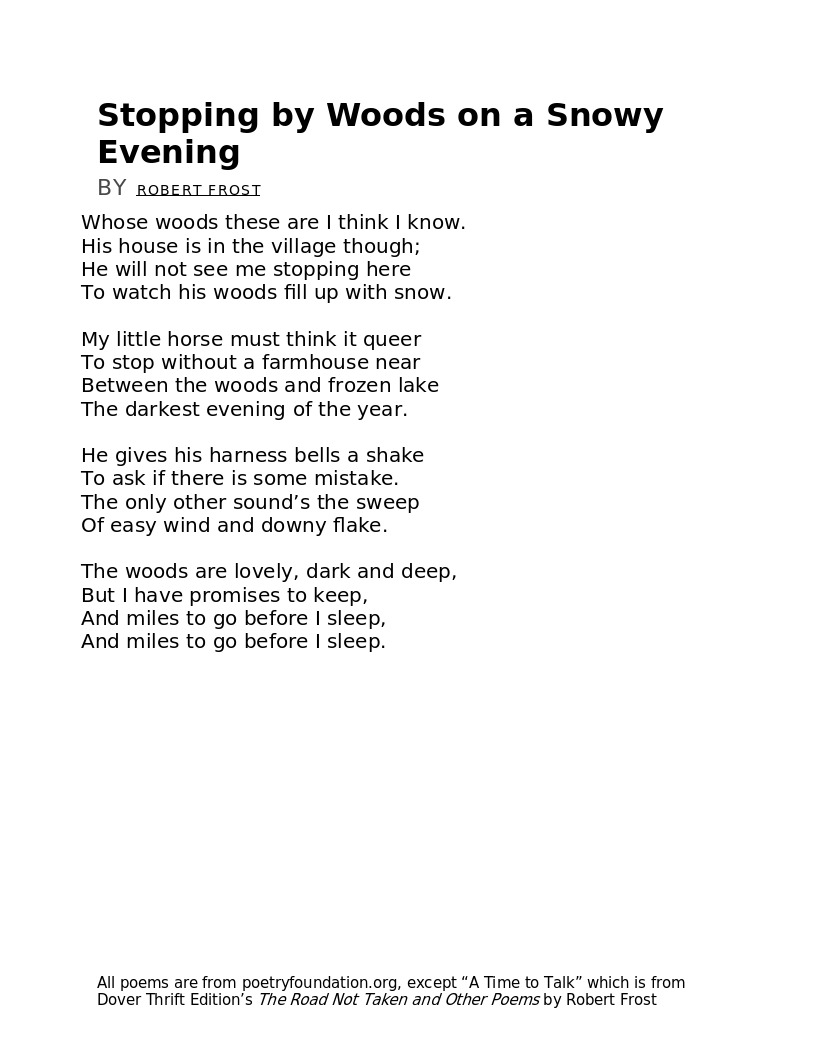
A selection of poems by Robert Frost followed by a worksheet for reflection, analysis, and response.
From the contributor: In CLE's Literature II (Unit 6, Lesson 6), we study Robert Frost's poem "The Tuft of Flowers." After discussing it and completing the lesson exercises in class, I assign the attached file to give a richer introduction to my favourite poet. Students read some more of Frost's poems, which are easy to understand, and write a response essay at the end (p. 7). My goal is to have them observe his topics (frequently rural and old-fashioned), themes (relationships, nostalgia, and values), mood (reflective and whimsical).